Archives de catégorie : Video Marketing

3 Digital Marketing Tactics Every Small Business Can Implement Today

  •  Photo: Shutterstock

Caption

Close


In this video, Entrepreneur Network partner Kate Volman meets with Ryan Boylston of Woo Creative to discuss digital marketing for small businesses.

Many small businesses overcomplicate their digital marketing strategies. Boylston says he most often notices that businesses are not even doing the easy things right. For example, when it comes to email marketing, there’s no need to break the bank. Email marketing is one of the least expensive digital marketing elements. All a company must do is pull together a list (you can export this from Quickbooks, pull it from your client list, etc.), create simple copy that reminds people of your brand and send out a monthly newsletter.


When it comes to SEO, a business must incorporate the right keywords, have an easy-to-read site that simply tells who a company is and what it does and make sure that the design is responsive on different devices (Google will penalize you if it’s not). 

In regards to social media, having a Facebook page and being verified on Google are the most important elements. If you have the time, join other online networks, but start with these two first. 

To learn more, click play. 

Watch more videos from Volman on her YouTube channel here. 

Related: How to Effectively Sell Using Social Media and Content Marketing

Entrepreneur Network is a premium video network providing entertainment, education and inspiration from successful entrepreneurs and thought leaders. We provide expertise and opportunities to accelerate brand growth and effectively monetize video and audio content distributed across all digital platforms for the business genre.

EN is partnered with hundreds of top YouTube channels in the business vertical and provides partners with distribution on Entrepreneur.com as well as our apps on Amazon FireRoku and Apple TV.

Click here to become a part of this growing video network.

Related:

Copyright 2016 Entrepreneur.com Inc., All rights reserved

This article originally appeared on entrepreneur.com

How to Make Video Content Work for Your Dealership

Videos are no longer just a nice extra for your digital marketing strategy. They are essential for success. This article explains how you can make video content work for your dealership.

Let’s start with some statistics about how much people love videos:

  • 5 billion: The number of videos watched on YouTube daily
  • 5 hours, 31 minutes: The amount of time U.S. adults spend watching video every day
  • 300 hours: The amount of video time uploaded to YouTube every minute

The numbers are astronomical, but the key point probably doesn’t surprise you: Video has become a major factor in how we experience pretty much everything.

We record videos of our own lives, we use video chat, and we look for videos in online shopping to help inform our decisions. Videos grab our attention and bring things to life. All of this explains why video is probably the single most effective way to boost inbound your marketing.

Consider some more facts: Including videos in email increases click-through rate by 200% to 300%. Videos on landing pages can increase conversions by more than 80%. Also, video content has the best ROI of any type of content, according to 52% of marketers.

In short, if video marketing isn’t already a priority in your digital strategy, you should make it one as soon as possible. Here are four ways video marketing can benefit your dealership.

Consideration

The consideration phase of shopping is when a potential customer thinks about whether or not to buy from you. If you engage your site visitors with a high-quality, high-value, two-minute video, that’s two minutes spent on your site considering your dealership.

The longer shoppers stay on your site, the more likely they are to do further research and become more invested in you. Use smart targeting to provide your website visitors with the video content that will help them engage with and consider your dealership.

Branding

You can use content and videos to promote understanding of and connection to your brand. Get your message out and build loyalty by using on-brand videos that promote your products.

Sales

Videos of cars will help you sell more of them. People want to see and understand the products they’re interested in buying.

Different angles and action shots help people feel more connected to and invested in your inventory. Target the right video offers to customers on your site and watch your sales increase.

Better digital experience

Buyers are doing more and more research while shopping online, so featuring informative videos allows customers to learn more before arriving at your dealership. This knowledge lets them shop in the way that they enjoy, and equips them for an even better in-store experience. With friendly, noninvasive video content, you will entice your site visitors to come in to your dealership.

Now that you’re sold on the importance of video for your dealership, here are some ideas for valuable video content you can create to engage your website visitors:

Remember, video content is not all about sales—it’s about sharing value with your site visitors and building relationships. Ultimately, though, if your videos benefit the people interested in your dealership, the result will be happier customers and a boost in sales.

Devorah Wolf is the content marketing manager at AutoLeadStar, a lead-engagement platform for the automotive industry. With many years of experience in content writing and editing, she blogs about making the most of your online traffic, and making your online shoppers happy so you get more customers to your showroom. Devorah is always open to industry interviews and reports, so please reach out to collaborate at devorah@autoleadstar.com.

H5P: A CMS plugin for creating HTML5 interactive content

Many educators want to create interactive content for their classroom or online course. If you’re not a HTML5 programmer like most of us, but you have heard HTML5 can simplify your work and provide a great, standard web experience for your students, here’s how to get started.

H5P is a free and open source tool that helps you create HTML5 content in the browser of your choice and share it across all operating systems and browsers. To explain more about the tool, I talked to Svein-Tore Griff With, the lead developer at Joubel.com, who together with his team, created H5P. 

Don Watkins (DW): How did you get into open source?

Svein-Tore Griff With (STGW): Before working fulltime on H5P, many of us on the Core Team were deeply involved with open source projects. Over the years we have been consulted for Drupal based projects, and we’ve always tried to contribute back to the Drupal community as much as we can. H5P is installed on over 7,000 websites. It is used by hundreds of universities, including Ivy League universities. It is being used by huge companies, including Fortune 50 companies, and other big organizations like parts of the UN.

DW: What was the impetus for H5P?

STGW: The world of interactive content is almost medieval. With no common format for interactive content the creation process seen from a global perspective has become very fractured and disorganized. Simple things such as multiple choice quizzes are handcrafted again and again, not only for different platforms but for different websites as well. The cost of great interactive content and tools is often extremely high since it usually involves making yet another custom version.

The H5P format is open and the tools for creating H5P content are open source. This guarantees that creatives own their own content and are not locked into the fate and licensing regime of a specific tool. Read more about how H5P ensures that the content remains yours in our blog.

DW: How does H5P allow users to create rich content in content management systems?

STGW: H5P is a plugin for existing CMS and Learning Management Systems (LMS) systems. Just plug in H5P and your system becomes able to create, share, and reuse great interactive content. For systems that doesn’t have an H5P plugin available yet it is possible to embed content using an iframe or using the Learning Tool Interoperability (LTI) standard. With the LTI and supporting APIs and specifications embedding an externally hosted H5P authoring tool is also possible.

DW: What is there about H5P that allows it to sense the device it is playing back on; i.e., iOS, Android, LInux, Firefox, Chrome, and Internet Explorer?

STGW: Usually H5P doesn’t sense the device it is running on, but there are a few cases where it does, for instance, to make full screen mode work, but it is usually just responsive design. H5P can’t control the head tags of the page where it is being used so we compare the width to the font sizes to identify break points for layout changes. You can read more about this on our blog.

DW: Why is your code licensed under both GPL and MIT?

STGW: We want everything to be MIT. Right now, there is some code from Drupal in H5P core to purify HTML. When that has been removed, we will only use MIT since GPL is more restrictive.

DW: I built a Moodle Server with the H5P plugin and saw how it connected to Moodle’s quiz feature to allow data collection of student answers. How is that accomplished in WordPress and/or Drupal?

STGW: We mainly rely on the xAPI standard for storing and analyzing the user’s answers. In addition, we save time spent and scores in all platforms and we have a special integration with Drupal’s Quiz module so that H5Ps may work as quiz questions. We’re leveraging xAPI to make this work.

DW: Are there tools built into the H5P code that allow it to store data collected from interactions with it?

STGW: There are two types of tracking in H5P. One is user tracking. Here we use xAPI. It is up to the host to determine what to do with all the xAPI data H5P generates. If the host system, Drupal for instance, doesn’t have a third-party module to handle this data, it doesn’t get stored at all. On H5P.org we send this data to Google Analytics.

The other type of is a report plugins are sending to H5P.org every month with anonymous data. It includes the number of H5P authors the site has, the number of H5Ps of each type, and more. When the plug-ins are enabled they give very valuable feedback about how H5P is used and they help guide the future development of H5P. You can disable these reports per site.

DW: Do you encourage developers to get involved?

STGW: We definitely do. The full potential of H5P will only be realized if we’re being embraced by a big portion of the web developers in the world. Developers can get involved in many ways. They can learn how to create new H5P content types and share their work on H5P.org. They can improve H5P content types through GitHub and participate in forum discussions.

The H5P code is hosted at GitHub.

Police probe online video of BMX riders at Splish Splash

RIVERHEAD – Police are looking into a video posted online of professional BMX cyclists at Splish Splash in Riverhead.

The video was posted on YouTube on Saturday by professional rider Billy Perry, of West Islip.

The video appears to show a group of BMX riders at Splish Splash on Thanksgiving riding and doing tricks on the water slides.

It also shows the group entering the park by hopping over barbed wire fences. The riders posted their own names, apparently knowing that they were breaking the law.

« It’s going to be insane if we don’t get arrested, » Perry says in the video. « Hopefully we don’t get arrested. »

He also says that the group spent about two hours in the park before a security worker spotted them.

Splish Splash general manager Mike Bengtson says Perry and his crew caused about $50,000 worth of damage to the slides.

Riverhead police say they are looking into the video and investigating the incident.

Brightcove joins IAB Australia’s Video Advertising Council

Brightcove Inc. (NASDAQ: BCOV), a leading provider of cloud services for video, is pleased to announce it is now a member of Interactive Advertising Bureau (IAB) Australia’s Video Advertising Council.

Joining the likes of MCN, News Corp, Yahoo!7 and Fairfax, Brightcove will help address key issues and challenges faced by the advertising industry, marketers and the members’ organisations.

Brightcove brings more than a decade of experience to the Council, being a key global platform that delivers digital video across most premium, ad-funded publishers in Australia. Joining the Video Advertising Council will allow Brightcove to provide its expertise and insights, contribute global best practices in online advertising, and collaborate more closely with the council in understanding and adopting future trends and standards.

Brightcove’s addition to the council will also enable the company to help the advertising industry transition through key technology challenges, such as the death of Flash, evolving industry standards like viewability measurements and ensure that online video advertising grows as an effective and engaging medium in the future.

“The advertising industry has undergone rapid changes in the last few years,” said Peter Howard, Solutions Engineer, Brightcove, who will represent Brightcove on the Video Advertising Council. “What worked a couple of years ago, might not work today. And it’s placing increasing pressure on brands and marketers. That’s why we feel it’s important to be part of the Video Advertising Council. We hope our expertise and industry insight will positively influence the future of digital advertising in Australia.”

Vijay Solanki, CEO at IAB Australia, commented, “IAB Australia have just re-energised the Video Advertising Council with a new chair and new members like Brightcove. As digital video is in hyper-growth, we need to champion new standards like VAST and educate the market on topics like connected TV. We want the best publishers, tech companies, agencies and marketers involved. Brightcove bring a combination of global expertise, technology know-how and the commercial expertise of working with the lead publishers in Australia. The Council meets to drive projects in relation to measurement, advertising standards, best practice, research across different consumer screens and video ad expenditure.”

The Video Advertising Council, formed in 2014, aims to help support the growth of video advertising, an area of the industry that now represents 15 percent of all digital display advertising. The Council meets every two months to drive projects in relation to measurement, advertising standards, best practice, research of streaming ads across different consumer screens and video ad expenditure.

About Brightcove

Brightcove Inc. (NASDAQ:BCOV) is the leading global provider of powerful cloud solutions for delivering and monetizing video across connected devices. The company offers a full suite of products and services that reduce the cost and complexity associated with publishing, distributing, measuring and monetizing video across devices. Brightcove has thousands of customers in over 70 countries that rely on the company’s cloud solutions to successfully publish high-quality video experiences to audiences everywhere.

To learn more, visit www.brightcove.com.

Trudeau et les pipelines : l’extraction avant l’environnement – ICI.Radio

Une analyse de Gérald Fillion  

Le signal est clair : on va augmenter la capacité de transport du pétrole par pipelines au Canada de 30 %, de plus d’un million de barils par jour, ce qui va permettre à l’industrie de poursuivre son développement pour augmenter sa production de pétrole issue des sables bitumineux.

Justin Trudeau cadre cette décision dans la transition énergétique en cours. Il a partiellement raison ici. Nous avons besoin de pétrole et c’est pourquoi nous en produisons, nous en achetons, nous en consommons. Mais soyons clairs : la décision annoncée mardi n’a rien à voir avec les besoins des Canadiens ou avec une quelconque transition. C’est un choix purement industriel en totale contradiction avec les impératifs environnementaux.

On produit plus qu’on ne consomme!

D’abord, les Canadiens consomment environ 2,5 millions de barils de pétrole par jour. La production actuelle de l’industrie au pays est de 3,9 millions de barils par jour. Avec l’inversion de la canalisation 9B, le Québec consomme maintenant majoritairement du pétrole américain et canadien. La part du pétrole algérien notamment est tombée sous les 10 % au Québec.

De plus, la capacité de transport des pipelines au Canada est de 4 millions de barils par jour, ce qui s’ajoute aux 140 000 barils par jour déplacés par trains. La capacité de transport dépasse légèrement la production, mais la capacité d’exportations demeure faible.

Ensuite, il faut se demander où et quand commence la transition énergétique. À quel moment se dit-on qu’il faut commencer à réduire la production de pétrole pour la remplacer par davantage d’énergies renouvelables? Pourquoi le gouvernement du Canada ne fait-il pas le choix de plafonner sa production de pétrole?

En approuvant de nouveaux projets de pipelines, l’industrie verra un avantage réel à augmenter sa production, en la faisant passer de 3,9 millions de barils par jour à plus de 5 millions, puis à plus de 6 millions de barils par jour en 2040.

Avec l’approbation possible de Keystone XL par la future administration Trump vers le sud des États-Unis et avec le projet Énergie Est de TransCanada, qui pourrait peut-être se réaliser un jour, de beaux jours s’annoncent pour l’industrie pétrolière canadienne. Après une croissance de 160 % en 35 ans, l’industrie pétrolière pourrait augmenter encore sa production de 55 % au cours des 25 prochaines années, selon les estimations.

Le PIB et les emplois avant l’environnement

On ne cesse de repousser les échéanciers pour réduire les émissions de gaz à effet de serre. Tous les experts s’entendent pour dire que le Canada ne sera pas capable de respecter ses engagements pour 2030. Et, de plus en plus, le discours du gouvernement s’articule autour de 2050. On pousse la neige chez les voisins, on cache la poussière sous le tapis, on remet les choix importants aux calendes grecques, sortez toutes les expressions que vous voulez, nous sommes engagés dans une sorte de procrastination énergético-environnementale.

Il faut bien comprendre que la décision de Justin Trudeau est une grande avancée pour l’industrie pétrolière canadienne avec l’ajout de plus de 30 % de capacité de transport par pipelines. À terme, cette décision pourrait faire grimper le prix du baril de pétrole au Canada, dont la valeur est amoindrie par les faibles capacités d’exportations du pays.

Des milliers de kilomètres de plus en pipelines permettront aussi à l’industrie d’éviter une hausse des coûts de transport qui aurait été engendrée par une utilisation plus grande du transport ferroviaire. Il ne faut pas se leurrer, avec ou sans pipeline, le transport du pétrole par trains est appelé à augmenter. Mais les oléoducs devraient permettre de ralentir cette croissance.

Au chapitre de l’environnement, le Canada a décidé d’arrêter la production de charbon d’ici 2030 et de tarifer le carbone au pays. Ce sont des mesures qui devraient permettre de réduire les émissions de gaz à effet de serre et d’avoir des répercussions économiques positives à long terme. Mais ces efforts pourraient être contrecarrés par la hausse de la production de pétrole qui, elle, devrait stimuler l’économie à court terme, mais lui nuire à long terme compte tenu du niveau élevé de pollution engendrée par l’exploitation des sables bitumineux et les ravages que cause le réchauffement climatique.

Aux États-Unis, sous la présidence de Barack Obama, la production de pétrole a doublé. Les Américains s’approchent de l’autonomie énergétique avec le développement du pétrole et du gaz de schiste. En même temps, Washington a investi massivement dans les énergies renouvelables, ce qui fait en sorte que les énergies éolienne et solaire sont celles qui fournissent les plus fortes augmentations de capacité de production électrique aujourd’hui aux États-Unis.

N’empêche, la forte croissance de la production de pétrole aux États-Unis et l’approbation de nouveaux pipelines au Canada nous obligent à conclure qu’il est difficile, aujourd’hui, de reprocher à Donald Trump de vouloir mettre en place un programme énergétique qui sera dommageable pour l’environnement. Est-ce qu’on fait vraiment mieux?


L’ex-maire de Laval Gilles Vaillancourt plaidera coupable – ICI.Radio

Un texte de Marie-Maude Denis d’Enquête

Il y a quatre ans, Gilles Vaillancourt démissionnait de son poste de maire qu’il occupait depuis près d’un quart de siècle.

Les allégations de corruption fusaient à son endroit dans les médias. L’Unité permanente anticorruption (UPAC) resserrait l’étau avec des perquisitions à l’hôtel de ville de Laval, dans des banques et à sa résidence privée.

Puis, en mai 2013, le roi de Laval est tombé de son piédestal. Il est arrêté, accusé notamment de fraude, d’abus de confiance et même de gangstérisme. Mais il a l’intention de se battre.

« J’ai plaidé non coupable, j’ai beaucoup d’arguments à faire valoir devant le tribunal au moment opportun. À partir de maintenant, je vais consacrer mes énergies à préparer ma défense et à prouver mon innocence », a-t-il affirmé à sa sortie du palais de justice.

Finalement, il a décidé de plaider coupable demain, au palais de justice de Laval, aux accusations de fraude envers le gouvernement, d’abus de confiance, de fraude et de complot.

6 ans de pénitencier

Selon nos informations, l’entente entre la poursuite et la défense prévoit une suggestion commune de 6 ans de pénitencier. De plus, Gilles Vaillancourt devrait rembourser 9 millions de dollars.

En contrepartie, le chef d’accusation de gangstérisme serait suspendu. Il y aurait également une entente concernant toutes les poursuites civiles et les réclamations fiscales auxquelles il faisait déjà face ou qui auraient pu être déposées par le gouvernement et par la Ville de Laval.

Si elle est entérinée par le juge, cette peine sera historique dans les dossiers de l’UPAC et même dans l’histoire judiciaire du Québec.

À titre de comparaison, l’ancienne directrice générale de la Ville d’Hudson, en Montérégie, a écopé de deux ans et demi de prison pour une fraude de près d’un million de dollars.

L’ancien maire de Boisbriand Robert Poirier et France Michaud de la firme de génie Roche ont pour leur part écopé de 18 mois de prison ferme, mais ils font tous les deux appel du verdict.

Lino Zambito et une autre ancienne mairesse de Boisbriand, Sylvie Saint-Jean, ont écopé chacun d’une peine de deux ans à purger dans la communauté.


Un ex de Goldman Sachs nommé secrétaire au Trésor

Steven Mnuchin, un ancien dirigeant de la banque d’affaires Goldman Sachs, a aussi confirmé la nomination de Wilbur Ross à la tête du département du Commerce, en charge de la politique industrielle américaine.

Interrogé sur les nominations – qui n’ont pas encore été annoncées par l’équipe du président élu – Steven Mnuchin, 53 ans, a déclaré: «nous pouvons (le confirmer). Nous sommes très heureux de travailler pour le président élu et honorés d’avoir été nommés à ces postes».

Un spécialiste des entreprises en difficultés

Né dans le New Jersey en 1937, Wilbur Ross a longtemps travaillé pour la banque Rothschild, se spécialisant dans les affaires de faillites. Il avait à ce titre aidé Donald Trump, dont les casinos d’Atlantic City (New Jersey, est) se portaient particulièrement mal à la fin des années 1980.

Au début des années 2000, M. Ross a créé sa propre société d’investissements, WL Ross Co, se lançant dans une entreprise de «sauvetage» de groupes sidérurgiques en difficultés.

Dans les années suivantes, il allait s’intéresser de la même façon au charbon, aux pièces détachées automobiles et au textile. Cela lui a permis de bâtir une fortune évaluée aujourd’hui par le magazine Forbes à 2,9 milliards de dollars, le situant au 232e rang des milliardaires américains.

Il a revendu WL Ross en 2006 à Invesco tout en restant président et gestionnaire principal.

WL Ross a dû payer 2,3 millions de dollars en août dernier dans le cadre d’un accord à l’amiable avec le gendarme de la Bourse américaine (SEC) portant sur la facturation de commissions aux investisseurs dans ses différents fonds.

Ancien proche des démocrates

Diplômé des prestigieuses universités de Yale et d’Harvard, il a longtemps été proche du parti démocrate mais a ensuite conseillé l’ex-maire républicain de New York Rudy Giuliani dans ses opérations de privatisation de certains secteurs d’activité de la ville. Il s’est rallié à Donald Trump au début de la campagne présidentielle.

Ses activités ne se limitent pas aux Etats-Unis. Il est ainsi devenu l’un des membres du Conseil d’administration de la Bank of Cyprus après que celle-ci a fait faillite en 2013 puis a été renflouée dans le cadre d’un plan de sauvetage européen du secteur bancaire chypriote se montant à 10 milliards de dollars.

Aussi les PME

Marié trois fois, dont en secondes noces à l’ex-gouverneure adjointe de l’Etat de New York Betsy McCaughey, Wilbur Ross a deux filles de son premier mariage.

Le ministère du Commerce couvre notamment la politique industrielle américaine et les petites et moyennes entreprises. Le volet des négociations commerciales internationales est, lui, dévolu au Représentant spécial pour le commerce (USTR) qui n’a pas encore été nommé.

La nomination des deux hommes doit encore être confirmée par le Sénat. (afp/nxp)

(Créé: 30.11.2016, 13h20)

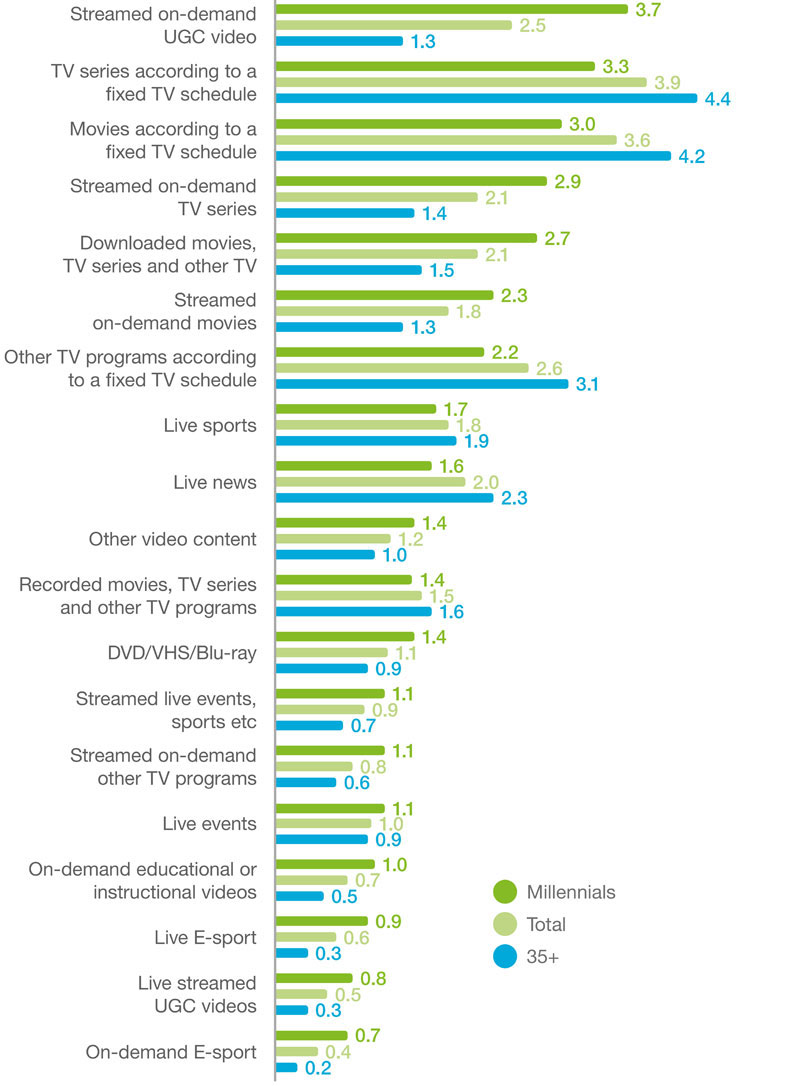
How Television and Video Viewing Habits Are Changing

The share of weekly video viewing time spent watching linear television (i.e., TV not on-demand) has decreased 16% since 2010, according to recent research from Ericsson.

The report was based on data from a survey of 30,000 consumers age 16-69 in 24 markets: Australia, Brazil, Canada, China, Colombia, Dominican Republic, Germany, Greece, India, Italy, Mexico, Netherlands, Poland, Portugal, Romania, Russia, South Africa, South Korea, Spain, Sweden, Taiwan, Turkey, the UK, and the US.

The share of weekly video viewing hours spent watching on-demand TV series, movies, and other programs has increased 50% since 2010, the analysis found.

The share of video viewing hours spent watching on-demand short video clips has jumped 86% since 2010.

In total, on-demand video watching now accounts for 43% of all weekly viewing time.


Consumers age 16-34 spend almost 2.5 hours more each week watching streamed on-demand user generated content (UGC) than do consumers age 35-69.

In contrast, consumers age 16-34 spend almost four hours less each week than consumers age 35-69 watching linear television.

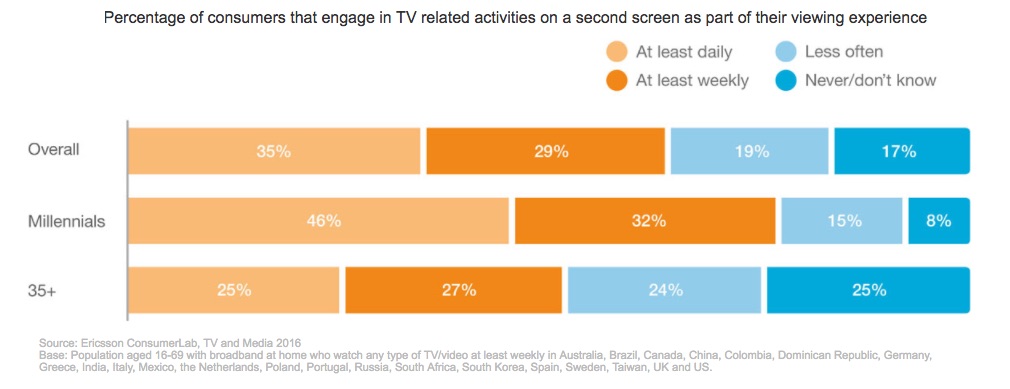
Some 64% of consumers say at least once a week they use a mobile device to complement or supplement what they are watching on television—including looking up actors, checking ratings, posting comments on social media, and watching video content on multiple screens.

About the research: The report was based on data from a survey of 30,000 consumers age 16-69 in 24 markets.

Porn marketing plan involving 3 girls brings Albion man decades in prison

GRAND RAPIDS, MICH. – An Albion man, like his partner, was hit with a lengthy term in federal prison for taking sexually explicit photos of three girls to sell on the Internet, including images showing the victims with a price chart behind them.

Numerous photos and videos were taken, but only a few made it to market. The sexual exploitation of children, coupled with possession of child porn, earned Normann Robert Pittelkow more than 22 years in prison followed by 10 years of supervised release.

Pittelkow also took a hit in the pocketbook. U.S. District Court Judge Robert Holmes Bell on Tuesday, Nov. 29 ordered that he pay $20,000 in restitution to help the girls with mental health services. He and Nicole Renee Jacob, his co-defendant and common-law wife, had custody of the girls.

More: Man who gave boy pacifier to muffle screams ordered to stand trial for assaults

“The minors need counseling now and into the future as a result of Pittelkow’s offenses against them,’’ Assistant U.S. Attorney Tessa K. Hessmiller wrote in a restitution memorandum. The girls specifically asked for restitution from Pittelkow, court records show.

Evidence against Pittelkow, 42, includes images showing the three girl posing nude with Jacob standing in the background holding up a sign with prices on it. The government also has videos of him talking about start-up costs associated with getting websites established.

Jacob, 35, was sentenced in late October to 15 years in prison for sexual exploitation of a child. The pair were charged in Oct. 2015; they’d been together for 14 years, court records show.

“Pittelkow sold some of these images and videos to people he met online,’’ Hessmiller wrote in the restitution memorandum. 

He could fetch $3 for every 20 pictures of one of the girls trying on different underwear and bras and $15 to $20 “if you’re willing to play with yourself,’’ Pittelkow told one of the victims, according to court records.

“It’s going to cost like $400 to get these websites up, alright?’’ he told one of the girls after setting up a video camera and leaving her in a room with a pile of underwear and instructions to “get naked’’ and “don’t be afraid,’’ court records show.

Albion police got involved in fall, 2015 when one of the victims told a friend that Pittelkow was taking sexually explicit photos. Police used a search warrant to enter the couple’s home and collect evidence.

Sexual exploitation of a child is punishable by a mandatory minimum term of 15 years in prison and up to 30 years. Possession of child pornography carries a 10-year term.

In a five-page letter to the judge, Pittelkow says he’s been taking Bible classes while locked up and hopes to one day become a pastor.

“I understand that I have already been forgiven by God but I also know I broke the law and have to answer for my guilt,’’ he wrote. “The public will be protected because I will be open with my story through Christ.’’

(© 2016 WZZM)