Archives par mot-clé : video

You Don’t Need a Big Budget to Get Started With Video Content

Video marketing is bigger than ever — this is an undeniable fact. In addition to traditional video content, live streams are very popular these days.

If you’re still not employing video content in your marketing mix, you are seriously missing out on opportunities. Social media platforms give preferential treatment to native videos and customers increasingly prefer consuming information in this format over the written word.

While producing professional video content may seem overwhelming, it is much less daunting than it appears to be.

Related: Want to Create a Video Presence? Here’s How to Write, Shoot and Market Your Content.

Creating video content.

So, how would a company with limited budget and staff go about staying on top of video marketing trends? Easily, if you ask me.

The videos don’t have to be Hollywood quality and highly-rehearsed. Here are some tips on how to get started in the video marketing arena.
An entry level digital camera that produces a decent quality video can range from $80 to $200. Don’t shy away from occasional smartphone videos for social media as well. As long as the subjects are well-lit and the speech is clear, you’re golden. In fact, consumers prefer casual and relaxed videos to the staged ones.

The reason is authenticity and sincerity. Remember that “people want to do business with people and not brands.” Consumers want to see the human side of the brand; and videos are a perfect way to lift up the curtain.

Related: How to Build a Great Visual Brand Through Video Content

To save time on scouring for ideas, you can repurpose your old and new content. Start by identifying your best-performing blog posts and record them in a video format. Look for similarities among your most engaging posts – are they “how-to” tutorials, industry analysis or behind-the-scenes moments? You can also create a few videos highlighting your product’s benefits or compare it to the competition.

The length of the videos.

Don’t stress over how long your videos are.

It is actually better to keep videos under five – better yet, under three – minutes in length. This forces you to focus on the important information and cut down the fluff. Besides, shorter videos have a better chance at retaining your viewers through the whole video before they’re too bored or distracted.

Wistia analyzed millions of video views and discovered that 80 percent of people will finish a 30-second video; more than 50 percent of viewers will finish 5- to 10-minute video, and less than half will finish a video that’s dragging on for more than ten minutes. So, as a general rule, shorter is better.

Related: How to Make Room for Video in Your Content Strategy

In case you have lots of insightful content to share, you could cut one 30-minutes recording into three 10-minutes video series to build anticipation and interest of your audience. As with any of your branded content, you decide on how to best shape and distribute it.

With all of the great abilities to create videos in a variety of apps, it is still best to record them with a camera or a smartphone through its native application. This way, you will have greater control over post-production effects, as well as, freedom to upload it to multiple networks natively.

So, here are a few video marketing tips you could act on immediately:

  • Go out and get a $100 camera, if you don’t have one yet.

  • Identify your best-performing blog posts.

  • Rework that content to sound natural when spoken out loud.

  • Identify a few people who feel comfortable in front of a camera.

  • Create and experiment.

Once you’re happy with the final result, upload it to all social media platforms you’re on. Currently, all social networks encourage native videos through better organic reach. You will also have a rich content library on all of your channels.

Related: The 4 Essentials of Video Content Marketing Success

Share it on your website as well; YouTube videos embedded in blogs might improve your SEO. You might even want to embed a screenshot of it in your newsletters and see if that will boost engagement and traffic.

Don’t stress out  over producing lots of videos fast. Just get started, so you can begin seeing the initial benefits and results. By creating just two short videos a month, you will have lots of new exciting content. If you can, create more.

Finally, have fun with this and your existing and potential followers will definitely feel it and enjoy it with you!


JamesAllen.com Seeing Success with Video Marketing

Online diamond bridal jewelry retailer JamesAllen.com, which has been seeing great success using video to market its products on social sites like Facebook and Instagram, said merchants need to adapt the content to the audience based on where they are consuming information and what they want to see.

“It’s all for naught unless you choreograph the placement of your videos appropriately, and make sure you’re clear on who is going to see it and where,” said Johanna Tzur, CMO of JamesAllen.com. “From there you create video that’s primarily suited to the channel where it’s being viewed and the viewer’s mindset. If you just try to create what seems like an interesting piece of content in a silo without understanding where it’s viewed and by whom, the content is compromised.”

For instance, the video content will be different when remarketing to someone familiar with your site and your brand, vs. a new visitor, Tzur said.

“If you’re remarketing, you don’t have to spend as much time introducing yourself,” she said. “If someone was viewing something else in YouTube and is actually being interrupted in their journey, you need to deliver the message in the first five seconds without aggravating them. These considerations are important when creating video content. You need to be focused on the consumer and their mindset.”

Tzur said JamesAllen.com began using video in its marketing and promotions in 2015 and began ramping it up last year based on positive early results. The company also has its entire product collection captured in high-definition videos with 360-degree views, a key differentiator from competitors who only recently have introduced videos on limited product ranges.

JamesAllen.com video ads on Facebook drive nearly double the traffic of carousel ads, with a click-through rate that’s 285% higher, Tzur said. In addition, website visitors who come from the company’s video ads are 15% more likely to visit multiple pages.

“There’s also a 20% greater likelihood of a purchase from our Facebook video ads vs. carousel ads,” Tzur said. “It’s also important from an SEO perspective to have more video behind our brand to help us rank as highly as possible for organic searches. Today we’re seeing Google’s algorithms ranking video higher in online search than ever, with 62% of its searches including video. So it’s delivering great relevance and branding for SEO as well.”

Marketing on a digital playground

Almost every business has an online presence these days. Irrespective of the industry, businesses are reaching out to customers with marketing expertise to realise their visions for growth. And digital is central to their expanding plans.

What is digital marketing?

It involves marketing products and services through a wide range of digital media like website, email, social media, display ads and mobile apps through interactive or engaging content. Digital marketing activities include search engine marketing, social media marketing, ecommerce marketing and messaging apps based marketing.

The shift from marketing products and services to customer engagement:

More brands are realising that just aggressively promoting their products and services is not going to cut it. In fact, it may alienate consumers. Also, just competing with competitors to make offers, give coupons and rebates is only going to bleed them financially. The trend that is fast catching up is actively engaging consumers in a dance that is up close and personal. Brands are moving towards storytelling and other immersive experiences to connect closer with consumers and also to create product experiences as close to reality as possible.

And digital is quick to embrace that change!

It’s difficult to say if technology has created the paradigm shift from marketing to engagement or if it has just embraced the change. Irrespective of where the change originated, technology has proved to be a great enabler of this paradigm shift. Moreover, the digital landscape itself is evolving to meet the demands of new age marketing.

So, what are the emerging trends in digital marketing?

Rise of video content: With the growing penetration of smartphones and wireless networks, there has been a rise in the amount of video content consumed on mobile. Brands are making use of this medium to create engaging content that educates, entertains and inspires to try or buy their products and services. And consumers are just loving it here!

Use of Artificial Intelligence (AI) to make smart recommendations:

Recommendation engines and chatbots have sprung up across the digital ecosystem of commerce. Powered by data about consumer demographics and preferences, they intelligently suggest products that consumer might need, or is yet to figure out that he needs. These are soon going to be the norm as conversational commerce comes to the forefront of marketing. With the likes of Facebook opening their messaging apps to business bots, messaging apps are currently in the spotlight of conversational commerce.

Advanced marketing analytics:

There is more data about a potential consumer on the web than ever before. Every like, comment, tweet and share is tracked. Analytics also plays a meaty role in connecting the dots in a way a marketer would have not imagined to produce big picture insights. These in turn are used to redefine marketing strategies in a way that the brand reaches the right customer at the right time.

Social media beyond Facebook:

Instagram, Pinterest and Snapchat have expanded the social media footprint of a consumer beyond Facebook and Twitter. The advertising here is done via stories, videos, pictures and ads. While earlier these spaces were limited to interpersonal conversations, brands have made their presence felt through great bite sized content.

The slow but steady arrival of Virtual Reality (VR) and Augmented Reality (AR):

To create immersive product and service experiences, businesses are adopting VR and AR technologies in their marketing. Not only are these fun and engaging but also create great brand recall. This is particularly so for the millennial demographic which is likely to appreciate the ‘cool quotient’ of a brand.

What’s the way ahead for digital marketing?

The next big thing in marketing is to build up on the Internet of Things (IoT) network making use of smart sensors and talking devices sense the mood of the consumer and make recommendations or personalized suggestions. Clearly, technology has changed the marketing game for good.

Indie Game Designer Estimates One PewDiePie Video Boosted Sales By More Than $100000

YouTube’s community of gamers, especially those who make videos that fall under the “Let’s Play” genre, can be a huge marketing asset for up-and-coming developers. Some video games, such as Day-Z, have received millions of sales thanks to their popularity on the internet.

How much impact does just one Let’s Play video have? When that video comes from YouTube’s most-subscribed channel, game makers sometimes see six figures as a result. The New York Times recently published a piece about video game developers and designers who use “YouTube as an accelerant. Among other anecdotes, the Grey Lady cited Ryan Clark, who estimated that YouTube star Felix “PewDiePie” Kjellberg’s playthrough of his game Crypt of the Necrodancer ultimately catalyzed more than $100,000 in sales.

In a 2015 video, Kjellberg booted up Crypt of the Necrodancer and navigated the game’s dungeons, which require the player to stay in beat with the soundtrack. The affable (if controversial) Swede seemed to enjoy his time with the game, and when he was done with it, he posted a video to his channel (which currently has more than 57 million subscribers) with the title “AMAZING RHYTHM GAME!”

His fans responded by picking up copies of Crypt of the Necrodancer for themselves. Clark told the New York Times that he believes the PewDiePie video generated about $60,000 in sales on its own. In addition, several other YouTubers decided to check out the game after seeing Kjellberg play it, and Clark estimated that this “halo effect” pushed his PewDiePie sales up above $100,000.

If you were curious why game companies are so eager to get their titles in front of YouTubers, the example of Crypt of the Necrodancer provides a compelling case study. For additional anecdotes about games that have prospered thanks to their popularity on the internet, check out the New York Timesreport.

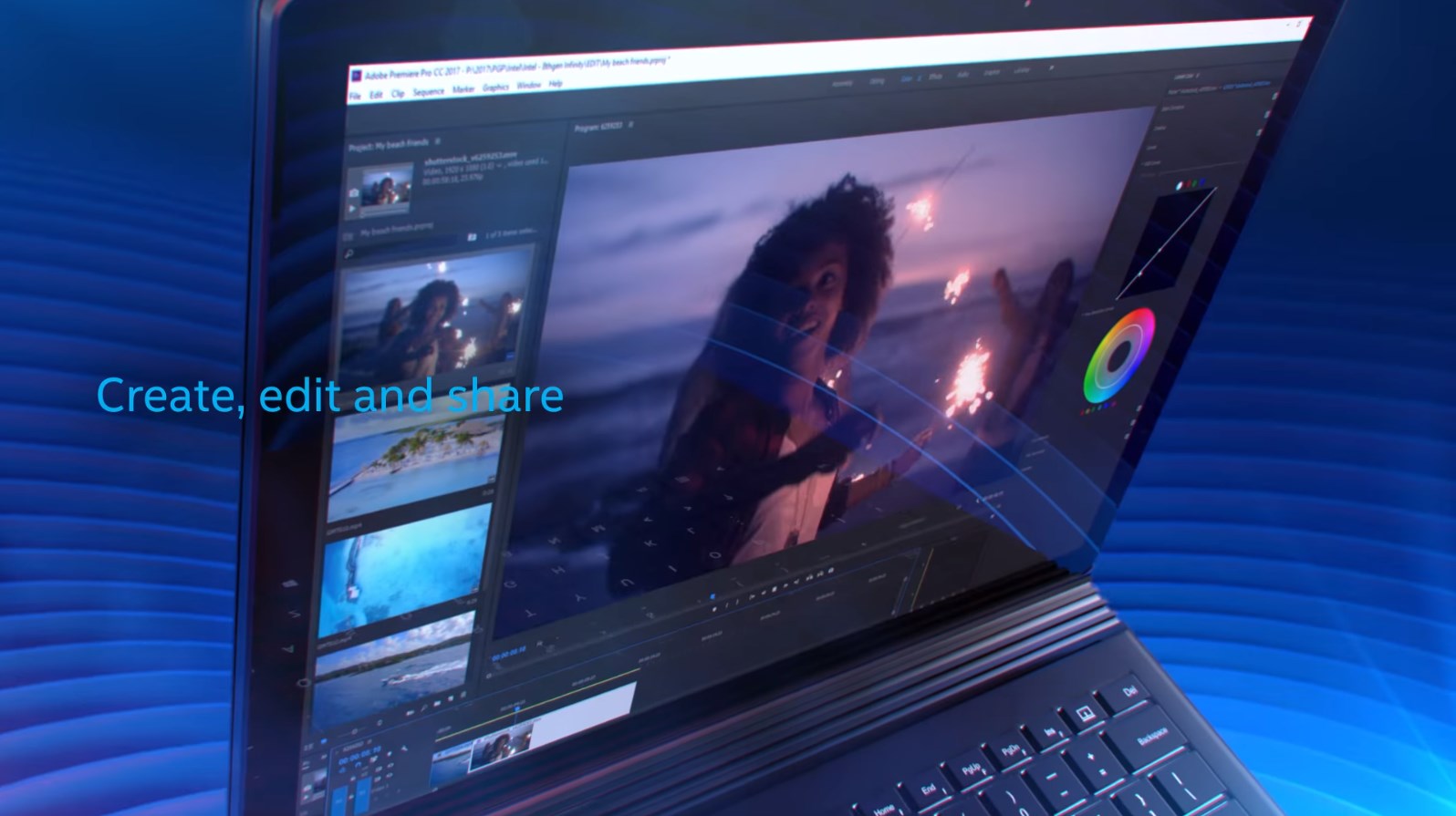
Intel has a mysterious black Surface Book in its new processor video

Intel unveiled its 8th generation Core processors earlier today, which will launch on laptops first. As part of the launch, Intel has produced a promotional video of what to expect from the next processors, which will bring quad-core chips more broadly to laptops. MSPoweruser has spotted that the video includes what appears to be a black Surface Book.

Microsoft currently manufactures a gray Surface Book, and the company hasn’t used black on its Surface line since the Surface Pro 2 nearly four years ago. The mysterious device in Intel’s video could be a marketing render, but it does include the exact same eject key found on the keyboard of the Surface Book and the unique fulcrum hinge that Microsoft uses on its laptop.

Microsoft is planning to launch an LTE version of the Surface Pro in October, and it’s possible the company might also refresh its Surface Book at the same time. Microsoft was one of the first PC makers to opt for Intel’s Skylake processor for its original Surface Book, but the company struggled with the architecture and a new Connected Standby (Instant On) feature of Windows 10.

While Microsoft eventually updated Surface Book firmware to fix some early issues, Consumer Reports recently found reliability problems with previous Surface devices. If Microsoft is planning to refresh the Surface Book, it would be surprising to see the company once again take Intel’s latest processors right away after the previous problems. Intel’s video tagline is “designed for what’s coming next,” so it could just be hinting that the next Surface Book will use the new quad-core Kaby Lake refresh processors.

Live Video Marketing Expert Joel Comm joins Switcher Studio as …

Louisville, KY, USA (August 17, 2017) – Makers of the original multi-camera streaming app, Switcher Studio, announced a new partnership with leading live video expert, marketing strategist, author and technologist Joel Comm, who will contribute to the company’s content and brand awareness campaign for its growing global footprint.

Louisville, KY (PRWEB) August 20, 2017

Makers of the original multi-camera streaming app, Switcher Studio, announced a new partnership with leading live video expert, marketing strategist, author and technologist Joel Comm, who will contribute to the company’s content and brand awareness campaign for its growing global footprint.

Comm, who sold a site to Yahoo! in 1998, wrote a New York Times Bestseller and created an iPhone app that went to #1 in the world, has since made live video a staple of his marketing and communications with his audience.

« Bringing Joel Comm on-board will bring a big value to our users, » commented Nick Mattingly, CEO of Switcher, Inc.. « He knows the tech, the strategy component and how to get people to find their WHY for going live. We are looking forward to working with Joel and bringing creators some great content. »

« Live video is the most significant development in social media since the invention of the smartphone, » said Comm. « Switcher has an easy to use product, good engineering and incredible customer support. I believe they can lead the market in mobile video creation on platforms like Facebook and YouTube for live video made with your iPhone or iPad. »

Comm has spent recent years building his career and personal brand around live video.

With Switcher, he will leverage his social-media following and live video know-how to help businesses and creators level-up their live video using the Switcher Studio mobile platform.

Along with outreach and education on his personal profiles, Comm will also contribute to the Switcher Facebook and YouTube channels and host « how-to » videos in which he’ll walk creators through some of the challenges they face when going live.

Founded in 2014, Switcher, Inc. has built a mobile production suite that allows content creators to use an iPhone or iPad as a portable video mixer. Easily add photos, videos, overlays, picture-in-picture, multiple angles and more. All you need is Switcher Studio and an iPhone or iPad – record the video output to your primary device and stream live video anywhere with an internet connection.

With its iOS app, desktop tools, cloud services and support, Switcher, Inc. aims to help businesses and creators get the most out of their live video to expand their audiences and grow.

Keep up with the latest in live video by joining Switcher’s user group on Facebook and signing up for the Switcher Studio blog

For the original version on PRWeb visit: http://www.prweb.com/releases/2017/08/prweb14616178.htm

View Comments and Join the Discussion!

“Focus on Feet, Not Eyeballs: Why New TV Metrics Are Turning The Industry Upside Down”

Lindsey DiGiorgio, VP of Marketing for NinthDecimal explains, the way we consume content has evolved quickly, forcing marketers to rethink the way they engage with their target market. Whether it’s trying to reach the millennials who want to escape a world of ad pollution or speak to the cord-cutting viewers who ditch cable or satellite subscriptions – advertisers are having to work harder than ever to find their audience

The way people watch TV is changing right before our eyes. Think back to the last time you watched an entire television series, week after week, at its regularly scheduled time; or when you waited for the evening news to hear about the day’s big stories. TV has become more about the type of content (e.g. long- versus short-form video) than the flat screen mounted in your living room. The proliferation of new TV formats and on-the-go viewing are creating an exciting new world of engagement opportunities for advertisers, as well as more sophisticated measurement solutions to calculate ROI.

Understanding how the effectiveness of new digital TV advertising is driving specific consumer action requires brands to rethink the metrics they use . Take, for example, the traditional metric for measuring how effectively a TV ad is delivering a brand’s message, gross ratings point (GRP). While the GRP certainly has a place in TV measurement, it does not address all the demands of this new media ecosystem. For one thing, it’s only modeled to measure ad exposure, not consumers’ behavior in response to an ad. GRP also does not take advantage of new, more sophisticated measurement techniques to understand how effective an ad was at driving people to a website or – even more important for brands with a retail presence – a store.

Unlocking TV ROI With Physical-World Behavior

Understanding what consumers do when they are in the real world is taking ROI measurement well beyond TV’s traditional “eyeballs” metrics for advertising effectiveness. CMOs have begun to embrace foot traffic measurement based on physical-world behavior as a more reliable and actionable metric for calculating ROI, especially for omni-channel marketing campaigns. That trend is also being embraced across TV, increasingly making it an industry standard and enabling TV advertising to stay relevant and demonstrate its value in the digital era.

New technology, for example, can directly connect traditional “linear” TV ads (as well as on-demand, streaming and addressable TV ads) to consumers’ real-world behavior by matching audiences’ mobile device IDs to households in an anonymized, privacy-friendly manner. Measuring the change in store visits from target audiences through location data allows brands to finally “unlock” precise TV campaign ROI measurement.

Solving the traditional media measurement problem is becoming increasingly important for the TV industry as it undergoes a dramatic shift. But it’s even more crucial as the advertising ecosystem moves towards an omni-channel approach that incorporates TV into a wide range of other digital and physical media. With foot traffic measurement tied to specific ads, marketers can move towards a new universal metric, like cost-per-visit, that not only measures advertising success but efficiency too.

If brands can better understand the cost-per-visit tied to a TV ad and compare that to other types of media, its value becomes much clearer. So, even while the cost of a 30-second TV spot is often much higher than a banner ad, cost-per-visit metrics can reveal that the commercial is delivering more foot traffic per dollar spent than the banner ad. The bottom line is that TV doesn’t have to go the way of print if it can stay relevant in the current media landscape by shifting to a new, more reliable and relevant metric that is comparable across different channels.

What Marketers Need to Know About New TV Metrics

There are several questions that every marketer should ask themselves before leveraging foot traffic measurement technology for their next TV ad campaign. First, what are the primary insights you hope to reach from this type of measurement? For example, are you looking to compare different creatives’ ability to drive traffic to stores? Or do you want to see which region was most affected by your national TV spot? Maybe you are looking to test the efficiency of different networks, dayparts, or even types of media. Whatever it might be, defining your goals upfront is important when deciding what measurement technology to use .

Second, it’s important to know that the data being used to create foot traffic insights will be reliable enough to meet your needs . Take exposure data sources, for instance: is the data based on linear, over-the-top (OTT) streaming, addressable TV or some combination of those? How is the measurement provider connecting real-world behavior and household viewing habits? (Watch out for convoluted guesswork and modeling or privacy violations.) Basically, you should be asking yourself, is the methodology sound and conducted on a statistically significant scale?

Finally, can the measurement provider deliver an apples-to-apples comparison of digital, mobile and other advertising mediums using the same metric? This is incredibly important in the new world of omni-channel advertising. As advertisers inevitably start to unify around more reliable metrics like cost-per-visit, marketers must fully understand what they mean (and the technology behind them) to realize their full value.

NZ’s tallest apartment block: deposits taken on $14.5m penthouses

Initial deposits have been paid for three penthouses, sold for $14.5 million, in the proposed and yet-to-be-built 57-level Pacifica Auckland apartment tower.

Gavin Lloyd, residential projects national director of sole agent CBRE, said the places had sold for $4.48m to $5.27m and were above the « sky homes » upper levels.

Extensive views from the planned Pacifica tower.

The apartments sold are to be on level 50 and 51, he said.

« The level 50 places will be 190sq m and 235sq m and the level 51 will be 190sq m. The 190sq m places are two bedrooms and the larger ones are three bedrooms, » he said.

All three places went to New Zealanders, he said.

« People from overseas are also interested, particularly from Britain, the United States, Australia, Hong Kong and Singapore.

« Earlier in the year, our offices in Hong Kong and Singapore were involved in marketing The Pacifica, mainly to ex-pat Kiwis living in those locations. But we’re not marketing it in China, » he said.

Deposits had now also been received for more than half of the 282 apartments in the 178m tower planned for 10-12 Commerce St off Customs St East opposite the Britomart area, Lloyd said. Construction work for the tower planned by Hengyi Pacific is due to start before the end of this year.

Buyers are putting down 10 per cent deposits.

« More owner-occupiers are buying into this than investors, which is quite unique in the Auckland CBD apartment market. The building has been deliberately designed to suit owner-occupiers. It’s not particularly aiming to draw Chinese who don’t live in New Zealand, » Lloyd said.

Apartments are selling from $657,000. The tower is divided into distinct zones: Commerce Residences, Tower Suites, Sky Homes and penthouses.

Buyers pick from 34 floor plans from one bedroom and one-bedroom plus a study, Lloyd said.

Read more: Who’s behind NZ’s biggest apartment tower?

Icon Co, a builder new to this country, was last month named as the construction company contracted to put up the tower between Customs St and Gore St in the CBD.

Hengyi Pacific, the Chinese-headquartered developer with an Australian office, announced the builder.

Dan Ashby, one of New Zealand’s most experienced high-rise commercial construction chiefs who also worked on the Burj Al Arab in Dubai, will head Icon here.

Westpac provides some tips about buying apartments off the plans.

« The key is to question what you’re getting into before handing over your cash. Because if you don’t do your research, you could end up with a very expensive lemon.

« You need to be careful to check out the developer’s and builder’s track record and credentials to be sure you can trust them. Otherwise, if you don’t get what you think you’re getting, you could end up in court, » Westpac warns.

« You need vision to visualise the finished product and everything that goes inside. Construction can take two to three years before completion. You need to be patient, » the bank says.

Nine apartments worth about $6m in Auckland’s giant Sugartree apartment project were being quietly promoted for sale last month, as buyers who put down 10 per cent deposits tried to sell before settlement in August.

Martin Dunn of City Sales said his company had sent out information to 35,000 potential buyers on his company’s database and he was confident the places would sell.

Cook Islands to build out digital marketing strategy after programmatic advertising success

Cook Islands Tourism (CIT) is looking to looking to build out a comprehensive digital advertising strategy after its first-ever programmatic activity resulted in double-digit brand recall across Australia and New Zealand consumers.

The month-long programmatic campaign ran in April and encompassed video, search and display ads running across Web and social channels targeting Australian and New Zealand consumers. A key element was building custom audience segments into a data management platform (DMP) in order to reach the destination’s target consumer: The ‘soft explorer’.

The work was done in partnership with Sparcmedia and The Core Agency and importantly, supported by pre- and post-brand impact research by Sparcmedia’s parent company, Pureprofile.  The research looked into the key objectives of the campaign, the advertising impact on raising brand awareness, and the improvement in how consumers perceived the destination as an adventurous holiday, rather than a resort island.

Cook Islands Tourism director of sales and marketing, Karla Eggelton, told CMO the islands are a new destination to the Australian market but a mature one for New Zealanders. The group recently implemented a destination brand, the first in over a decade, and wanted to understand how audiences related to its messaging as well as verify pre-conceived notions about what Australians wanted in a holiday destination.

The team was also looking for a way to use measurable insights to develop a digital strategy that could amplify its brand work.

Live Video Marketing Expert Joel Comm joins Switcher Studio as Brand Ambassador

Louisville, KY, USA (August 17, 2017) – Makers of the original multi-camera streaming app, Switcher Studio, announced a new partnership with leading live video expert, marketing strategist, author and technologist Joel Comm, who will contribute to the company’s content and brand awareness campaign for its growing global footprint.

Louisville, KY (PRWEB) August 20, 2017

Makers of the original multi-camera streaming app, Switcher Studio, announced a new partnership with leading live video expert, marketing strategist, author and technologist Joel Comm, who will contribute to the company’s content and brand awareness campaign for its growing global footprint.

Comm, who sold a site to Yahoo! in 1998, wrote a New York Times Bestseller and created an iPhone app that went to #1 in the world, has since made live video a staple of his marketing and communications with his audience.

« Bringing Joel Comm on-board will bring a big value to our users, » commented Nick Mattingly, CEO of Switcher, Inc.. « He knows the tech, the strategy component and how to get people to find their WHY for going live. We are looking forward to working with Joel and bringing creators some great content. »

« Live video is the most significant development in social media since the invention of the smartphone, » said Comm. « Switcher has an easy to use product, good engineering and incredible customer support. I believe they can lead the market in mobile video creation on platforms like Facebook and YouTube for live video made with your iPhone or iPad. »

Comm has spent recent years building his career and personal brand around live video.

With Switcher, he will leverage his social-media following and live video know-how to help businesses and creators level-up their live video using the Switcher Studio mobile platform.

Along with outreach and education on his personal profiles, Comm will also contribute to the Switcher Facebook and YouTube channels and host « how-to » videos in which he’ll walk creators through some of the challenges they face when going live.

Founded in 2014, Switcher, Inc. has built a mobile production suite that allows content creators to use an iPhone or iPad as a portable video mixer. Easily add photos, videos, overlays, picture-in-picture, multiple angles and more. All you need is Switcher Studio and an iPhone or iPad – record the video output to your primary device and stream live video anywhere with an internet connection.

With its iOS app, desktop tools, cloud services and support, Switcher, Inc. aims to help businesses and creators get the most out of their live video to expand their audiences and grow.

Keep up with the latest in live video by joining Switcher’s user group on Facebook and signing up for the Switcher Studio blog

For the original version on PRWeb visit: http://www.prweb.com/releases/2017/08/prweb14616178.htm

View Comments and Join the Discussion!