Video content has seemingly arrested the attention of the entire internet, which makes good sense, given that humans are wired to process visual information. And it’s an ideal marketing tool, because video has been proven to wield profound influence on the decision making process, often leading to increased sales.
Archives par mot-clé : video
How Facebook’s Big Bet on Video Could Change TV
Facebook is aggressively ramping up its video strategy, cultivating content whether it comes from users, advertisers or Hollywood, or is developed internally. With its nearly two billion monthly users, the social network could make a big dent in traditional TV and help usher in a major shift towards social TV, Wharton experts say. The social network’s latest video push is partly due to a need to find more ad spaces. In its latest earnings call, Facebook says growth in the second half of 2017 will slow due to a peaking ad load, or how many ads are served up to users.
CEO Mark Zuckerberg is also tipping his hat to a fast-growing trend: Digital video viewing is exploding. According to Cisco Systems, video accounted for 60% of mobile data traffic in 2016 and should rise to 78% by 2021. The Interactive Advertising Bureau says ad spending on U.S. mobile video rose 178% in the first half of 2016 from a year ago, comprising more than 40% of the $3.9 billion total online video market. “Social media is moving from text to pictures to video, so Facebook is following its consumers,” says Wharton marketing professor Jonah Berger.
Facebook’s video efforts include the recent launch of Facebook Live, which is a live-stream service similar to Twitter’s Periscope. The social network also created an app for Apple TV and other set-top boxes so people can watch its videos on a TV screen. It debuted 360-degree videos and reportedly is planning to add episodic shows from Hollywood — or produce its own original content — up to 30 minutes long. The company has hired Ricky Van Veen, co-founder of video site CollegeHumor, as creative chief, and also MTV executive Mina Lefevre to develop original TV shows.
“Although Facebook has not historically been a media company, it makes sense that they want to [prevent] their massive user base from moving to other online sites that have scripted show offerings. Therefore, they are capitalizing on a very ‘hot’ area right now — online scripted shows,” says Shawndra Hill, senior fellow at the Wharton Customer Analytics Initiative.
“The democratization of content, production and consumption has already begun.”–Shawndra Hill
“It could possibly be a perfect marriage between a large, engaged user base, new and exciting content, and perhaps most importantly, an already healthy advertising ecosystem that users are very familiar with,” Hill adds. “Even more interestingly, Facebook has a way to reach millennials, a group of viewers that companies find hard to reach by traditional advertising.”
Wharton marketing professor Pinar Yildirim further points out that the lines are already blurring between social networks and media companies. “Both are ultimately about content creation — whether by users or professionals — and consumption,” she says. Folks now are using social media and watching TV concurrently. “Combining the two, or allowing individuals to also interact over networks while consuming content, is eliminating one friction.”
Indeed, “the world is moving in the direction of consuming more media content online. As people spend an increasing proportion of their day using online services for scripted content, it will be even more difficult to grasp consumer attention via linear TV,” Hill says. “Attention will be fragmented by online services.”
But social TV needs good content to thrive. To encourage creators, Facebook took a page from YouTube and agreed to share ad revenues. It will keep 45% of the pot, according to The Wall Street Journal. However, in a departure from industry practice, Facebook has banned pre-rolls, or ads that play in front of the content, in favor of those that play in the middle of the video for a better user experience. Facebook also is paying some celebrities and media firms to create Live videos.
“Videos are a good way to elicit engagement. For example, they draw more comments than photos,” says Kartik Hosanagar, Wharton professor of operations, information and decisions who has written a research paper on Facebook. However, “one challenge for Facebook has been that its users have slowed down in terms of the amount of content and updates they now post on the social network. Also, Facebook has been looking for ways to diversify its business. In light of these two observations, the decision to go into video starts to make sense.”
The Race for Ad Dollars
Facebook and Google already attract the most online advertising dollars. With the video push, Facebook and Google’s YouTube “may replicate their mobile advertising dominance,” according to a report by Bloomberg Intelligence. To be sure, there are plenty of other video contenders. “Google, Facebook, Snapchat, Yahoo and Twitter all aim to compete for new video ad dollars,” the report said. Also in the running are Hulu and Amazon. Thus far, Netflix is avoiding commercials.
“People just want to see what their high school buddies are doing — and making it a standalone entertainment service might not work.”–Peter Fader
“All of these services will aim to crowd out one another. For the consumer, however, it will be great to have fresh new content that is both similar to traditional TV via existing TV network partnerships, and innovative [services] by introducing solutions like virtual reality, where viewers themselves can be ‘part’ of shows,” Hill says. “I foresee a lot of innovation and evolution in this space before we can say for sure what is most interesting to viewers. In any case, the barriers are low right now for people to switch around and watch all solutions (from Hulu to YouTube to Facebook). However, this might not always be the case, as content providers think through pricing for their solutions.”
YouTube is making changes to be more competitive. It will do away with 30-second ads that cannot be skipped starting in 2018 in favor of other unskippable formats, like six- and 20-second ads. Netflix is looking into creating versions of its content that look better on small screens. Facebook has launched an ad campaign — reportedly the biggest in its history — encouraging marketers to create video clips that would display well on smartphones.
“The key is to design the content to fit the medium,” Berger says. “Understand how consumers are using these mediums and what they are looking for, and build content that matches” the format. Adds Katherine Milkman, Wharton professor of operations, information and decisions: “My research suggests that if the goal is to create viral content, then making sure the content elicits an emotional response is key. The types of emotions that make your heart race … are more useful for creating a viral response than emotions that dampen excitement, [such as] sadness. Making it useful, surprising and interesting is also important.”
Hill points out that these ads are useful to Facebook advertisers because they “open the door to do more precise one-to-one marketing. From an advertiser’s perspective, the most exciting aspect of these services is that viewers can be reached both inside their living room and just about anywhere else — on the subway or a plane, for instance,” Hill says. “In addition, these services will know exactly who is watching and for how long, since viewership will be linked to an individual-level user ID.”
“Will it be successful? It’s anyone’s guess. Consumers have enough options for video today.”–Kartik Hosanagar
Hill adds that since people are already online, “advertisers can provide calls to action that land viewers on the relevant web pages to get information or make a purchase — or even better, the calls to action can be voice-activated to simply say ‘purchase’ in the future to reduce the likelihood that people turn away from shows. Once online media solutions have reached the point where they are replacing linear TV in significant numbers, TV and ad measurement the way we know it now will be dead.”
Facebook Premium?
Wharton marketing professor Peter Fader says Facebook ought to consider a premium service that includes videos and other content and services accessible only to paying members. “Look at Amazon Prime and how they leveraged it in so many different directions” including bundling digital video, two-day shipping, e-book rentals and other perks, he points out. “Who can deny the success of that? [Facebook needs] to be looking in that direction.”
It should learn from the missteps of struggling YouTube Red, the video site’s premium service that is free of ads, carries original content developed by YouTube and allows offline playback. “It’s just not clear to me how different the [subscriber] experience is,” Fader says. “With Amazon, it had free shipping, etc. Maybe [YouTube Red’s proposition] just wasn’t enough.” YouTube Red costs $10 a month or $120 a year, higher than Amazon Prime’s $99 yearly cost.
But will people want to watch TV on Facebook? Perhaps “people just want to see what their high school buddies are doing — and making it a standalone entertainment service might not work,” Fader says. “But on the other hand, it now has such a share of mind [and] it is such a huge platform that it makes sense for the advertiser to go there.” He points out that Facebook has already evolved during its 10-year history and it could become a multifaceted platform one day.
One thing is clear: There is a definite shift away from traditional TV. “I think we’ll move away from thinking of scripted shows as TV,” Hill says. It will all just be content. “We will soon enter a world where we call content connected media and it will be watched over the internet. The democratization of content, production and consumption has already begun. There will continue to be many players in this space initially, but we will eventually converge to a few large players, I think.”
Will Facebook be one of those remaining players in video? “Will it be successful? It is anyone’s guess. Consumers have enough options for video today. For social video, there is YouTube. For premium content, we have Hulu and Netflix,” Hosanagar says. “So it’s unclear what niche Facebook can occupy in that market. Unless Facebook identifies a clear niche … it’s not clear it will have mass market success.”
Google announces new brand safety controls for display & video advertisers

A day after Matt Britton, Google’s EMEA head of operations, apologized for advertisers’ ads appearing adjacent to extremist content — after a stream of advertisers announced they were puling ad from Google’s ad networks — the internet giant’s chief business officer announced new brand safety controls.
As Marketing Land has reported, the Google Display Network includes many extremist sites propagating right- and left-wing ideologies, hoaxes and misinformation. The company updated its policies to address mirepresentative sites in November but did not address brand safety concerns of ads appearing alongside extremist content and misinformation.
Philipp Schindler, Google chief business officer, wrote that as of Tuesday, the company is “taking a tougher stance on hateful, offensive and derogatory content. This includes removing ads more effectively from content that is attacking or harassing people based on their race, religion, gender or similar categories. This change will enable us to take action, where appropriate, on a larger set of ads and sites.”
The changes are also meant to address complaints of brand messaging appearing on exremist videos on YouTube. Schindler said Google will “ensure that ads show up only only against legitimate creators in our YouTube Partner Program — as opposed to those who impersonate other channels or violate community guidelines” and take another look at its ad policies.
The changes as Schindler announced them:
- Safer default for brands. We’re changing the default settings for ads so that they show on content that meets a higher level of brand safety and excludes potentially objectionable content that advertisers may prefer not to advertise against. Brands can opt in to advertise on broader types of content if they choose.
- Simplified management of exclusions. We’ll introduce new account-level controls to make it easier for advertisers to exclude specific sites and channels from all of their AdWords for
- Video and Google Display Network campaigns, and manage brand safety settings across all their campaigns with a push of a button.
- More fine-tuned controls. In addition, we’ll introduce new controls to make it easier for brands to exclude higher risk content and fine-tune where they want their ads to appear.
Schindler continued to assert that the company mostly gets it right and has controls like topic exclusions and site category exclusions. Yet he added that advertisers will have more visibility into where their video and display ads appear and that the company is reviewing its polices.
About The Author
Don’t worry about going viral; just make the right video
Video marketing has never been more popular. Your social media strategy demands it, but I’m here to take some pressure off.
You don’t need a viral video.
 This is a great city, and you can hire any number of Milwaukee video production companies to create an awesome video for your business. However, none of them can guarantee it’ll go viral.
As a video producer, I don’t have any control over that phenomenon. I have the power to create a good video. I have the power to tell a great story. But I do not have the power to make someone share that video.
The good news: a viral video doesn’t ensure business success. For every “Will it blend?” (the viral blender infomercial) success story there’s a “Carrie” failure. The 2013 horror film reboot promotion went viral, with more than 67 million views to-date, but the movie was a box office flop.
It’s more important to produce videos focused on the “right” audience, instead of one that reaches millions who might not be your customers.
Focus on your viewers when you produce videos. Who is our audience? What is going to appeal to them? How can we help serve them with our content? All questions you should be asking before you start shooting.
Lutheran Social Services of Wisconsin and Upper Michigan, one of our customers, does an awesome job with this.
Its videos are incredibly powerful and effective marketing tools. LSS officials show the videos to people who might need the services, as well as potential donors. In short, they show the videos to the people they most want to connect with.
See… you don’t need a viral video. You need a marketing video plan that focuses on your core audience. That’s a better recipe for video success.
-Tony Gnau is founder and chief storytelling officer at Milwaukee-based T60 Productions.
With an Uncanny Ability to Engage, Video is Reshaping Modern Marketing
Recent studies show that videos are driving Internet content and increasing market revenue. ePlanet’s Asad Khan discusses why businesses should include videos in their marketing toolkits.
Salt Lake City, UT (PRWEB) March 20, 2017
With its ability to reach and engage multiple audiences worldwide, video is becoming a vital component of the marketing toolkit. In 2017, video content is expected to account for 74% of all Internet traffic.1 Research indicates that businesses that use video to market grew revenue 49% faster year-over-year than businesses that did not.2 When it comes to attracting an audience, four times as many customers would prefer to watch a product video rather than read about it.1 Asad Khan, founder of ePlanet Communications, Inc., a global business process outsourcing provider, points out that the use of video in marketing is a vital part of an overall strategy.
Research has shown that video marketing offers a significant return on investment and increases the likelihood of a sale.1,2,3 While it costs an average of $115 in marketing funds to convert a sales lead using non-video marketing, it costs just $93 to convert a lead using video marketing.3 Because video has such tremendous appeal, any upfront investment is rewarded with high click-through and share rates, and ultimately an increase in sales.4
Using video on a digital platform provides the advantage of improving search engine optimization (SEO).2,3 Video generally engages a visitor for a relatively long period, improving a website’s bounce rate and session duration—two factors which greatly influence search engine listings.2 According to Forrester Research, the use of video increases the chances of getting a page one search engine ranking by 50 times.3
« Marketing evolves constantly, » said Kahn. « Companies should always be open to trying different digital marketing strategies. I suggest video as a medium to my clients, because it offers the ability to reach various demographics and creates a connection with the customer. » Video can instill trust by offering useful, entertaining or interesting content to consumers. For international businesses, language barriers matter less when a story can be told with images.
Creating valuable content that interests and engages a customer (and, possibly, encourages them to share) serves to promote a positive brand image and demonstrate thought leadership. Industry leaders are realizing that their audience craves useful content. In 2016, videos with « how to » in their titles were 70% more prevalent.2 When making a decision to purchase a product, 90% of consumers say that video is helpful.2
Khan added, « Given the state of technology today, where most people in the western world are connected to the Internet and have a mobile device, the web is probably the best platform for showcasing video content. » Considering that YouTube reaches more 18 to 49 year-olds than any cable television network, creating the next viral Internet sensation may promise a much greater reach than a traditional television commercial.3
Khan emphasized that « content is king, » and producing something that resonates with the viewer is extremely important. As professional production costs are going down, it’s the right time for companies to budget for video marketing. Small businesses that can’t afford to hire professional production companies can use a smartphone or tablet to create their own amateur videos which, while possibly not as aesthetically pleasing as professionally shot videos, can nonetheless prove to be effective.
After successfully showcasing the business at the, 2017, Affiliate Summit Marketing Conference in Las Vegas. ePlanet will be showcasing again at the Affiliate Summit Marketing Conference from July 30-August 1, 2017, in New York City with others prominent in the performance/direct and digital marketing industry. The event promises to be a premier event in the global marketing industry, with over 5,500 digital marketers from over 70 countries attending.
About ePlanet Communications:
ePlanet Communications is a global business process outsourcing provider with extensive experience in call center operations, digital media solutions, and direct response solutions. By using its integrated channel management capabilities and highly-trained staff, ePlanet develops and deploys inbound and outbound customer support fully integrated with its clients’ marketing campaigns. Digital media solutions include website design, digital franchising, fully functioning eCommerce operations, and the creation of interactive, immersive and responsive social media campaigns across different platforms. ePlanet is also highly experienced in the area of direct response trial, consistently delivering improved customer satisfaction, increased customer retention, and better order value. To learn more about ePlanet and its capabilities, please visit http://www.eplanetcom.com.
1. Curtis, Matt. « The Benefits of Video Marketing in 2017. » Business 2 Community. N.p., 9 Mar. 2017. Web. 10 Mar. 2017.
2. Beccalori, Joe. « Five Reasons To Incorporate Video Into Your Next Marketing Campaign. » Forbes. Forbes Magazine, 08 Mar. 2017. Web. 10 Mar. 2017.
3. Totka, Megan. « 4 Reasons Why Video Is the New Star of Your Small Business Marketing Strategy. » All Business. Dun Bradstreet, 04 Mar. 2017. Web. 10 Mar. 2017.
4. Joshi, Swati. « Why Video Marketing Is the New Darling of the Marketing World. » The Huffington Post. TheHuffingtonPost.com, 15 Feb. 2016. Web. 13 Mar. 2017.
For the original version on PRWeb visit: http://www.prweb.com/releases/2017/03/prweb14158111.htm
Laptops And Electronics Banned On Flights From Some Middle Eastern Countries
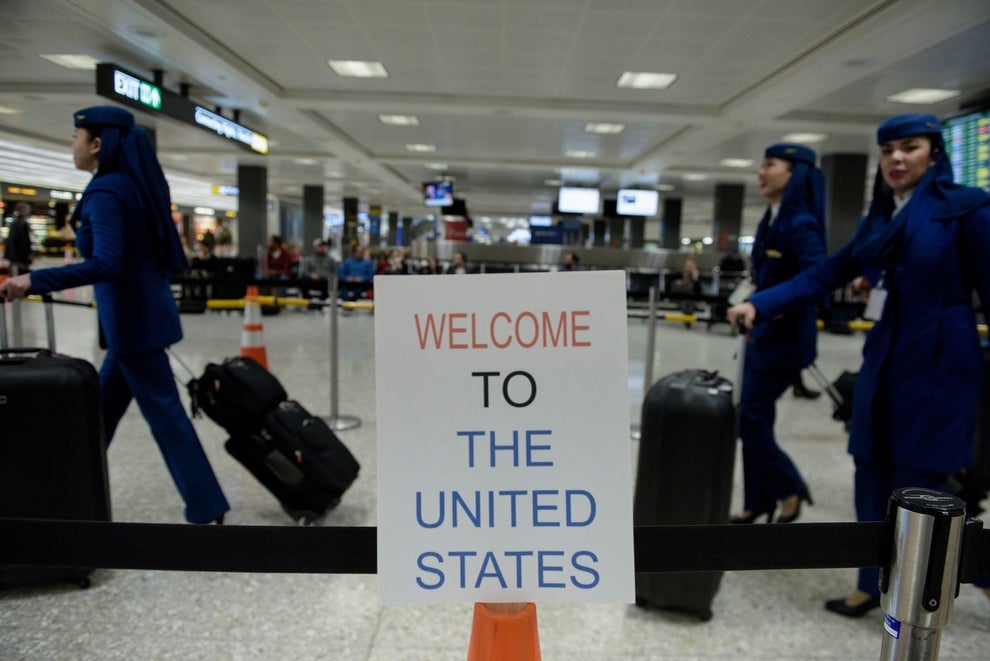
Brendan Smialowski / AFP / Getty Images
The US is barring passengers from bringing laptops, tablet computers, and other electronic devices as carry-on items on non-stop flights from 10 airports in the Middle East and North Africa.
The ban was revealed Monday after two Middle Eastern airlines began telling passengers about the new restrictions. A representative of Saudi Arabian Airlines, based at JFK International Airport in New York, told BuzzFeed News that the ban begins immediately, and covers all electronic devices, excluding cell phones. The airline said the ban applies on flights headed to the US.
The representative declined to answer further questions and said inquiries should be directed to the Transportation Security Administration.
The ban will hit every major air travel hub in the Middle East, including the home airports of global airline industry giants like Emirates, Etihad, Qatar Airways and Turkish Airlines. A US official told the Associated Press that the ban covers all direct flights to to the US from Cairo, Egypt; Amman, Jordan; Kuwait City, Kuwait; Casablanca, Morocco; Doha, Qatar; Riyadh and Jeddah in Saudi Arabia; Istanbul, Turkey; and Abu Dhabi and Dubai in the United Arab Emirates.
All these countries are US allies, many of them crucial ones: Turkey is a NATO member, Egypt is the second-largest recipient of American military aid and Qatar hosts the forward operating headquarters of the US Central Command. Dubai’s airport is the world’s busiest for international passenger traffic, while Abu Dhabi’s is so trusted that US customs and immigration checks are conducted there.
Details of the ban will be announced on Tuesday, NBC News reported, saying such changes to security rules “are made periodically in response to threat intelligence, and laptop computers have long been the source of concern.”
The devices banned from the cabin will need to be packed in checked baggage. Former officials said the use of certain electronic devices in the flight cabin has presented a longstanding threat, but some questioned why action is being taken now.
“If this is true, the threat of attempts to disguise explosives within laptops and other large electronic devices carried through the last point of departure airports bound for the United States is not new. What appears to be new is this latest overreaction,” a former administration official familiar with aviation security procedures told BuzzFeed News. “It appears to be a Muslim ban by a thousand cuts.”
For as many as two years, US officials have trained airport security personnel across the Middle East on how to search for explosives, the former official said.
“It’s an unnecessary piece of overreach that is a kind of punishment meted out to a group rather than a targeted application of reasonable security measures,” the person said.
The TSA referred inquiries on the matter to the Department of Homeland Security. A Homeland Security spokesperson told BuzzFeed News: “We have no comment on potential security precautions, but will provide an update when appropriate.”
A Republican aide to the House Homeland Security committee confirmed to BuzzFeed News that Chairman Michael McCaul and committee members had been briefed on the issue, but could not provide additional details.
Adam Comis, a spokesperson for Democrats on the committee, said ranking member Bennie Thompson had been briefed but Comis said he could not provide more details about the ban either.
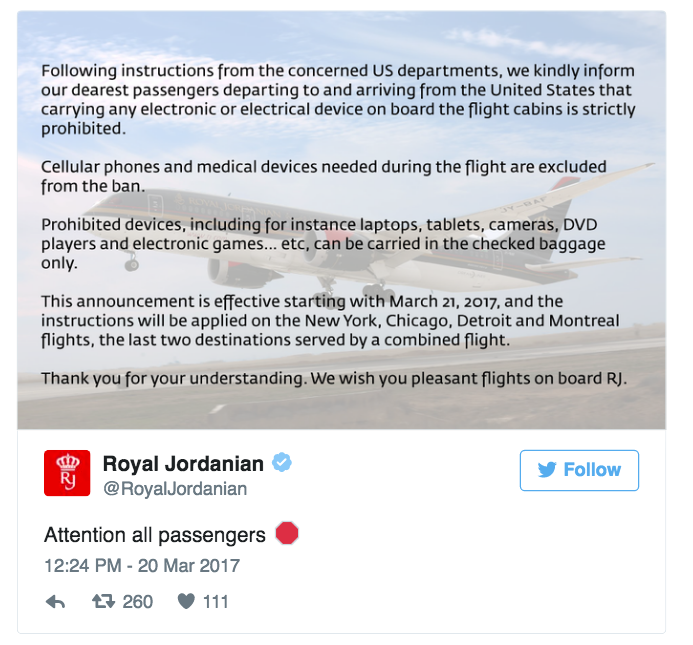
Royal Jordanian Airlines informed passengers of a ban coming into effect on Tuesday. “Following instructions from the concerned US departments,” it said in a tweet, all electronics are banned on US-bound flights, with an exception for cell phones and medical devices.
That tweet has since been deleted. In a response to inquiries from BuzzFeed News, a representative said “further updates will be announced soon.”
Here’s the original, deleted Royal Jordanian tweet.
As of Monday night, not all members of the Homeland Security committee had been briefed on the security changes.
“I have not been briefed yet, but it’s a conversation that’s happening,” one member told BuzzFeed News. The committee will be briefed on Wednesday, the person said.
JFK-based representatives of Dubai’s Emirates Airline and Doha-based Qatar Airways said they had not heard of any changes. BuzzFeed News has reached out to other Middle Eastern and African airlines, and will update this article when responses are received.
BuzzFeed News reporters Emma Loop, Lissandra Villa and Nancy Youssef contributed to this report from Washington, DC.
FBI Director Comey confirms probe of possible coordination between Kremlin and Trump campaign
FBI Director James B. Comey acknowledged Monday that his agency is conducting an investigation into possible coordination between the Kremlin and the Trump campaign in a counterintelligence probe that could reach all the way to the White House and may last for months.
The extraordinary disclosure came near the beginning of a sprawling, 5½ -hour public hearing before the House Intelligence Committee in which Comey also said there is “no information” that supports President Trump’s claims that his predecessor ordered surveillance of Trump Tower during the election campaign.
Comey repeatedly refused to answer whether specific individuals close to the president had fallen under suspicion of criminal wrongdoing, “so we don’t wind up smearing people” who may not be charged with a crime.
The FBI traditionally does not disclose the existence of an investigation, “but in unusual circumstances, where it is in the public interest,” Comey said, “it may be appropriate to do so.”
Comey also said he was authorized by the Justice Department to confirm the existence of the wide-ranging probe into Russian interference in the electoral process. He drew fire last year after he notified Congress 11 days before the presidential election — and against the department’s strong advice not to — that the FBI had reopened an examination of Hillary Clinton’s use of a private email server.
That move, Democrats charged, hurt Clinton as she was heading into the home stretch of her campaign. Now, the tables are turned.
Rep. Devin Nunes (R-Calif.), the committee chairman, urged Comey to reveal if and when the bureau has information clearing any of its targets, and to do so as quickly as possible.
“There’s a big gray cloud that you’ve now put over people who have very important work to do to lead this country, and so the faster that you can get to the bottom of this, it’s going to be better for all Americans,” Nunes said.
Comey said that the investigation began in late July and that for a counterintelligence probe, “that’s a fairly short period of time.”
The hearing came amid the controversy fired up by Trump more than two weeks ago when he tweeted, without providing evidence, that President Barack Obama had ordered his phones tapped at Trump Tower.
“I have no information that supports those tweets,’’ Comey said. “We have looked carefully inside the FBI,’’ and agents found nothing to support those claims.
He added that the Justice Department had asked him to tell the committee that the agency has no such information, either.
Under questioning from the top Democrat on the panel, Rep. Adam B. Schiff (Calif.), Comey said no president could order such surveillance.
Remarkably, Trump’s presidential Twitter account continued to fire away throughout the widely watched hearing, live-tweeting comments and assertions that lawmakers then referred to and used to question Comey and National Security Agency Director Michael S. Rogers.
[Full transcript: FBI Director James Comey testifies on Russian interference in 2016 election]
Comey and Rogers both predicted that Russian intelligence agencies will continue to seek to meddle in U.S. political campaigns, because they consider their work in the 2016 presidential race to have been successful.
In an influence campaign that the U.S. intelligence community in January said was ordered by Russian President Vladimir Putin, hackers working for Russian spy agencies penetrated the computers of the Democratic National Committee in 2015 and 2016, as well as the email accounts of Democratic officials. The material was relayed to WikiLeaks, the intelligence community reported, and the anti-secrecy group launched a series of damaging email releases that began just before the Democratic National Convention last summer and continued through the fall. The Russians’ goal was not only to undermine the legitimacy of the election process but also to harm Clinton’s campaign and boost Trump’s chances of winning, the intelligence community concluded.
“They’ll be back in 2020. They may be back in 2018,” Comey said. “One of the lessons they may draw from this is that they were successful, introducing chaos and discord” into the electoral process.
Rogers agreed: “I fully expect they will maintain this level of activity.” And, he said, Moscow is conducting a similar “active measures” campaign in Europe, where France and Germany are holding elections this year.
The panel’s Democrats focused on possible contacts between Trump associates and Russian officials. Schiff outlined a series of events that took place last July and August that he said appear to be “pivotal” to the question of whether there was improper contact.
He ticked off a list of more than a dozen incidents, including former Trump campaign adviser Carter Page’s trip to Moscow and alleged meeting with Igor Sechin, a Putin confidant and chief executive of the energy company Rosneft; and Trump political adviser Roger Stone’s boasts about his connections to WikiLeaks founder Julian Assange and Stone’s prediction that the emails of Clinton campaign adviser John Podesta would be published.
“Is it possible that all of these events and reports are completely unrelated and nothing more than an entirely unhappy coincidence? Yes, it is possible,” Schiff said. “But it is also possible, may be more than possible, that they are not coincidental, not disconnected and not unrelated. . . . We simply don’t know, not yet, and we owe it to the country to find out.”
At the White House, press secretary Sean Spicer stressed that an investigation into possible collusion between Russian officials and Trump associates doesn’t mean that there was any.
“Investigating it and having proof of it are two different things,” Spicer said. “I think it’s fine to look into it, but at the end of the day they’re going to come to the same conclusion that everybody else has had.” Said Spicer: “There’s no evidence of a Trump-Russian collusion.”
The committee Republicans, meanwhile, seemed most exercised by leaks to the media. Information shared with the press has resulted in stories since the election on the intelligence community’s conclusion about Moscow’s desire to see Trump win, and on contacts Trump administration officials or close associates had with Russian officials.
One story in particular that apparently upset the Republicans was a Feb. 9 piece by The Washington Post reporting that Trump’s then-national security adviser, Michael Flynn, discussed the subject of sanctions with the Russian ambassador, Sergey Kislyak, in the month before Trump took office. The Post reported that the discussions were observed under routine, court-approved monitoring of Kislyak’s calls. Flynn, who had denied to Vice President Pence that he had spoken about sanctions, was forced to resign.
Rep. Trey Gowdy (R-S.C.) suggested that the leaks were political. He asked Comey whether the intelligence community had shared such information with Obama or his attorney general, Loretta E. Lynch.
Comey — who had acknowledged that in general, senior officials, including Lynch, would have access to such information — said he would not comment on his conversations with Obama or Trump.
As the hearing was going on, Trump’s presidential Twitter account — in an apparent dig at Comey and carrying the suggestion that Obama administration officials were behind the leaks — posted the tweet: “FBI Director Comey refuses to deny he briefed President Obama on calls made by Michael Flynn to Russia.”
[Comey: Please don’t draw conclusions from my no-comments. Trump: Nah, I’m good.]
At another point, the account tweeted out, “The NSA and FBI tell Congress that Russia did not influence electoral process.”
Rep. Jim Himes (D-Conn.), noting that the tweet had gone out to 16.1 million Americans, asked Comey, “Is that accurate?”
“We’ve offered no opinion . . . on potential impact because it’s not something we looked at,” Comey said.
Nunes sought an admission from the officials that the leaks were illegal under the Foreign Intelligence Surveillance Act, the law that governs foreign intelligence-gathering on U.S. soil or U.S. persons overseas.
“Yes,” Comey answered. “In addition to being a breach of our trust with the FISA court.”
Rep. Thomas J. Rooney (R-Fla.) pressed Rogers to clarify under what circumstances it would be legitimate for Americans caught on tape speaking with people under surveillance to have their identities disclosed publicly.
Rogers stressed that the identities of U.S. persons picked up through “incidental collection” — in which investigating agents hear the words of people conversing with the targets of a wiretap — are disclosed only on a “valid, need-to-know” basis, and usually only when there is criminal activity or a potential threat to the United States at play.
Comey confirmed that individuals within the NSA, the CIA, the FBI, the Justice Department and others — including personnel in the White House, in some situations — could have requested the unmasking of the names of U.S. persons. But he stressed that only the collecting agency, whether it’s the FBI, the NSA or the CIA, can unmask the identities of people.
Read more:
President Trump’s 9th grandchild is on the way
Chat with us in Facebook Messenger. Find out what’s happening in the world as it unfolds.
Six Highlights From the Gorsuch Confirmation Hearing
Log In
Don’t have an account? Sign up here »
FBI Director Comey: Justice Dept. has no information that supports Trump’s tweets alleging he was wiretapped by Obama
FBI Director James B. Comey acknowledged Monday that his agency is conducting an investigation into possible coordination between the Kremlin and the Trump campaign in a counterintelligence probe that could reach all the way to the White House and may last for months.
At the same time, Comey repeatedly refused to answer whether specific individuals close to the president had fallen under suspicion of any criminal wrongdoing, “so we don’t wind up smearing people” who may not be charged with a crime.
The extraordinary disclosure came near the beginning of a sprawling, 5 ½ -hour public hearing by the House Intelligence Committee, the panel’s first into the Russian government’s efforts to interfere in the 2016 election.
The FBI traditionally does not disclose the existence of an investigation, “but in unusual circumstances, where it is in the public interest,” Comey said, “it may be appropriate to do so.”
Comey also said he was authorized by the Justice Department to confirm the existence of the wide-ranging probe into Russian interference in the electoral process. He drew fire last year after he notified Congress 11 days before the presidential election — and against the department’s strong advice not to — that the FBI had reopened an examination of Hillary Clinton’s use of a private email server.
That move, Democrats charged, hurt Clinton as she was heading into the home stretch of her campaign for president. Now, the tables are turned.
Rep. Devin Nunes (R-Calif.), the committee chairman, urged Comey to reveal if and when the bureau has information clearing any of its targets, and to do so as quickly as possible.
“There’s a big gray cloud that you’ve now put over people who have very important work to do to lead this country, and so the faster that you can get to the bottom of this, it’s going to be better for all Americans,” he said.
The hearing came amid the controversy fired up by President Trump more than two weeks ago when he tweeted, without providing evidence, that President Barack Obama had ordered his phones tapped at Trump Tower.
Comey said there is “no information” that supports Trump’s claims that his predecessor ordered surveillance of Trump Tower during the election campaign
“I have no information that supports those tweets,’’ he said. “We have looked carefully inside the FBI,’’ and agents found nothing to support those claims.
Under questioning from the top Democrat on the panel, Rep. Adam Schiff (Calif.), Comey said no president could order such surveillance. He added that the Justice Department had asked him to also tell the committee that that agency has no such information, either.
Remarkably, Trump’s presidential account continued to fire away throughout the widely watched hearing, live-tweeting comments and assertions that lawmakers then referred to and used to question Comey and National Security Agency Director Michael S. Rogers.
[Full transcript: FBI Director James Comey testifies on Russian interference in 2016 election]
Comey and Rogers both predicted that Russian intelligence agencies will continue to seek to meddle with U.S. political campaigns, because they view their work in the 2016 presidential race as successful.
“They’ll be back in 2020. They may be back in 2018,’’ Comey said. “One of the lessons they may draw from this is that they were successful, introducing chaos and discord” into the electoral process.
“It’s possible they’re misreading that as ‘it worked,’ so we’ll come back and hit them again in 2020,” Comey added.
Rogers agreed: “I fully expect they will maintain this level of activity.” And, he said, Moscow is conducting a similar “active measures” campaign in Europe, where France and Germany are holding elections this year.
The panel’s Democrats focused on contacts between Trump associates and Russian officials, while the Republicans seemed most exercised by leaks to the media. Information shared with the press has resulted in a series of stories since the election about the intelligence community’s conclusion about Moscow’s desire to see Trump win and about contacts Trump administration officials or close associates had with Russian officials.
One story in particular that apparently upset the Republicans was a Feb. 9 piece by The Washington Post, reporting that Trump’s national security adviser, Michael Flynn, discussed the subject of sanctions with the Russian ambassador, Sergey Kislyak, in the month before Trump took office. The Post reported that the discussions were monitored under routine, court-approved monitoring of Kislyak’s calls. Flynn, who had denied to Vice President Pence that he had spoken about sanctions, was forced to resign.
Rep. Trey Gowdy (R-S.C.) suggested that the leaks were political. He asked Comey whether the intelligence community had shared such information with Obama or his attorney general, Loretta E. Lynch.
Comey — who had acknowledged that, in general, senior officials, including Lynch, would have access to such information — said he would not comment on his conversations with Obama or Trump.
As the hearing was going on — in an apparent dig at Comey and carrying the suggestion that Obama administration officials were behind the leaks — Trump’s presidential Twitter account tweeted out “FBI Director Comey refuses to deny he briefed President Obama on calls made by Michael Flynn to Russia.”
[Comey: Please don’t draw conclusions from my no-comments. Trump: Nah, I’m good.]
Just hours before the start of the hearing, Trump posted a series of tweets claiming Democrats “made up” the allegations of Russian contacts in an attempt to discredit the GOP during the presidential campaign. Trump also urged federal investigators to shift their focus to probe disclosures of classified material.
“The real story that Congress, the FBI and all others should be looking into is the leaking of Classified information,” Trump wrote early Monday. “Must find leaker now!”
Nunes sought an admission from the officials that the leaks were illegal under the Foreign Intelligence Surveillance Act, the law that governs foreign intelligence-gathering on U.S. soil or of U.S. persons overseas.
“Yes,” Comey answered. “In addition to being a breach of our trust with the FISA court.”
Rep. Tom Rooney (R-Fla.) pressed Rogers to clarify under what circumstances it would be legitimate for Americans caught on tape speaking with people under surveillance to have their identities disclosed publicly, and whether leaking those identities would “hurt or help” intelligence collection.
“Hurt,” Rogers noted.
Rogers stressed that the identities of U.S. persons picked up through “incidental collection” — that being the way intelligence officials picked up on Flynn’s phone calls with Kislyak — are disclosed only on a “valid, need-to-know” basis, and usually only when there is criminal activity or a potential threat to the United States at play.
Rogers added that he has delegated a total of 20 people in the NSA to make decisions about when someone’s identity can be unmasked.
Comey did confirm that the NSA, CIA, FBI, main Justice Department and others — including personnel in the White House in some situations — could have access to unmasked names of U.S. persons.
But he stressed that only the collecting agency can unmask the identities of people. Others with whom the information is shared “can ask the collectors to unmask,” he said — but can’t do it on their own.
GOP members fretted that the leaks to the media would complicate the effort by lawmakers to renew Section 702 of the Foreign Intelligence Surveillance Act, which allows the government to collect through U.S. companies general categories of foreign intelligence contained in phone calls, emails and other electronic communications when one end of the communication is overseas.
Comey rejected the suggestion.
“This conversation has nothing to do with 702,” he protested, adding: “702 is about targeting non-U.S. persons overseas. The FBI can apply to collect electronic surveillance in the United States [on individual targets], but it’s a different thing from 702.”
[Intelligence chairman: No evidence for Trump’s claim of wiretapping]
Comey declined to say whether any officials had sought approval from the Foreign Intelligence Surveillance Court to monitor anyone in the Trump campaign, saying he did not want to discuss the workings of the highly secretive court. Individuals familiar with the investigation, who spoke on condition of anonymity to discuss a sensitive matter, have said there was no such request made during the campaign.
The FBI probe combines an investigation into hacking operations by Russian spy agencies with efforts to understand how the Kremlin sought to manipulate public opinion and influence the election’s outcome
In January, the intelligence community released a report concluding that Russian President Vladimir Putin wanted to not only undermine the legitimacy of the election process but also harm the campaign of Hillary Clinton and boost Trump’s chances of winning.
Hackers working for Russian spy agencies penetrated the computers of the Democratic National Committee in 2015 and 2016 as well as the email accounts of Democratic officials, intelligence official said in the report. The material was relayed to WikiLeaks, the officials said, and the anti-secrecy group began a series of damaging email releases just before the Democratic National Convention that continued through the fall.
Read more:
The web of relationships between Team Trump and Russia
James B. Comey complicated the life of every Republican elected official today