Archives par mot-clé : video

When the going got tough, Nintendo and Microsoft decided to go for broke on video-game strategy – Tribune

Updated 3 hours ago

LOS ANGELES — Nintendo was hemmed in on both sides and in deep trouble.

The company’s Wii U video-game console, an effort to add a small, semiportable screen to the hit motion-sensing Wii, was a flop. And Nintendo’s handheld consoles, descendants of the legendary Game Boy, were suffering as people opted to play games on smartphones instead.

This was in 2014, the year the Japanese gaming giant recorded its third consecutive annual loss, a setback that followed decades of profitability. Critics called for the company to reboot its hardware, or perhaps reduce the emphasis on its own devices by bringing beloved characters like “Super Mario” or “Zelda” to smartphones.

“You gotta either go back and do something that’s more (traditional) consolelike, or go forward and do something that’s all motion, like the Wii,” said Phil Spencer, the head of Microsoft’s Xbox gaming business, describing the prevailing industry opinion at the time.

“And they didn’t.”

Instead, Nintendo doubled down on its effort to build a console that combines mobile and living-room gaming, developing the Nintendo Switch.

So far, it has been a wild success. Nintendo has struggled to make enough devices to satisfy demand since its launch in March, and at the E3 trade show here earlier this month, Nintendo had a bit of its swagger back.

Spencer’s Microsoft is trying to pull off a similar rebound. His team is going back to the roots of the Xbox business: pushing the boundaries of the power you can pack into a gaming machine.

The company’s Xbox One X, unveiled at E3, is — as Microsoft’s marketing mantra repeated constantly — the most powerful console ever made, aimed at hard-core gamers who want every bit of graphical realism they can get.

Microsoft and Nintendo had taken a similar path: Facing speculation that they would have to reboot or rethink their video-game businesses to respond to rival Sony’s dominance, they instead doubled down on what makes their devices stand out.

Living-room battlefield

The competition to sell living-room video-game consoles is among the oldest battlefields in video gaming, dating to the emergence in the 1980s of Atari and Nintendo devices that plugged into television sets.

This market has seen competitors come and go, but a pattern has remained remarkably steady. New devices tend to come out in waves every few years, “generations” in industry-speak, adding each company’s take on the latest technological advances.

When Sega dropped out of the market in 2001, the contest winnowed to three primary entrants: Sony, Microsoft and Nintendo.

The current generation began in 2012, with Nintendo’s Wii U. Sony’s PlayStation 4 and Microsoft’s Xbox One followed a year later.

Sony, with a hardware package that was easy to use for both game developers and consumers, and a laser focus on drawing the best games, quickly took a wide lead.

In Tokyo and the Seattle area, Nintendo and Microsoft plotted their response. Microsoft’s campus in the Seattle-area city of Redmond is adjacent to Nintendo of America, the Japanese company’s subsidiary for the Western Hemisphere. Nintendo, which set up shop in Redmond a year before Microsoft came to town in 1986, sold Microsoft some of the land that became its campus during one of the company’s growth spurts.

Cultural divide

Far more ground separates the two corporate cultures.

Microsoft, which helped put a computer on every desk with Windows and today runs a sprawling business-software empire, got into gaming at first through experiments in entertainment CD-ROMs. Dabbling in encyclopedias turned into computer games that pushed the boundaries of PC hardware and highlighted the power of Windows.

The company’s dive into consoles began when some leaders in the Windows unit worried that Sony’s popular PlayStation would conquer the living room and shut Microsoft out.

The Xbox console was born in 2001, a brand Microsoft tried to associate with raw computing power and graphical fidelity.

Since then, Xbox — which is far more popular in the United States than abroad — has also been closely tied to hard-core gamers. Microsoft’s most popular franchises, “Halo” and “Gears of War,” are both “shooters,” the top U.S. console-game genre.

Nintendo strikes a more lighthearted tone, one explicitly aimed at appealing to a broad range of people — “from 5 to 95,” as Nintendo of America chief Reggie Fils-Aime says.

The 127-year-old company got its start making playing cards, and eventually wound up in the business of building arcade games. Nintendo’s later living-room consoles, and visionary game designers, helped establish video gaming as a popular pastime.

Its more recent efforts haven’t fared so well. With the Wii U flagging, Nintendo accounted for about 5 percent of global console and console-game sales last year, researcher IDC estimates. But instead of dropping the concepts the device explored, Nintendo dug deeper.

In October, the company announced a new console that kept the Wii U’s portable small-screen concept, but rebuilt the device as a sleek, tablelike tool that could be plugged into a television dock for traditional play.

Nintendo’s internal game studios, in need of a hit to go with the new device, built one in “The Legend of Zelda: Breath of the Wild,” one of the best-reviewed games of all time.

Frustration at microsoft

Microsoft’s situation wasn’t so dire, but the company’s Xbox One, after marketing missteps that placed the focus on broader entertainment instead of games, was selling at just half the rate of Sony’s PlayStation 4.

The company stopped reporting sales of the console entirely, officially a move to emphasize use of the Xbox Live subscription gaming service, but to some a capitulation to Sony’s dominance.

Microsoft faced calls from outside observers to try to blow up the console market entirely and go with something different.

Spencer, the Xbox chief, had voiced frustration with the console model and its tendency to make old games outdated. That, along with a renewed Microsoft embrace of PC gaming, had many analysts speculating as they went into the E3 show that the company would opt for a device that blurred the line between Xbox and PC gaming, perhaps with a new operating system or closer ties to Windows.

But the company’s research showed that while the growth in console gamers globally had stagnated over the last decade, people still identified as either a PC or console gamer, and were unlikely to drop one device entirely.

Building a PC box risked ceding the console market – which researcher Newzoo pegs at $34 billion this year — to Sony.

Spencer gave the greenlight to develop the Xbox One X shortly after taking over the Microsoft gaming business in 2014.At the E3 show, he unveiled the console in front of a few thousand people in a basketball arena.

The reception was mixed. Observers praised the promised capabilities of the device.

But others thought that the demand for a $500 Xbox – $100 more expensive than Sony’s PlayStation 4 Pro – might not amount to much.

“They need to do something different if they want to make a meaningful run at Sony,” said Doug Creutz, who tracks video gaming at Cowen. “They need to shake things up.”

Spencer said the Xbox One X builds on work the company has already done, and that there’s plenty of room in the market for a focus on hard-core gamers. He points to the Xbox Elite controller, which at $150 cost about $90 more than Microsoft’s standard console controller.

“I had similar questions from people, ‘I don’t understand what this is for,’” he said. “And if you remember, we couldn’t make enough” to satisfy demand.

Spencer, who has been with Microsoft’s gaming unit since 2002, is also a big Nintendo fan.

The roster of Nintendo consoles he has owned goes back decades to the SNES Nintendo 64. (He even has some nice things to say about the Game Cube, the relatively unloved turn-of-the-millennium console).

What impresses him about the company, he said in an interview, is how it has stuck to its guns over the years, and learned as it went along.

“It’s not like everything they’ve done has been as successful as the Wii,” he said.

Spencer draws a line from the ultimately unsuccessful ideas in the Wii U to those that caught on with the Switch.

“Persistence is just so critical,” he said. “To learn, move forward, innovate again. That’s so important.”

He might as well have been talking about Xbox.

‘Morning Joe’ Hosts and Trump Bring National Enquirer Into Their Feud

Mr. Trump fired back on Twitter that it had been Mr. Scarborough who asked him to quash the story. “I said no!” the president wrote.

The bizarre back-and-forth, which has drawn blanket coverage on cable news, left Washington veterans stupefied. “I don’t remember anything quite like this,” said Vin Weber, a Republican lobbyist and former congressman from Minnesota.

But the episode also underscores several truths about a president who has yet to shed the habits of his pre-political life. After five months in office, Mr. Trump still kibitzes with television stars, keeps close tabs on his news coverage, and is unafraid to lash out in public against journalists he deems disloyal.

Advertisement

Continue reading the main story

In his years as a real estate developer and socialite, Mr. Trump leaned on gossip outlets to burnish his image — and place news items to harm his enemies. Mr. Scarborough’s account on Friday raised the question of whether Mr. Trump has brought those tactics into the West Wing, using The Enquirer and its wealthy publisher, the president’s close friend David Pecker, as a collaborator.

On the air Friday, Mr. Scarborough said that three White House aides had repeatedly “begged” him to apologize to Mr. Trump for his critical commentary, so that the president would stop the Enquirer story from running.

Allies of Mr. Trump, who has fumed over the often-scathing coverage of him on “Morning Joe,” rejected that interpretation of the exchanges, saying that no ultimatum was issued.

The exact nature of the discussions remained murky. But at one point, Mr. Scarborough contacted Jared Kushner, the president’s son-in-law and one of his top advisers, after learning that The Enquirer was pursuing a story about him and Ms. Brzezinski.

Mr. Kushner told the host that he needed to speak with Mr. Trump about his concerns, according to three people familiar with the conversation who requested anonymity to discuss a private conversation.

When Mr. Scarborough, who has taken to questioning Mr. Trump’s mental fitness on-air, noted that he and the president were not on good terms, Mr. Kushner suggested an apology may be in order, the people said.

On Friday, Mr. Scarborough said that he had text messages and emails to back up his account, but he declined to release them, citing the privacy of his sources.

For its part, the Enquirer — which endorsed Mr. Trump for president and often runs stories favorable to him and critical of his opponents — said it wanted nothing to do with the fight. “We have no knowledge of any discussions between the White House and Joe and Mika about our story, and absolutely no involvement in those discussions,” its editor, Dylan Howard, wrote in a statement.

Newsletter Sign Up

Continue reading the main story

The story in question was published in early June, under the headline “Joe Mika: TV Couple’s Sleazy Cheating Scandal.’’ Ms. Brzezinski said in a phone interview that she was rattled when her children and friends received calls from Enquirer reporters before it ran. But she added, “We never once considered calling Donald, let’s just put it that way.”

Advertisement

Continue reading the main story

The Enquirer incident came to light as the “Morning Joe” stars reacted to a furor that broke out on Thursday, when Mr. Trump tweeted that Mr. Scarborough was a “psycho” and claimed he had once seen Ms. Brzezinski “bleeding badly from a face-lift.”

His comments were met with a bipartisan backlash, including from Republican lawmakers crucial to his legislative agenda, and revived a broader discussion of the president’s habit of making insulting remarks about women’s appearances.

Ms. Brzezinski and Mr. Scarborough were once friendly with Mr. Trump, visiting him and his family at his Florida estate. But they are now blistering critics, a reversal that Mr. Trump took as an insulting and personal betrayal.

The controversy spilled into Friday, overshadowing the White House’s plans. The hosts wrote an op-ed in The Washington Post. A meeting between the president and his South Korean counterpart, Moon Jae-in, a sober discussion about North Korean aggression, shared coverage on cable news with segments about the Enquirer’s disreputable past and onscreen graphics including “TV Hosts: White House Used Tabloid Story to Threaten Us.”

By nightfall, CNN — which has engaged in its own war of words with Mr. Trump this year — was airing a discussion of whether the White House had veered into the realm of extortion.

Mr. Pecker, The Enquirer’s publisher, was the subject of a recent profile in The New Yorker examining his decades-long friendship with Mr. Trump, which included allegations that he had quashed stories critical of Mr. Trump during the presidential race. (Mr. Pecker denied this.) The Enquirer endorsed Mr. Trump last year and ran questionable articles about his Republican opponents, including a piece that falsely linked Senator Ted Cruz’s father to the Kennedy assassination.

Dick Morris, a former political consultant who now writes for The Enquirer, said in an interview that the criticism of the president on “Morning Joe”’ was a sign of “the media itself becoming Donald Trump’s political opponent.”

“He’s no longer opposing the Democratic Party,” Mr. Morris said. “He’s opposing the media.”

Advertisement

Continue reading the main story

Presidents before Mr. Trump often griped about their coverage, but took a more hands-off approach in responding to journalists. Barack Obama prided himself on ignoring cable news, and George W. Bush preferred his television tuned to ESPN, said Alex Conant, a former spokesman for Mr. Bush.

“Trump is not the first politician to have a thin skin when it comes to bad media coverage,” said Mr. Conant, who led communications for Senator Marco Rubio’s presidential campaign. “It’s his reaction to it that’s so unusual, and counterproductive.”

The talk-show host Dick Cavett, reached by telephone on Friday, recalled his brush with a president’s ire. Richard Nixon was recorded in the Oval Office complaining about Mr. Cavett’s commentary, and asking his chief of staff, H. R. Haldeman, what to do.

“Is there any way we can screw him?” Mr. Nixon can be heard asking of Mr. Cavett.

So would Mr. Cavett offer any advice for Ms. Brzezinski and Mr. Scarborough?

“It’s a considerable honor,” he said, laughing. “I would say, sit back and enjoy it.”


Continue reading the main story

Glance: How states are handling voter information request

State-by-state responses to a request for detailed voter data from President Donald Trump’s Presidential Advisory Commission on Election Integrity, which is investigating whether there was voter fraud in last year’s election.

ALABAMA

Undecided

Secretary of State John Merrill said he has questions about security and other issues. He wants those answered before turning over any information. He declined to detail the other issues.

___

ALASKA

Partial

Division of Elections Director Josie Bahnke says she will respond to it as she would to any request for voter information. Some information, she said, can be provided, such as voter names, voting histories and party affiliations. But other information is considered confidential and would not be provided.

___

ARKANSAS

Undecided

Chris Powell, a spokesman from the secretary of state’s office, said the office had not yet received the letter and did not have a comment on the request.

___

CALIFORNIA

Deny

“California’s participation would only serve to legitimize the false and already debunked claims of massive voter fraud,” Secretary of State Alex Padilla, a Democrat, said in a statement.

___

COLORADO

Partial

Colorado Secretary of State Wayne Williams, a Republican, said he will provide some of the requested information. State law prohibits releasing Social Security numbers, driver’s license numbers or dates of birth.

___

CONNECTICUT

Partial

Connecticut’s secretary of state says her office plans to comply in part. Denise Merrill says in the spirit of transparency the state will share publicly available information. She says the state will ensure the privacy of voters is honored by withholding protected data.

___

DELAWARE

Undecided

The elections commissioner hasn’t received the letter, which may have gone to the secretary of state. The commissioner says state law would not allow release of birth dates or any part of Social Security numbers.

___

DISTRICT OF COLUMBIA

Deny

“The best thing I can do to instill confidence among DC residents in our elections is to protect their personally identifiable information from the Commission on Election Integrity. Its request for voter information, such as social security numbers, serves no legitimate purpose and only raises questions on its intent. I will join leaders of states around the country and work with our partners on the Council to protect our residents from this intrusion,” Democratic Mayor Muriel Bowser said in a statement.

___

FLORIDA

Undecided

When asked this morning, Gov. Rick Scott said he was unaware of the request. Sarah Revell, a spokeswoman for Secretary of State Ken Detzner, said the state was reviewing the request but did not provide any additional information.

___

GEORGIA

Partial

“The Georgia Secretary of State’s office will provide the publicly available voter list. As specified in Georgia law, the public list does not contain a registered voter’s driver’s license number, social security number, month and day of birth, site of voter registration, phone number or email address.”

___

HAWAII

Undecided

Hawaii hasn’t received the request, said Nedielyn Bueno, voter services section head.

___

IDAHO

Undecided

State Election Director Betsie Kimbrough said the office will fulfill the request if Secretary of State Lawerence Denney, a Republican, determines it complies with state public records law. The state allows handing over voter registration records that include voting history, but not Social Security numbers or dates of birth.

___

ILLINOIS

Undecided

Illinois State Board of Elections spokesman Ken Menzel said the office has not yet received the letter. Once it’s received, they will review the request and decide how to proceed. However, Menzel noted that Illinois” election code has provisions that limit which entities may receive voter information and what type of information can be released.

___

INDIANA

Partial

“Indiana law doesn’t permit the Secretary of State to provide the personal information requested by Secretary Kobach. Under Indiana public records laws, certain voter info is available to the public, the media and any other person who requested the information for non-commercial purposes. The information publicly available is name, address and congressional district assignment,” Indiana Secretary of State Connie Lawson said in a statement.

___

IOWA

Partial

Statement from Secretary of State Paul Pate: “My office received a letter from the Presidential Advisory Commission on Election Integrity late Wednesday and has not yet responded to it. There is a formal process for requesting a list of registered voters, as specified in Iowa Code. We will follow that process if a request is made that complies with Iowa law. The official list request form is available on the Iowa Secretary of State’s website, sos.iowa.gov. Some voter registration information is a matter of public record. However, providing personal voter information, such as Social Security numbers, is forbidden under Iowa Code. We will only share information that is publicly available and complies with Iowa Code. I am attending a national meeting of Secretaries of State next week, where the Commission’s letter will likely be discussed.”

___

KANSAS

Partial

Kansas Secretary of State Kris Kobach is vice chairman of the commission, but even his office does plan to provide the last four digits of Social Security numbers because that information is not available to the public under Kansas law, spokeswoman Samantha Poetter said. All information that is publicly available will be provided.

___

KENTUCKY

Deny

“As the commonwealth’s secretary of state and chief election official, I do not intend to release Kentuckians’ sensitive personal data to the federal government,” Kentucky Secretary of State Alison Lundergan Grimes said in a statement. “The president created his election commission based on the false notion that ‘voter fraud’ is a widespread issue. It is not.”

___

LOUISIANA

Undecided

“We have received the letter and are reviewing with staff and our attorneys to determine our response,” said Meg Casper Sunstrom, spokeswoman for Secretary of State Tom Schedler. “Our priority, as we’ve demonstrated in the past, will always be to protect voter’s protected, personal information. This includes Social Security numbers, mother’s maiden name and date of birth. As you know, voter lists are publicly available by law but only include limited information including name, address and voter history. Voter history is not how a voter cast their ballot; it’s whether they participated.” Sunstrom said Louisiana law prohibits the release of Social Security numbers.

___

MAINE

Undecided

Maine Secretary of State Matthew Dunlap said he is reviewing with the attorney general’s office whether to comply with the request.

___

MARYLAND

Undecided

Maryland State Elections Administrator Linda Lamone said she has asked the state attorney general’s office for an opinion on how the board should respond. She received the letter on Friday, after it was forwarded to her by the Maryland secretary of state’s office.

___

MASSACHUSETTS

Deny

A spokesman for Secretary of State William Galvin said the state’s voter registry is not a public record, and information in it will not be shared with the Presidential Advisory Commission on Election Integrity.

___

MICHIGAN

Undecided

A spokesman for Republican Secretary of State Ruth Johnson said the department had not yet received the request and would review it if it does. Fred Woodhams said voter lists are public record under state law, and the department has no authority to deny voter data. It is common for political parties and candidates to obtain voter information, he said. “The department will provide voter information consistent with state law but will not provide info protected by state law.” He noted that voter info is readily available in many states for a nominal fee.

___

MINNESOTA

Deny

Minnesota Secretary of State Steve Simon, a Democrat, announced Friday he would not share the data with Trump’s commission.

___

MISSISSIPPI

Deny

Mississippi Secretary of State Delbert Hosemann, a Republican, said in a statement Friday that he had not received the request for information from the Trump commission, but another secretary of state had forwarded the correspondence to him. In a federal court case after a contentious U.S. Senate primary in Mississippi in 2014, a group called True the Vote sued Mississippi seeking similar information about voters, and Hosemann fought that request and won. Hosemann said if he receives a request from the Trump commission, “My reply would be: They can go jump in the Gulf of Mexico, and Mississippi is a great state to launch from.” Hosemann also said: “Mississippi residents should celebrate Independence Day and our state’s right to protect the privacy of our citizens by conducting our own electoral processes.”

___

MISSOURI

Partial

In Missouri, Republican Secretary of State Jay Ashcroft said he is happy to “offer our support in the collective effort to enhance the American people’s confidence in the integrity of the system.” On Friday, Ashcroft spokeswoman Maura Browning said the state is providing only publicly available information. She said that means no Social Security numbers, no political affiliations and no details on how people voted.

___

NEBRASKA

Undecided

A spokeswoman for the secretary of state said it’s not clear whether the request has been received.

___

NEVADA

Partial

Secretary of State Barbara Cegavske says her office will provide public information only, but not Social Security numbers or how people voted. The state will turn over voter names, addresses, telephone numbers, dates of birth, party affiliation and turnout.

___

NEW HAMPSHIRE

Partial

New Hampshire Secretary of State Bill Gardner, a member of the Trump commission, said his office will provide public information: names, addresses, party affiliations and voting history dating to 2006. Voting history includes whether someone voted in a general election and which party’s primary they voted in.

___

NEW JERSEY

Undecided

No response from spokeswoman for the Division of Elections.

___

NEW MEXICO

Deny

Democratic Secretary of State Maggie Toulouse-Oliver says she will never release personally identifiable information for New Mexico voters that is protected by law, including Social Security numbers and dates of birth. She also declined to provide information such as names and voting histories unless she is convinced the information is secured and will not be used for “nefarious or unlawful purposes.”

___

NEW YORK

Deny

Democratic Gov. Andrew Cuomo announced Friday his decision not to comply with the commission’s request for information. He said state laws include safeguards to protect sensitive voting information and that the state “refuses to perpetuate the myth voter fraud played a role in our election.”

___

NORTH CAROLINA

Partial

North Carolina’s elections board will provide voter data requested this week by President Donald Trump’s commission investigating alleged voter fraud. But the records will not include personal information deemed confidential in state law, including dates of birth and Social Security numbers.

___

NORTH DAKOTA

Partial

North Dakota, the only state that does not have voter registration, does require identification at the polls and does have a central database of voters, compiled with the help of state Transportation Department records and county auditors. However, the information can be used only for “election-related purposes” under state law, such as compiling poll books for elections. “We certainly can’t comply with that part of the request, but we are going to submit a response,” Deputy Secretary of State Jim Silrum said.

___

OHIO

Partial

Secretary of State Jon Husted, a Republican, issued a statement saying voter registration information is already public and available to the commission but that he will not provide the last four digits of voters’ Social Security numbers or their driver’s license numbers. He also said voter fraud is rare in the state and that bipartisan boards have conducted reviews of credible reports of voter fraud and suppression after the last three federal elections. Those results are in the public domain and available to the commission, he said. He added, “In responding to the commission, we will have ideas on how the federal government can better support states in running elections. However, we will make it clear that we do not want any federal intervention in our state’s right and responsibility to conduct elections.”

___

OKLAHOMA

Partial

A spokesman for the Oklahoma State Election Board said the state will not provide the last four digits of voters’ Social Security numbers. “That’s not publicly available under the laws of our state,” said Bryan Dean. He said the commission’s request will be treated like any other from the general public. The election board will tell the panel to fill out an online form asking for the information. Oklahoma’s voter roll is routinely provided to political campaigns, the press and other groups that ask for it.

___

OREGON

Partial

Secretary of State Dennis Richardson, a Republican, wrote a letter to the commission saying it could receive a statewide list of voters for $500, just like anyone else. However, he noted that he is barred legally from disclosing Social Security and driver’s license numbers. Two members of Oregon’s congressional delegation and Gov. Kate Brown, a Democrat, had urged Richardson to refuse the request. Richardson said in the letter that there is “very little evidence” of voter fraud or registration fraud in Oregon.

__

PENNSYLVANIA

Partial

Gov. Tom Wolf, a Democrat, wrote a letter saying the state will not cooperate, but said the state will sell the commission the same data the public can purchase. It cannot be posted online, however.

___

RHODE ISLAND

Partial

Rhode Island Secretary of State Nellie Gorbea says she won’t share some of the requested voter information, including Social Security numbers or information regarding felony or military status.

___

SOUTH CAROLINA

Undecided

The AP was unable to reach anyone from the Secretary of State’s office on Friday.

___

SOUTH DAKOTA

Deny

A spokesman for South Dakota Secretary of State Shantel Krebs says the state will not share voter information with the Trump commission.

___

TENNESSEE

Deny

“Although I appreciate the commission’s mission to address election-related issues like voter fraud, Tennessee state law does not allow my office to release the voter information requested to the federal commission,” said Tennessee Secretary of State Tre Hargett, a Republican.

___

TEXAS

Partial

Texas Secretary of State Rolando Pablos said Friday he will provide the commission public information and “protect the private information of Texas citizens.” Much of the information requested — including names, addresses, date of birth and party data — are already publicly available in Texas. Social Security numbers cannot be released under Texas law. Publicly available voter registration lists in Texas also do not include information about military status or criminal history.

___

UTAH

Partial

Republican Lt. Gov. Spencer Cox says he will send information classified as public, but Social Security numbers and dates of birth are protected.

___

VERMONT

Partial

Vermont’s top election official, Democrat Jim Condos, said Friday he is bound by law to provide the publicly available voter file, but that does not include Social Security numbers or birth dates. Condos said he must first receive an affidavit signed by the commission chairman, as required by Vermont law. He said there is no evidence of the kind of fraud alleged by Trump. “I believe these unproven claims are an effort to set the stage to weaken our democratic process through a systematic national effort of voter suppression and intimidation,” he said.

___

VIRGINIA

Deny

“At best this commission was set up as a pretext to validate Donald Trump’s alternative election facts, and at worst is a tool to commit large-scale voter suppression,” said Gov. Terry McAuliffe, a Democrat.

___

WASHINGTON

Partial

Secretary of State Kim Wyman, a Republican, says her office will send the commission names, addresses and birth dates of registered voters because they are public record. She will not send Social Security numbers, driver’s license numbers or other information.

___

WEST VIRGINIA

Undecided

Secretary of State Mac Warner, a Republican, said in a statement that his office would review the request but is limited by state law in what it can provide.

___

WISCONSIN

Partial

Administrator Mike Haas issued a statement Friday saying most of the information in the state’s voter registration system is public, including voters’ names, addresses and voting history. The state does not collect any data about a voter’s political preference or gender, he said.

He said the state routinely sells the information to political parties, candidates and researchers. It would charge the presidential commission $12,500 for the data, the maximum amount allowed under agency rules, Haas said. State law doesn’t contain any provisions for waiving the fee, he said.

Wisconsin law allows the commission to share voter birth dates, driver’s license numbers and Social Security numbers only with police and other state agencies, and the presidential commission doesn’t appear to qualify, Haas said.

___

WYOMING

Undecided

Officials did not respond Friday to multiple requests from the AP.

Copyright 2017 The Associated Press. All rights reserved. This material may not be published, broadcast, rewritten or redistributed.

Doctor Opens Fire at Bronx Hospital, Killing 1 and Wounding 6

A disgruntled doctor armed with an AR-15 rifle and wearing a lab coat went on a rampage on Friday in the Bronx hospital where he had worked, killing a female doctor and wounding six other people — five of them seriously — before setting himself on fire and shooting himself in the head, the authorities said.

The furious attack by the doctor — identified by the police as Henry Bello, 45 — sent workers at the hospital, Bronx-Lebanon Hospital Center, diving behind desks and doors as gunshots and smoke filled the hallways of a place devoted to healing. Witnesses described medical workers’ ripping a fire hose from the wall to use as a tourniquet on one victim’s leg, while others recalled the horrific sight of the gunman, his torso aflame, running down a hallway.

Dr. Bello had a troubled past, having worked at the hospital for about six months before quitting after being accused of sexual harassment, officials said. And years earlier, he was arrested and charged with sexual abuse after assaulting a woman in Manhattan.

The attack appeared to be the type of mass shooting by a lone gunman that has struck communities around the United States.

Photo

Henry Bello

“He’s shooting! He’s shooting!” one woman yelled in the frantic initial moments of the afternoon assault, as recounted by a mother in the pediatric emergency room who had cowered with her five children, ages 1 to 10.

Some believed that the death toll would have been far higher had the shooting occurred anywhere but where it did — a hospital filled with state-of-the-art medical equipment, and with doctors and nurses who rushed to victims and performed triage where they fell, in staircases and hallways, even as the gunman was still at large.

“The situation unfolded in the middle of a place that people associate with care and comfort,” Mayor Bill de Blasio told reporters outside the hospital, on the Grand Concourse in the Claremont Village neighborhood. The gunman acted alone, Mr. de Blasio said, adding that it appeared to be a workplace dispute that ended when the gunman committed suicide — “but not before having done horrible damage,” the mayor said.

The police did not identify the victim, other than as a woman and a doctor. The five seriously injured patients were “fighting for their lives,” said the police commissioner, James P. O’Neill. The sixth had a gunshot wound to the leg.


2,000 Feet

MOUNT HOPE

CROSS BRONX EXPWY.

MANHATTAN

95

Bronx-Lebanon

Hospital Center

E. 173RD ST.

Claremont

Park

Harlem

River

MOUNT EDEN

CLAREMONT

GRAND

CONCOURSE

BRONX

Site of

shooting

BRONX

QUEENS


By The New York Times

Dr. Bello was armed with a rifle, an AR-15, that investigators believe he sneaked into the hospital under his lab coat, police officials said.

While investigators were still trying to determine a motive, one official said, “Most likely it’s a workplace violence on the part of a former disgruntled employee.”

Dr. Bello was hired in August 2014, according to Errol C. Schneer, the hospital’s vice president, and left in February 2015, in lieu of being terminated. The police said he resigned after an accusation of workplace sexual harassment.

In 2004, Dr. Bello was arrested and charged with sex abuse and unlawful imprisonment after a 23-year-old woman told officers he had grabbed her crotch area outside a building on Bleecker Street in Manhattan and tried to penetrate her through her underwear, a law enforcement official said. The woman told officers that Dr. Bello had lifted her up in the air and dragged her while saying, “You’re coming with me.”

Photo

The police escorted people across the street outside the Bronx-Lebanon Hospital Center on Friday.

Credit
Mary Altaffer/Associated Press

Court records indicate that Dr. Bello pleaded guilty to unlawful imprisonment in the second degree, a misdemeanor, and was sentenced to community service. The felony sexual abuse charge was dismissed.

Mr. Schneer said on Friday night that the hospital did not know about Dr. Bello’s criminal past when he was hired. “At that time, and as a result of a human resources and security department background check, which includes fingerprinting, there was no record of any conviction for sexual abuse,” he said.

Dr. Bello was a graduate of Ross University School of Medicine on the Caribbean island of Dominica, a New York State official said.

The state’s Education Department said Dr. Bello had received a limited permit to practice as an international medical graduate in order to gain experience so that he could be licensed. The permit was issued on July 1, 2014, and expired on July 1, 2016. He also had an expired pharmacy technician license, issued in California in 2006.

Photo

In front of Bronx-Lebanon Hospital Center in New York after a shooting on Friday.

Credit
Jeenah Moon for The New York Times

The carnage took place around 2:50 p.m. Friday on the 16th and 17th floors of one of the Bronx’s largest hospitals, which has 1.1 million patient visits and over 140,000 emergency room visits a year, according to its website. Witnesses said that on Friday afternoon, Bronx-Lebanon’s rooms and corridors were filled with patients and visitors.

As the situation developed, emergency workers were at first prevented from entering the building. At least one of the wounded was being treated by people inside the hospital who had tied an emergency fire hose as a tourniquet, a Fire Department official said. At one point, the police escorted into the building a group of emergency workers wearing armor, as the gunman was still being sought.

Dr. Sridhar Chilimuri, the physician in chief at the hospital, said the doctor who was killed had been shot in the chest. Of the five victims in critical condition, one is a family services physician, three are medical students and one is a gastrointestinal specialist. Dr. Chilimuri said he had treated some of the victims, who were friends and colleagues. The situation was “extraordinarily difficult,” he said.

Norma Ruiz, a patient-care technician at Bronx-Lebanon, said the shooting took place on a floor where she works, and she recalled seeing a man, now believed to be the gunman, on fire. “He was running down the hall throwing himself on the floor,” she said. “We threw ourselves on the floor, and when everybody was quiet, my co-worker and me, we lift our heads, and the doctors’ station was on fire.”

Photo

Hospital staff stood outside the Bronx-Lebanon Hospital on Friday.

Credit
Timothy A. Clary/Agence France-Presse — Getty Images

“Everybody just started screaming,” said the mother in the pediatric unit, who asked that her name not be used to protect her children’s medical privacy. The hospital staff frantically tried to quiet everyone, she said, ordering people in the packed waiting room to lie on the floor while the lights were turned off.

The woman ran into an exam room with her children and shoved them underneath a hospital bed, while she lay on the floor as a barricade in front of them. When her 1-year-old began to cry, she breast fed him to keep him quiet, she said. “My heart was pounding,” she said. “I was shaking, just shaking.”

Miguel Mercado, 61, was lying in a hospital bed on the 10th floor, waiting for an M.R.I. after complications from back surgery earlier in June, when the police burst into the room and ordered patients who could walk to head down the stairs with their hands up. “The cops came and started emptying out the rooms floor by floor — ‘Everybody get out, get out, get out!’” he said about an hour after the shooting, standing in the parking lot outside the hospital, IV tubes dangling from his arm. On his feet he wore only hospital socks.

“It’s been happening almost anywhere, but nobody was waiting for this,” Mr. Mercado said, referring to the workplace shooting. “Who would have thought it would happen in a hospital?”

Shortly after the shooting, graphic images emerged online that purported to show the suspect lying on the hospital floor, in a button-down shirt worn under a lab coat, the scene covered in blood.

As patients and employees drifted from the hospital in the hours after the shooting, Ms. Ruiz, the patient-care technician, stood in her green scrubs, deeply shaken.

“I just want to get out of here,” she said, recalling the moment she heard the gunman. “We hear, ‘Boom, boom, boom.’ We thought, ‘A patient, a relative.’ But no, it came from the doctors’ station.”

Reporting was contributed by Hannah Alani, Al Baker, Nick Corasaniti, Annie Correal, David Gonzalez, Benjamin Mueller, William K. Rashbaum, Rick Rojas and Marc Santora. Susan C. Beachy contributed research.


Continue reading the main story

Why Angela Merkel, known for embracing liberal values, voted against same-sex marriage


Parliamentarians, including German Chancellor Angela Merkel, prepare to vote at the Bundestag on a new law to legalize same-sex marriage in Germany on Friday, in Berlin. (Sean Gallup/Getty Images)

Friday’s parliamentary vote in Berlin to recognize the right of same-sex couples to wed was a long-awaited victory for German liberals. But the vote was a defeat for the woman who seemed to have emerged as one of the country’s most popular icons of liberalism: German Chancellor Angela Merkel.

She welcomed over 1 million refugees, abandoned nuclear energy over safety fears and has urged President Trump to respect human rights.

On Friday, however, Merkel voted against same-sex marriage, despite having paved the way to its recognition only days earlier.

The anti-marriage-equality party line of Merkel’s Christian Democratic Union (CDU) had long prevented the law from being passed. But on Monday, the German chancellor cleared the way for the issue to win approval in the German Parliament by allowing lawmakers to choose according to their personal convictions after being pressured into a vote by the Social Democratic Party. “I would like to steer the discussion more toward the situation that it will be a question of conscience instead of me forcing something through by means of a majority vote,” Merkel said earlier this week.

What she did not say at the time was that she would oppose the law. Merkel’s Friday vote against marriage equality may have come as a surprise to international observers who consider her an increasingly influential liberal icon or even “leader of the free world.” At home in Germany, not everyone was equally surprised.

Her seemingly inconsequential vote encapsulates some of the opposing forces tugging at Merkel, said Robert Beachy, the author of “Gay Berlin: Birthplace of a Modern Identity.” She is at once an exponent of a liberal Western vision and the leader of a country, and party, tied to more conservative values.

“It occurs to me that Merkel is feeling increasingly exposed because she certainly wants to align herself with a progressive E.U. culture and tradition, and she’s in some ways the leader of that now,” Beachy said. “It made the absence of same-sex marriage in Germany that much more glaring.”

The daughter of a Protestant pastor, Merkel has long sided with the right of her party on the issue. In 2015, the chancellor said: “For me, personally, marriage is a man and a woman living together.” She repeated those comments almost word for word Friday. What has since changed, however, is Merkel’s stance on the right of same-sex couples to adopt children, which she now appears to be in favor of.

Her ambiguity on the issue fits a common pattern that has shaped much of her 12 years as German chancellor: Merkel hardly defines her role in an ideological sense. As chancellor, Merkel has repeatedly turned her back on herself and her own party when she deemed it necessary to adjust to the political winds.

On other subjects, her party and supporters have willingly followed suit. In contrast, same-sex marriage has proved to be a more difficult challenge for the chancellor, as many members of her party remain staunchly opposed to it even as most Germans support marriage equality.

German Chancellor Angela Merkel leads the weekly Cabinet meeting of her government at the chancellery in Berlin. (Markus Schreiber/AP)

Since 2001, Germany has allowed same-sex couples to register civil partnerships, which afford some but not all of the benefits accruing to married couples. Unlike in other Western European nations, such as France or Spain, same-sex marriage remained a red line for many Christian conservatives.

That red line would have been challenged sooner rather than later. All major parties Merkel’s CDU could form a coalition with after the general elections in September are in favor of same-sex marriage. From a tactical perspective, there was no way around marriage equality.

By allowing the law to pass before the elections despite opposing it, Merkel appealed to the majority of voters but might have avoided the anger of much of her party — following Merkel’s long-standing rationale of trying to make the least enemies whenever possible. “I hope that with today’s vote not only that mutual respect is there between the individual positions, but also that a piece of social peace and togetherness could be created,” Merkel said after the Friday vote.

She likely knew that her personal opposition would matter to her party but not make a difference overall, given that the German parliament voted 393-226 in favor of modifying the country’s civil code.

Isaac Stanley-Becker contributed from Berlin.

Read more:

Germany approves same-sex marriage, bringing it in line with much of Western Europe

‘Flat out gross and disgusting’: Cable TV erupts at Trump’s Mika Brzezinski tweets

Hours after President Trump posted a pair of ugly tweets attacking cable TV hosts Joe Scarborough and Mika Brzezinski, cable news talk shows across the political spectrum featured lengthy, often angry monologues accusing him of demeaning his office as well as women.

Conservatives Charles Krauthammer and Tucker Carlson criticized the tweets on Fox News, with Krauthammer saying “Presidents don’t talk like this.”

On CNN, Don Lemon and Anderson Cooper dedicated their opening remarks to what Lemon called Trump’s “flat out gross and disgusting” tweets.

And on a CNN panel Thursday night, USA Today columnist Kirsten Powers got into a lively debate over the definitions of “feminism” and “misogyny” with Trump surrogate Jeffrey Lord.

But even Lord, who usually defends anything and everything Trump does, said, “I don’t think he should have done it.”

Few were as impassioned as Nicolle Wallace, a former communications director for President George W. Bush. On her MSNBC show Thursday afternoon, Wallace delivered a scorched-earth monologue.

“As someone who once proudly called myself a Republican, the party will be permanently associated with misogyny if leaders don’t stand up and demand a retraction,” Wallace said, challenging women in the Trump administration to publicly denounce their boss’s words and “work behind the scenes to educate him about just how offensive they are.”

Wallace singled out Trump adviser Kellyanne Conway, Transportation Secretary Elaine Chao, deputy national security adviser Dina Powell and Education Secretary Betsy DeVos.

“Most importantly,” Wallace continued, “as the mother of a son, I ask any woman who’s defending these comments how they plan to raise good men if the most powerful man in the world gets away with this.”

Other conservative hosts shared in her exasperation.

At the beginning of an interview with Republican National Committee Chairwoman Ronna Romney McDaniel, Fox News anchor Julie Banderas said she would “love to start this segment out about health care, the travel ban” or the controversial off-camera White House press briefings, “but instead I have to start with the president’s tweets.”

McDaniel defended the president’s instinct to fight back against criticisms doled out by Scarborough and Brzezinski, but Banderas pushed back, saying Trump didn’t “need to stoop to that level.”

“I don’t care who you are. You don’t stoop to the level of that,” Banderas said. “I mean that’s like me scolding my 4-year-old for using a bad word and then me repeating it. That’s just not how you run a country or you parent a 4-year-old.”

Krauthammer, the dean of conservative newspaper columnists and frequent Trump critic, said during a panel with Fox News’s Bret Baier that Trump was behaving like authoritarian leaders.

“Presidents don’t talk like this. They never have,” Krauthammer said. “This is what it sounds like when you’re living in a banana republic. This is how Hugo Chávez would talk about his opponents. This is how the worst dictator, Duterte in the Philippines, would talk about opponents.”

Fox News contributor Mercedes Schlapp pushed back, saying she didn’t support the tweets but understood Trump’s desire to defend himself. She also took issue with Krauthammer’s comparison to dictators, saying Trump was not “sending military guards to go shut down” the press.

“When you defend the president of the United States by pointing out that he hasn’t sent the tanks out in the streets to shut down the media, you’ve reached a fairly low level of defense,” Krauthammer countered.

On various shows across networks, commentators noted that while President Barack Obama faced harsh and often unfair criticism, he didn’t launch personal attacks in response.

“People used to call him a Muslim. People used to call him underqualified, a sellout to America, a hater of Israel,” Banderas said on Fox News. “I mean they called him every name in the book, but you didn’t see him lash out.”

“CNN Tonight” host Don Lemon began his segment Thursday night by asking his producers to kill his intro music.

“I have to say something before we start,” he said. “I have heard and said the phrase ‘this is not normal’ so many times that I’m sick of hearing it and I’m sick of saying it.”

Lemon called Trump’s tweets “flat out gross and disgusting.”

“Saying it was juvenile would be insulting to children,” Lemon said. “If your children said or did what he tweeted, you would discipline them. Any employee would face some very serious consequences. And for anyone out there, any of you attempting to defend what he did, you’re an enabler.”

Lemon cut to a clip of Thursday’s White House press briefing with deputy press secretary Sarah Huckabee Sanders, who said that outrage over Trump’s retaliatory insults was hypocritical. She added that it was like “we’re living in the ‘Twilight Zone.’”

“Yes, it is like living in the ‘Twilight Zone,’” Lemon retorted. “The president should be ashamed of himself. But he’s not. He apparently thinks he is proving what a tough guy he is. But he’s actually embarrassing himself, his party and America.”

On the same network, CNN host Anderson Cooper, who has come under fire from some for using sharp language and at times crude references to critique the president, also referenced Huckabee Sanders’s “Twilight Zone” quote in his opening monologue.

“Somewhere in the ‘Twilight Zone,’ a teeny tiny violin is playing the world’s saddest song for the most powerful man on earth,” Cooper said. “Other than that, few are shedding any tears for the president’s plight.”

Cooper said Trump was “many things, but tough is not one of them.”

“Tough is fighting for the health care reforms that he actually campaigned on,” Cooper said. “Tough is rising above insults and actually leading. What our president does is not a display of toughness. It’s a display of weakness of character, of thinness of skin.”

He also took considerable time to point out apparent contradictions between the words and actions of the Trump family. Ivanka Trump, he said, had made elevating women a central tenet of her business and political platform, yet had said nothing to condemn her father’s remarks. Melania Trump promised to focus on cyberbullying as first lady, but Cooper pointed out, has yet to launch any such initiative.

Cooper opened his show by reading his audience a “passage from a book full of advice on how a president ought to behave.”

“‘The president of the United States is the most powerful person in the world. The president is the spokesman for democracy and liberty. Isn’t it time we brought back the pomp and circumstance and the sense of awe for that office that we all held?’”

“‘The writer went on to say, ‘That means everyone in the administration should look and act professionally, especially the president.’” Cooper read. “The writer concludes, ‘Impressions matter.’”

That quote was from a 2015 book called “Crippled America,” Cooper said. The author was Donald Trump.

“It’s easy at this point to just shrug and say, ‘This is what our president does, it’s who he is.’” Cooper said. “Maybe to some this even seems normal. But it’s not normal. This is the most powerful man on the face of the entire planet.”

Cooper’s frustration was amplified later during a panel debate on his show, when the anchor interrupted his guests to ask: “What about the friggin dignity of the presidential office?”

“George W. Bush insisted people wear a tie in the Oval Office and now that seems like a laughable notion,” Cooper continued. “Like, why should any kid look up to the president of the United States now?”

Lord, the Trump surrogate and a panelist, agreed, but took issue with the notion that the president’s bleeding facelift insult was sexist. Lord argued to fellow-panelists Powers and New York Times reporter Maggie Haberman that Trump doles out equally offensive attacks to his adversaries, regardless of their gender.

“I believe in equality of the sexes,” Lord said.

The panelists countered Lord’s argument, explaining that Trump has a history of disproportionately attacking women on their physical appearance. But Lord said he doesn’t see her “as a woman” but “as an equal, as a talk show host.”

“It has nothing to do with equality,” Powers said. “Equality would be not talking to the woman that way.”

And although grandstanding about misogyny was not an element of Tucker Carlson’s opening monologue Thursday night, the Fox News host did offer his own critique of the president’s ill-advised tweets after mocking what he characterized as a dramatic overreaction from liberals.

Carlson called them “stupid and counterproductive” with “no policy objective.” The tweet “brought joy to the left while embarrassing the president’s supporters.”

“That’s the real tragedy of today’s tweets,” Carlson said. “They were a diversion.”

More from Morning Mix

Why hundreds of New York Times employees staged a walkout

Vinyl records are so popular that Sony plans to make them again

Kendall and Kylie Jenner accused of cultural appropriation. This time by Notorious B.I.G.’s mom.

Now following: Mongabong

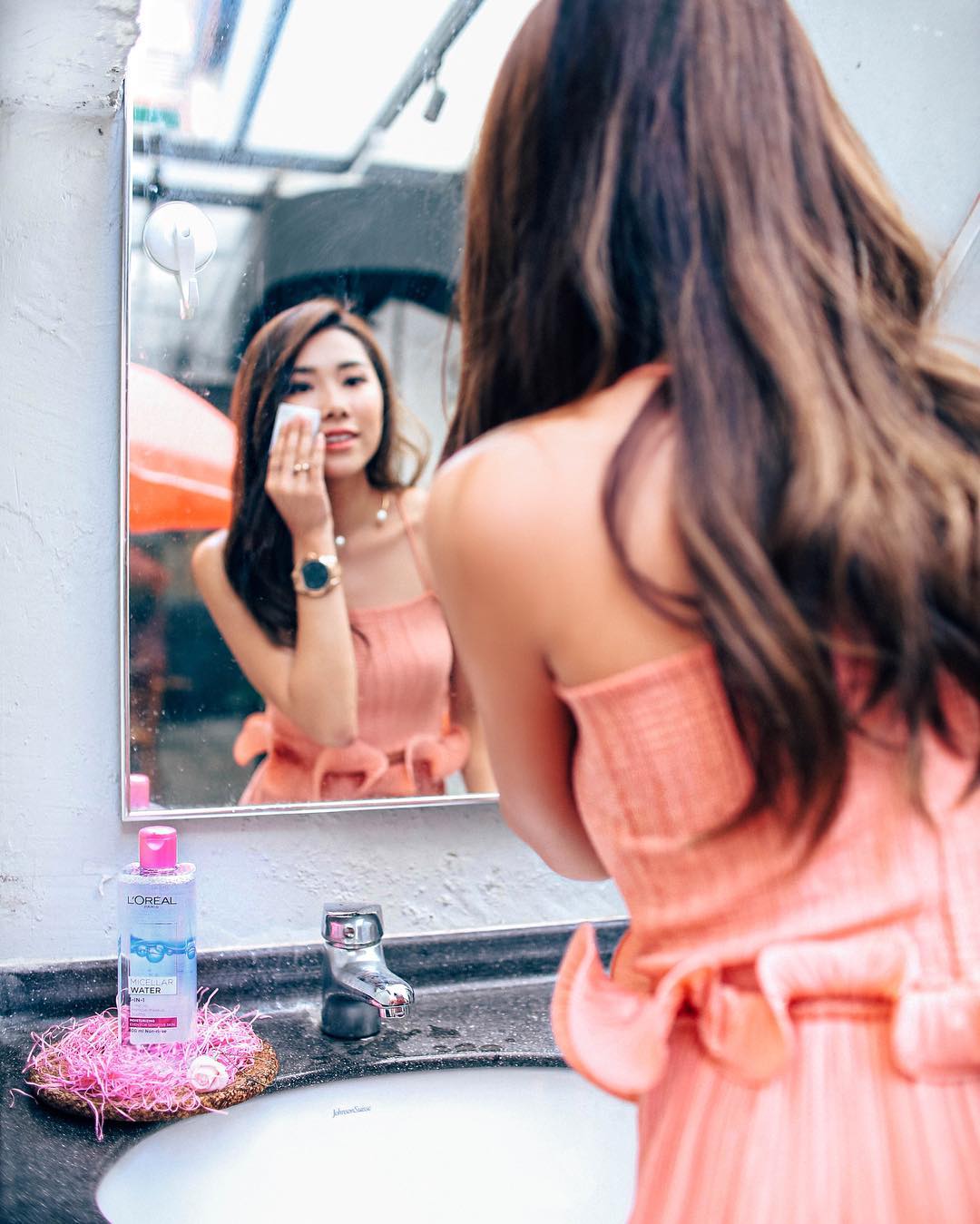
Starting out like many others in the blogshop modelling scene, Mongchin Yeoh made a name for herself in the social media scene. Possessing beauty and brains, the Singapore Management University Accountancy undergraduate carved a niche for herself through her love for fashion, beauty, food and travel.

In this edition of Now following, Yeoh sits down with Marketing to talk about her influencer journey so far. Some clients she has worked with include Clinique, L’Oreal, Dyson, Urban Revivo and Cebu Pacific Airways to name a few.

Mongabong (3)

Mongabong (1)

Mongabong (4)

Marketing: When and how did you start out as an influencer?

I started out when I was still in university, around 2012! I started by doing blogshop modelling first and was sharing about my life and recommendations with my friends, documented on my blog. I write about lifestyle, beauty and fashion. I don’t think I had a time or any particular event that shot me to fame, it happened very gradually.

Marketing: How would you describe your followers? What do you do to strike a connection with them?

They are mostly females aged 19-29, that are interested in beauty and fashion. I’ll reply to every comment and queries to the best of my ability!

Marketing: Which platform gives you the highest engagement with your readers?

Instagram.  This is especially with the Instagram Stories feature which allows me to connect with my readers on a more personal basis. Now with the added Instagram Live function, my readers are able to see the real me and get to speak with me at real-time. This makes it a lot more real and relatable, compared to a curated feed of photos.

Marketing: What are some of the challenges of being an influencer in Singapore?

The challenge lies in coming up with good and new content on a very frequent basis. I also have to pick up skills such as photography, videography and learn how to use the different types of photo and video editing softwares from scratch.

Marketing: Any funny or silly boo-boos you have made so far in your career?

I don’t see mistakes committed as silly. (Laughs) I tend to learn from them and move on! Every mistake is a precious lesson learnt.

Marketing: Any outrageous demands you have gotten from clients?

Some try to get work which is pretty, time-consuming and skills-heavy for free.

Marketing: What are some things you feel clients should take note of when it comes to working with influencers?

I feel some clients look solely at the influencer’s numbers and statistics without doing much homework, such as background checks about said influencer.

The hardest part about a campaign is finding the right fit. Everything has to match, from the influencer to the image of her brand, to the demographics of her followers and what are the platforms that would work best for the particular campaign, to name a few.

Sometimes when the campaign doesn’t produce results as per expected, clients immediately put the blame on influencers.

Some might even lose faith in social media marketing using influencers which I think can be a little unfair at times.

Marketing: How can marketers make the influencer-client relationship sweeter?

Be open in discussions with the influencer, and find out more about what the influencer thinks. Ultimately influencers should know their audience best. It would be great if the client allows space and flexibility for them to work their creativity.

Marketing: Who is an influencer you look up to? Any fellow local influencers you look up to?

Chriselle Lim, Jenn Im, Pony (make up), Notjessfashion. Locally, I look up to Dreachong and Xiaxue.

Mongabong (6)

Marketing: What are some of your views on the influencer landscape locally and globally?

I feel that the Singapore’s social media market is still pretty new and we have a lot of room to grow. I’m looking forward to see how much we can stretch this in 2017!

Marketing: What’s next for you?

My goal for myself in 2017 is to really put my time and energy into building my brand by improving my content. I also aim to be more consistent and also put out quality work on my platforms. This year, I’m starting to shift my focus on YouTube and I’m still in the process of learning about video editing along the way. So far my viewers have been nothing but really kind and patient with me and I’m very blessed!

As for the future, I try not to think too much about it and take each day as it comes. Of course I hope to establish enough experience and influence first before moving onto think about greater things.

Read also: 
Now following: Xiaxue
Now following: Youtiao666
Now following: Andrea Chong
Now following: Jemma Wei
Now following: Saffron Sharpe
Now following: Cheekiemonkies
Now following: The Chill Mom
Now following: Eunice Annabel

Soccer Team’s Animated Video Is Marketing Gold

Bias Alert: We nerd-heart the Premier League – England’s top-flight, globally watched professional football (soccer) league.

But even if we weren’t keen on the EPL or soccer, we’d still be telling our friends about the marketing genius Premier League club Southampton FC delivers in a two-part animated video that debuts the team’s 2017-18 kits.

Here’s the Reader Digest’s Version:

Four Southampton players race from their futuristic training facility to use their soccer-superhero powers to track down the evil villain who has stolen their team’s new uniform design. The villain is a disliked former manager, Ronald Koeman, who in real life left Southampton for a heftier payday at a bigger team (Everton).

In the end, the four Saints, as Southampton is nicknamed, defeat Koeman and his nefarious accomplices from rival soccer clubs. They then return to the Southampton facility where a geek-tastic computer hologram-thingy uploads the new uniforms on to them – thereby also introducing the jerseys, shorts and socks to fans who might like to purchase said items. There’s even a low-pressure call-to-action, “Pre-Order Now SouthamptonFC.com.”

To truly appreciate Southampton’s work, you have to watch the videos. It will only cost you about five minutes. Take the time – it’s entertaining and productive. Productive? Yep, because it could be a source of inspiration, or at least an edifying indication of how marketing is evolving – getting more creative and entertainment-driven to stand out in a media-saturated world and to compel buying action.

Watch the Videos

Episode 1

Episode 2

Watching the videos, we thought of something Brandon Brown, marketing director at Top 40 promo supplier SnugZ/USA (asi/88060), told us recently:

“Intrusive, interruptive, self-centered marketing no longer works the way it once did, and its effectiveness will only continue to diminish. What will replace the legacy model? There’s a one-word answer: Stories. Good content marketing moves the brand needle, increasing awareness, changing perception, and creating desire and drive to purchase.”

Indeed, Brandon. Indeed.

Internet Marketing Agency, fishbat, Discusses 5 Ways to Use Photo-Sharing Sites for B2B Products

PATCHOGUE, N.Y., June 30, 2017 /PRNewswire-iReach/ — fishbat, a leading internet marketing agency, which combines proven digital marketing strategies that include search engine optimization (SEO), digital ads, and social media optimization (SMO) to help businesses increase profits, discusses six ways to use photo-sharing sites for B2B products.

Overlooking the power of visuals in online B2B outreach is a misstep that can have a big impact on a business’ competitive edge in today’s digital marketplace. Photo-sharing sites and utilization of photos, videos, infographics, and other visual elements in social media outreach, help brands to showcase products in a way that creates connections, commands attention, and drives traffic through SEO boosts.

  1. Build targeted contacts Being targeted improves your conversion probability and increases your productivity. Building targeted contacts within photo-sharing sites helps to reach B2B decision makers, making social sharing efforts more productive. Build contacts through the industry, job titles, user interests, and other qualifiers, to increase product awareness with qualified buyers, drive up conversion, and increase social proof.
  2. Optimize for SEO Photo-sharing sites create SEO potential. Include inbound links, URLs, meta tags, descriptions, keywords, and other SEO driving tactics to maximize the power of visuals on photo-sharing sites. Employing SEO driving factors will increase traffic to your business site and product-postings through improved search engine rankings and increased online visibility.
  3. Include videos For products that are best seen in action, include videos on photo-sharing social media platforms. Videos command attention, communicate quickly and easily to the audience, drive traffic, and provide SEO juice. Demonstrating products in use via video adds validity to the products and generates interest from B2B decision makers. Videos are also more widely shared on social media than other forms of outreach, which will grow your social media visibility.
  4. Add licenses and a vanity URLs Adding licenses to photos for B2B outreach generates free marketing from interested B2B connections, as well as the general viewing audience. Licenses enable linking and social mentions from those who take an interest and utilize the photos in their outreach. Including vanity URLs also promotes increased social sharing by making the brand and products easier to remember, therefore easier to share. Vanity URLs increase click-through rates on search engines and can contain specific targeted keywords to elicit sharing from a qualified B2B audience. This increases brand recognition within the industry and with B2B decision makers.
  5. Real-time photo-sharing Photos and videos are the heroes of B2B product showcasing and promoting, but real-time sharing can take that to the next level. Real-time sharing creates urgency with the audience, drives SEO, and increases social sharing potential.

Digital marketing agency, fishbat is a full-service digital marketing firm that takes a holistic business approach to their clients’ digital marketing programs. The fishbat team understands the importance of business principles just as well as the nuances of the latest digital technologies. fishbat offers every digital marketing service available from digital marketing research and planning to brand development to website and asset creation through social media management and search engine optimization programs – all custom calibrated for both B2B and B2C businesses. 

Media Contact: Scott Darrohn, fishbat, 855-347-4228, [email protected]

News distributed by PR Newswire iReach: https://ireach.prnewswire.com


SOURCE fishbat