Archives par mot-clé : video

As Trump leaves for Europe, a question looms: Will he really commit to NATO once and for all?


NATO flags flutter during the final day of NATO Saber Strike exercises in Orzysz, Poland, on June 16. President  Trump is expected to make a speech in Warsaw’s Krasinski Square on Thursday, then head to Germany to attend the G-20 Summit on Friday and Saturday. (Ints Kalnins/Reuters)

President Trump’s second foreign trip kicks off today in Warsaw — the first leg of a trip that includes the G-20 Summit in Hamburg  and a stop in Paris for Bastille Day. The trip comes in the wake of the turmoil from the president’s European trip to the G-7 meeting in May, with the additional drama of the first Trump-Putin bilateral meeting.

But for  Trump and for the United States, the Warsaw stop will present a set of modern-day challenges with historical echoes. On the one hand, Trump probably will have his most favorable meetings in Poland. Warsaw’s right-wing government and anti-immigration stance, among other things, are more in line with his administration’s anti-internationalist stance.

On the other hand, Poland — like much of Europe — will also be looking for Trump to put European allies at ease, and make a strong U.S. commitment to NATO’s Article 5 treaty. Poland, along with the NATO member states bordering Russia, is fearful of Russia’s recent aggression spreading westward.

Poland and Estonia are two of only five NATO members that meet the target of spending 2 percent of gross domestic product  on defense, a commitment NATO members agreed to work toward after the 2014 Wales Summit. Three other nations in the region, Romania, Latvia and Lithuania, are set to join this list by next year.

Article 5 is the glue holding NATO together

What all of these countries want to hear is a firm statement on Article 5 of the NATO treaty — which simply stipulates that an attack on one alliance nation is an attack on them all. This is the core of the NATO alliance, and U.S. adherence to Article 5 dominates alliance members’ calculations, especially in Eastern Europe. Although Trump pledged U.S. adherence to Article 5 during a June news conference with the Romanian president, many in the alliance remain uncertain, given the president’s failure to make a public commitment during his speech to fellow NATO leaders in May.

Collective defense was the core of the NATO alliance’s formation and credibility in 1949, and it remains so. As a crucial first step in NATO’s creation — and a prerequisite as far as the United States was concerned — Britain, France, Belgium, the Netherlands and Luxembourg proved that they could come together for collective defense in the 1948 Brussels Treaty. To solidify a credible deterrent to the Soviet Union, the defense pact needed to expand to include the United States.

The biggest hurdle for the Truman administration at the time was overcoming a historical antipathy against alliances to create the first “entangling alliance” since the 1778 treaty with France. Realizing what was at stake in the growing Cold War, the administration worked across the political aisle to get key Republicans on board, most notably Sen. Arthur Vandenberg (R-Mich). In short, Vandenberg crafted the requisite legislation that would allow the United States to bind itself to the “progressive development of regional and other collective self-defense.”

As NATO historian Stanley R. Sloan points out, “Today, the collective defense commitment still endows the North Atlantic Treaty with special meaning. It is a potential deterrent against would-be enemies of the allies and a source of reassurance should future threats develop.”

Historically, Poland could use some reassurance

Poland hasn’t had the best of luck controlling its sovereignty over the past two centuries. It was partitioned between regional powers in the late 1700s and gained independence only in 1918. As we know from more recent history, that didn’t last long.

The Nazi-Soviet Non-Aggression Pact of August 1939 divided Poland between Hitler’s Germany and Stalin’s Soviet Union. On Sept. 1, 1939, the German invasion of Poland launched World War II. Berlin eventually reneged on the pact and invaded the Soviet Union in the summer of 1941. The Poles, especially Polish Jews, would suffer some of the worst atrocities of the war.

The Soviet Red Army’s liberation of Poland in 1945 and the conclusion of World War II didn’t give Warsaw much of a break. Stalin sought a sphere of influence in Eastern Europe to act as a buffer between himself and the West, the direction from which Russia’s adversaries had come twice in the past 30 years. Against American protests, the Soviets installed a Moscow-friendly communist government in Warsaw, ushering in close to 45 years of Soviet dominance. Warsaw would also become the namesake for the pro-Soviet alliance system — the Warsaw Pact — created in 1955 to become NATO’s counterfoil.

NATO’s front lines have shifted

During the Cold War, if a “hot war” between NATO and the Warsaw Pact was going to begin, the chances were it would begin in a divided Berlin. For more than 40 years, the two sides stared at one another across dividing lines with names such as “Checkpoint Charlie” — and weathered a major crisis from 1958 to 1961. The Berlin Wall’s fall in 1989, Germany’s unification and the collapse of the Soviet Union in 1991 ended the Cold War and nightmares of Soviet tanks crossing into Western Europe.

In the past 25 years, NATO expanded eastward to include former Warsaw Pact members such as Poland, as well as former Soviet states. As tensions with a resurgent Russia have risen, many of these states worry that, as in Ukraine and Crimea, the Russians will find a pretext to initiate a “hybrid war” in the region to regain lost influence and control. This is why such a large portion of Russia’s neighbors in Europe spend at least 2 percent of GDP on defense, or will by 2018.

As the Monkey Cage has noted, NATO stepped up its involvement in Eastern Europe in response to Russia’s actions in Ukraine, including Obama administration-ordered troop increases in Poland and other Eastern European nations. Poland and its Baltic neighbors will be looking for Trump to give strong assurances in a major speech he will deliver in Poland. Media reports after Trump’s May speech at NATO headquarters note that it appears the president intentionally removed a sentence reaffirming U.S. adherence to Article 5.

According to national security adviser H.R. McMaster, the president “will reiterate … America’s commitment to NATO’s common defense” this week in Poland. Whether this is a formal adherence to Article 5, a common understanding of the threat Russia poses to the region, or continued backing of American forces in the Baltics and Poland remains to be seen.

Kelly M. McFarland is a U.S. diplomatic historian and director of programs and research at Georgetown University’s Institute for the Study of Diplomacy and an adjunct professor in the Walsh School of Foreign Service.

Businesses to get advice on using video in marketing at Archant’s …

Jamie Brown and Steve Philp from Archant. Picture : ANTONY KELLY

Jamie Brown and Steve Philp from Archant. Picture : ANTONY KELLY

archant 2017

It is one topic on the agenda for the Digital Decoded sessions organised by media group Archant.

The seminars in Norwich, Ipswich and Great Yarmouth will seek to explain some key elements of digital marketing and how these can be deployed to attract consumers at different stages of the purchase process.

Jamie Brown, Archant regional digital manager for Norfolk and Suffolk, said: “Video is interesting – all of us are able to create video all the time because most mobile phones will do it.

“What has happened is people are now so accustomed to seeing things in video form it is becoming a standardised way of consuming information.

“Information becomes a lot more engaging and is consumed more when it is transformed into video, but there are a number of constraints which means you need to get advice on what you use and where you use it.”

He added: “We need to see more small and medium businesses using video because it has become a form of content people expect to see.”

Video marketing specialist David Fieldhouse, from Archant’s Norwich-based regional television channel Mustard TV, will also be attending the sessions to lend some expert tips to businesses on the use of video.

Mustard TV also manages the Youtube channel Norfolk Now, which shares news, sports, entertainment and lifestyle videos.

Mr Brown said: “Mustard TV has volunteered to give people some advice on the content and also around the technology aspect.”

The seminars from Archant, publisher of the Eastern Daily Press and East Anglian Daily Times, are targeted at small and medium businesses keen become more digital-savvy in their advertising.

The sessions will take place at Dunston Hall Hotel near Norwich on Tuesday, July 11; Wherstead Park in Ipswich on Wednesday, July 12; and Great Yarmouth Racecourse on Thursday, July 13.

Two sessions take place each day, at 8.15am and 11.30am.

To book, contact your Archant account manager or visit www.archanthub.co.uk/digitaldecoded

Facebook adds two new original video shows

Dive Brief:

  • Facebook announced two new original video series: “Returning the Favor” hosted by Mike Rowe of “Dirty Jobs” fame and a docuseries that hasn’t been titled yet about the Ball basketball family, including controversial patriarch LaVar and sons Lonzo, Liangelo and LaMelo per Deadline Hollywood. Lonzo Ball was picked second by the LA Lakers in the recently held NBA draft.
  • Facebook has been ramping up its push into premium, TV-like video content for some time and has been working to find creators and partners who can produce shows that will build online communities, according to Nick Grudin, VP Media Partnerships, Facebook, as quoted in the Deadline report.
  • Facebook has also been testing Audience Direct, a self-service tool that allows publishers to sell video inventory directly to advertisers via Facebook’s people-based ad platform. Deadline pointed out the two newly announced series demonstrate the type of content Facebook thinks will succeed in this model.

Dive Insight:

In May, Facebook announced signing millennial-friendly publishers including Vox Media, BuzzFeed, ATTN and Group Nine Media to produce original programming for its premium video service. The service itself will include two tiers with scripted shows 25 to 30 minutes long owned by Facebook and creators getting $250,000 per episode from the tech giant. Shorter unscripted shows of five to 10 minutes long won’t be owned by Facebook but will earn creators $10,000 to $35,000 per episode along with 55% of ad revenue from mid-roll ad breaks. The Deadline report didn’t include length or number of episodes for the two newly announced shows.

Facebook is one of a number of digital platforms looking to capitlize on the growing trend of viewers breaking with traditional TV to access streaming content whenever and wherever they want. The list of platforms going after these consumers also includes Netflix and Amazon Prime Video, which are obvious competitors to broadcast and cable TV, as well as entrenched video platform YouTube. Even less obvious platforms are eyeing original content like social media app Snapchat. For its part, Facebook has been emphasizing video on its platform for some time and even released a set-top box app that puts its video content on TV screens.

Video: How Customer Experience is Impacting Marketing – Which

Leading organisations are embracing customer experience and, when necessary, implementing significant operational changes to deliver good CX, according to Ed Breault VP, Marketing Industry Solutions Aprimo.

“Some of the best marketers out there are moving backwards from the customer touchpoint and making their organisation more customer centric. They’re even redesigning and rebuilding their operating models,” Breault said in an interview with Which-50.

It’s a significant change for many organisations, but Breault said it is a necessary one in order to break down silos, create real culture change and remove legacy impediments. All measures that can help organisations respond to more informed customers with growing expectations.

“Customers have more information available to them at their fingertips. It’s an always on information economy now,” Breault said.

Customer expectations and further digital disruption means marketers are operating in an increasingly complex environment and leaders are innovating new strategies in order to respond, he said.

Iterative and rolling planning allow marketers to set long term goals but also remain agile and ready to respond to market cues throughout campaigns, according to Breault.

“You definitely have to be thinking about what’s next in the market and have your long term plan and strategy, but you have to go into the year with iterative cycles in planning.”

“As you’re executing, results are coming back and you have to be able to implement those indicators of success.”

Enter Operating Platforms

According to Breault keeping plans on track is an area where marketing operations platforms can be useful.

“It’s designed ahead of time, before you go into deployment. It helps keep guard rails in the process and drive accountability in those planning cycles,” he said.

“It keeps you accountable to your plan and your strategy.”

Implementing significant new technology will require a corresponding culture change and “tackling culture through change management needs to be part of your marketing strategy,” Breault said.

“Often I’ll see technology projects can tend to fail if you don’t go out in front and change the culture.”

“You really need to have strong leadership, that is key. Its got to come from the top,” he said.

“You’ve got to have that leader who has the vision, who truly believes and can get the rest of the organisation behind them.”

The Reddit user behind Trump’s CNN meme apologized. But #CNNBlackmail is the story taking hold.

The Reddit user said he never intended his anti-CNN meme — you know, the one tweeted by President Trump in which the now-president beats up CNN in a wrestling match — to become a call for violence against journalists.

“I am not the person that the media portrays me to be in real life,” user HanA‑‑‑‑‑‑Solo wrote in an apology, posted to the popular pro-Trump r/The_Donald subreddit  Tuesday. “I was trolling and posting things to get a reaction … and never meant any of the hateful things I said in those posts.”

The apology, which has since been deleted along with the user’s entire Reddit account, ended with a call for peace: “This is one individual that you will not see posting hurtful or hateful things in jest online. This is my last post from this account and I wanted to do it on a positive note and hopefully it will heal the controversy that this all caused.”

It didn’t.  

#CNNBlackmail was the top trending Twitter topic  Wednesday morning, thanks to the efforts of a furious Trump Internet, who had concluded that HanA‑‑‑‑‑‑Solo’s apology was forced by a “threat” from CNN. Their evidence? A story CNN itself published, detailing its attempts to contact and identify the anonymous Reddit user ahead of their apology, whose offensive posting history suddenly became part of a national news story.

The part of the article that infuriated the Trump Internet — and people on both sides of the political spectrum, who questioned the ethical standards of the network’s decision — had to do with how CNN described its reasoning for not identifying the Redditor by name. Reporter Andrew Kaczynski wrote that CNN had spoken with the person behind the account, and would not identify the user because “he is a private citizen who has issued an extensive statement of apology,” who had promised not to continue flooding the Internet with offensive memes.

But, he wrote, “CNN reserves the right to publish his identity should any of that change.”

Like many online controversies of this era, it’s difficult to explain exactly what’s going on here in one smooth narrative. The ethical question of whether a news outlet should withhold the identity of a private citizen who posted extremely offensive things online on the apparent condition that they behave better in the future is one that resonated well beyond the bubble of the Trump Internet. But the meme that Trump supporters have picked up and spread is a mix of fact and fiction, of genuinely outraged conservatives and the gleeful meme-literate arsonists who just like to see the Internet burn with fury.

The media has often struggled to cover Trump’s online supporters, whose skepticism of mainstream publications has evolved into a total rejection of the idea that places like CNN are even trying to report the truth. At the head of that rejection is the president himself, who regularly tweets that news outlets he doesn’t like are “fake news.” Media ethics experts who look at CNN’s article on all this might discuss it in the context of a long and tricky media discussion about outing anonymous, racist Internet trolls. On the Trump Internet, however, the subtext of the meme is that “blackmailing” sources is a normal part of mainstream journalistic practice. The difference is, they believe, that someone finally got caught.

Overnight, the r/The_Donald board that once hosted HanA‑‑‑‑‑‑Solo’s apology and plea for peace was filled up with even more anti-CNN memes, and posts calling for a full-on war against the network. The Trump-supporting Redditors picked up an idea from 4chan’s /pol/ board, organizing mass calls and tweet-storms to a long list of companies, demanding they stop advertising on CNN. The story soon spread to Trump-friendly publications like Gateway Pundit and Infowars. It was the front page of Drudge:


Image/The Drudge Report

The CNN reporter tweeted Tuesday that the line about withholding the troll’s identity is being “misinterpreted.”

Meanwhile, a tantalizing but extremely unconfirmed detail began to attach itself to the meme. Was HanA‑‑‑‑‑‑Solo a 15-year-old kid, as many posts on the #CNNBlackmail hashtag repeat as fact? Even though CNN, and screenshots of HanA‑‑‑‑‑‑Solo’s own Reddit history seem to contradict this, indicating that the user is significantly older, the notion that CNN had just threatened to dox a minor was extremely shareable among Trump supporters, including one of the president’s own sons:

Others called for a very personal form of revenge against CNN, and Kaczynski specifically. A link to a pastebin page that appeared to contain the personal identifying information of Kaczynski, some of his family members and his colleagues circulated on 4chan Wednesday morning. And the neo-Nazi Daily Stormer website called for even more. A popular post called for CNN employees to quit their jobs and denounce the network, or face consequences if they didn’t:

“We are going to track down your parents.
We are going to track down your siblings.
We are going to track down your spouses.
We are going to track down your children. Because hey, that’s what you guys get to do, right? We’re going to see how you like it when our reporters are hunting down your children.” 

It’s a particularly threatening version of an inversion that is common on the Internet today: keep reporting on the Trump Internet, and the Trump Internet will decide it’s “reporting” on you. And many mainstream outlets are still struggling to contend with it.

More reading: 

Porn, Nazis and sarcasm: How these 3 old rules basically explain the entire Internet

What we learned from enduring a week-long news cycle about Alex Jones

The viral bot that gives Trump’s tweets ‘the honor that they deserve

US Troops Reassure Allies in Poland Ahead of Trump’s G-20 Visit

ORZYSZ, Poland — In a clearing in the forests some 40 miles from the Russian border, the rattle of American machine-gun fire and distant thud of grenades was intended to send clear messages.

To European allies, it was a reassurance that America will protect them; to Russia, a warning that any attack would incur a direct response from the U.S. military.

« To show the flag out here is reassuring to our allies, » Capt. Craig Hymel told NBC News on a visit to the firing range in Poland last week. « We’re showing, by all of us being here, that we’re all committed to the collective defense of NATO against any aggressor. »

Hymel is a commander with the 2nd Squadron, 2nd Cavalry Regiment, a unit of about 1,000 U.S. troops that redeployed from Germany to Poland in March.

They are part of a strengthened NATO force — some 4,600 troops from the U.S., Canada and Europe — that has grown along the Russian border over the past three years.

NBC News visited NATO’s Battlegroup Poland that includes American, British and Romanian forces at their military base near the Polish town of Orzysz ahead of President Donald Trump’s visit to the country Wednesday.

Trump will then attend the G-20 summit in Germany, a meeting of leaders from the world’s major developed and emerging economies.

During his campaign and in office, Trump has caused alarm across Europe with his mixed messages on NATO.

As a candidate, Trump initially branded the alliance « obsolete, » and even as president, he was slow to affirm his commitment to NATO’s central principle of collective defense. He also suggested the U.S. would not come to the aid of allies unless they upped their military spending to the recommended amount.

As president, Trump and his team said their support for NATO is clear — provided its members devote enough of their budgets to defense.

The president later said NATO was « no longer obsolete. » After months of mixed messages on NATO, the president in June backed the alliance’s central Article 5 policy of collective defense.

Related: Trump Faces ‘Uncomfortable Conversations’ With World Leaders at G-20 Summit

Trump’s tone has contrasted with support provided by American troops across Europe.

Their numbers were bolstered under the administration of President Barack Obama following Russia’s annexation of Crimea in 2014, an incursion that drew international condemnation.

In Poland, U.S. troops are joined by British and Romanian forces.

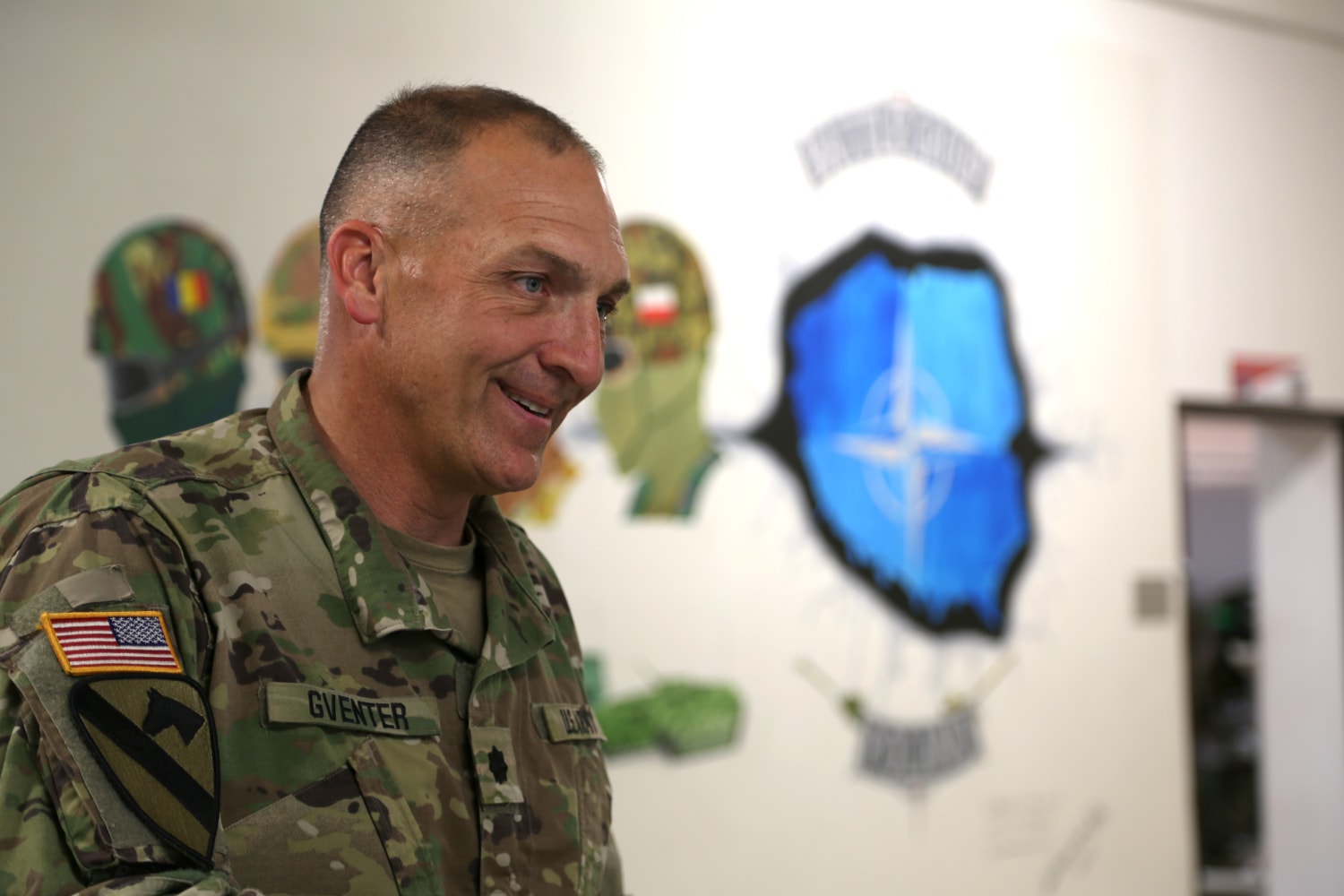
Image: LTC Steven Gventer, a U.S. Army officer, commands NATO's Battle Group Poland


Image: LTC Steven Gventer, a U.S. Army officer, commands NATO's Battle Group Poland

« They’re family, » said Lt. Col. Steven E Gventer, a U.S. Army officer who has become NATO’s commander of the Battlegroup Poland. « I know if someone tells me to leave the base to go out and defend, the British and the Romanians will go with me. »

On what was an overcast day last week, around 20 U.S. soldiers wearing helmets and protective vests discharged their pistols down a shooting range. Nearby, other American personnel fired machine guns and launched grenades at targets hundreds of yards away.

Further down the firing line was a unit of about 50 Polish machine-gunners.

In an adjacent field of long grass and wildflowers, a reconnaissance unit flew a small drone, capable of looking behind enemy lines with its onboard camera.

Hundreds of feet up in the air, it was hardly visible against the graying sky. But with thunderstorms moving in, the soldiers quickly landed the fixed-wing drone, which was the size of a model airplane, and packed up their gear.


Russia was hardly mentioned by name on the base, but the signals were clear: NATO forces want to show they’re capable of dealing with an equally-equipped military such the one marshaled by Moscow.

At the same time, Trump is deeply unpopular across Europe. A study by the Pew Research Center in June said that 79 percent of people across 10 countries said they had « no confidence » in him to do the right thing on world affairs.

He is more well liked in Poland, where a relatively low 53 percent of people have « no confidence » in him on world affairs. He is expected to receive a warm welcome from crowds bused in just for the occasion.

Related: To Welcome Trump, Poland Taps Old Communist Party Playbook

But what concerns many Poles right now is the threat from the East.

What worries some analysts isn’t the unlikely scenario of Russia launching a full-scale conflict, but that President Vladimir Putin could launch something more akin to a « hybrid war, » particularly in the Baltic nations that have a sizable population of ethnic Russians.

This could involve implanting pro-Moscow activists to foment local ethnic tensions, and deploying personnel in unmarked military fatigues, whose connection to Russia could be denied by the Kremlin. Tactics similar to those allegedly deployed in Ukraine.

Image: U.S. Army soldiers move an armored Stryker vehicle into position during live-fire training.


Image: U.S. Army soldiers move an armored Stryker vehicle into position during live-fire training.

Reliant on American support and fearful of Russian influence, European leaders will be closely watching a highly anticipated meeting between Trump and Putin on the sidelines of this week’s G-20.

« The stakes are pretty high for Europe in terms of how that meeting turns out, » said Susi Dennison, a senior policy fellow at the European Council on Foreign Relations. « For Europe, how the personal meeting goes between these two is going to be pretty crucial. »

European leaders are also unsure whose word actually represents U.S. policy, according to Matthew Harries, a research fellow at the International Institute for Strategic Studies, a British research institute.

Establishment figures in his team, such as Defense Secretary James Mattis and National Security Adviser H. R. McMaster, have been far more clear than their boss in supporting NATO’s allies across the pond.

Related: Russian Fighter Jet Twice Came Close to U.S. Navy Plane

In May, after Trump failed to endorse Article 5 during a speech at NATO’s headquarters in Brussels, McMaster, told journalists later that « of course » the president backed the principle of collective defense.

One report in Politico even suggested that Trump had blindsided his own team by omitting that section from the speech without telling them.

« Nobody’s entirely sure who speaks for the U.S. and whether what the president says is official policy, which is very unusual, » said Matthew Harries, a research fellow at the International Institute for Strategic Studies, a British research institute.

« European leaders are perfectly happy with Mattis but their problem is with Trump, » Harries added. « Does the president speak for the U.S. or does the defense secretary? If it’s Mattis then Europe will be happy. If it’s Trump then they won’t. »

At G-20 summit, it looks more and more like Trump against the world


European Council President Donald Tusk, German Chancellor Angela Merkel, U.S. President Donald Trump, French President Emmanuel Macron and Japanese Prime Minister Shinzo Abe walk after a family photo during the G7 Summit in Italy in May. (Reuters/Jonathan Ernst)

President Trump and key global leaders are on a collision course ahead of the G-20 summit in Germany this week, with Trump’s unapologetic “America First” mantra on trade and climate change running into emboldened, and increasingly united, opposition overseas.

Trump reiterated his threats on Wednesday to pull the United States back from existing trade deals, arguing they were against the national interest. As Trump threatens to retreat from global trade, other world powers are exploring new economic ties.

The European Union and Japan are expected on Thursday to announce plans for a major new free trade agreement. The EU-Japanese deal, which has only been negotiated in broad terms thus far, would lower barriers to exports of cars flowing in both directions, as well as reduce Japanese barriers to imports of trains and agricultural products, including cheese and chocolate, according to media reports. It would create a free trade area similar in size to North America, which is linked by the 1994 NAFTA agreement.

If completed, the E.U.-Japan trade deal would be a sign of other top economies adjusting to a new world order in which they attempt to work around the United States instead of looking to it for direction on building global trade. Trump, with support from Congress, already ended an effort for the United State to reach a trade agreement with Japan and other Asian countries, and he has threatened to withdraw from the North American Free Trade Agreement and from a separate trade agreement with South Korea.

Amid strengthening overseas opposition, Trump faces one of the most consequential economic decisions of his tenure so far, as he considers imposing new restrictions on steel imports to protect U.S. producers — a move vociferously opposed by Germany and other U.S. allies. The Commerce Department was close to recommending new restrictions, but other top Trump advisers warned it could lead to major economic fallout, and now the decision is hanging over the both the administration and the summit of global leaders.

Trump’s advisers plan to push other countries at the G-20 to agree to concrete steps that would crack down on the way China exports steel, people briefed on the planning said, and if Trump is successful in this effort it could buttress his willingness to challenge other countries on a range of issues. But if the attempt backfires and numerous countries reject the U.S. push, it could further isolate the country.

The divergent trade approaches have set up the G-20 as a potential crossroads for the international economic order. Trump is attempting to leverage the United States’ economic power to negotiate new deals in the country’s favor, while foreign leaders — including those of the United States’ appear increasingly ready to bypass the United States in favor of stronger ties elsewhere.

There are also signs that other nations are willing to challenge Trump more directly. German Chancellor Angela Merkel, who faces elections in September in a country where Trump is deeply unpopular, said she would press Trump about his trade threats as well as his recent decision to withdraw from the 2016 Paris climate agreement that aimed to curb greenhouse gas emissions. In advance of the meeting, Merkel and Trump discussed « global steel overcapacity » in a phone call on Monday, something that could become the top trade issue at the summit. Germany is a large exporter of steel and officials there worry they could be caught in any U.S. crackdown.

“There has been no love lost between Germany and Trump from the beginning, but now Chancellor Merkel is operating in campaign mode where all the numbers show that President Trump is deeply disliked,” said Michal Baranowski, director of the Warsaw office for the German Marshall Fund of the United States, a think tank. “The concern is certainly very high about protectionist language and potentially protectionist ideas coming from the Trump administration.”

« It is important for us to wave the flag of free trade in response to global moves toward protectionism by quickly concluding the free trade agreement with Europe, » Japanese Prime Minister Shinzo Abe said on Tuesday, according to Reuters, as he touted the potential Japan-E.U. trade pact.

Trump appeared ready for a scrap ahead of the meeting. « The United States made some of the worst Trade Deals in world history. Why should we continue these deals with countries that do not help us? » he wrote in a Wednesday morning Twitter post. That followed a Monday post in which Trump implied he might soon take action on steel, writing “Don’t like steel aluminum dumping!

U.S. officials have accused China – not Germany and Canada – of “dumping” excess steel on global markets in a way that drives down prices. Because China is a G-20 country, Trump could try — for the first time — to directly challenge Chinese leader Xi Jinping in person at the Hamburg meeting. The United States imports very little steel from China, but Trump administration officials say the way China produces and exports steel still hurts the U.S. steel industry because it sells it at low prices to other countries, driving down prices.

China now makes more than half of the world’s steel. Some of that steel goes to feed the factories, roads and skyscrapers that have cropped up around the country as China’s economy has grown in past decades.

But U.S. companies say that the Chinese steel boom is also due to unfair government subsidies and state ownership that protects steel mills from market forces and causes them to produce much more steel than the world needs. Much of this glut of Chinese steel ends up in overseas markets, lowering the global steel price to a point where foreign companies can’t profitably compete. In 2015, China produced 10 times as much crude steel as the United States.

“The United States stands firm against all unfair trading practices, including massive distortions in the global steel market and other non-market practices that harm U.S. workers,” White House National Economic Council Director Gary Cohn said. “We ask the G20 economies to join us in this effort and to take concrete actions to solve these problems.”

U.S.-China relations are further complicated by international tensions over North Korea, after dictator Kim Jong Un’s regime — to broad international condemnation — conducted a military exercise designed that seemed to demonstrate the increased range of its missile technology.

Trump took a combative posture with China ahead of the meeting, ripping the country for allegedly increasing its trade with North Korea. « Trade between China and North Korea grew almost 40% in the first quarter. So much for China working with us – but we had to give it a try! » Trump wrote in another Wednesday morning Twitter missive.

Trump had taken a more conciliatory approach with China in recent months, backing away from a threat to label Beijing a « currency manipulator » and saying he thought both countries could work closely together on a range of issues. But relations appear to have soured in recent weeks, and his Wednesday accusation that China has enabled North Korea’s missile programs marks a low point between his administration and Chinese leader Xi Jinping.

A number of trade experts said it remains unclear whether Trump is simply threatening tariffs as a way to lure other countries to offer him concessions, or if he will follow through on new restrictions, rebuffing advice from many in his cabinet. He has taken steps to renegotiate the North American Free Trade Agreement and he has also said he wants a new trade deal with South Korea, but so far those efforts are only in initial stages. Global leaders have seen in opening in persuading Trump to change course, as he made a last-minute decision to renegotiate – rather than withdraw – from NAFTA after intense pressure from Canada and Mexico.

“There’s a big difference between being unpredictable with your adversaries and being erratic with your friends and allies,” said Daniel Price, former international economic affairs adviser to President George W. Bush, who helped organize the first G20 summit in 2008.

Still, Merkel has emerged as one of the global leaders most willing to challenge Trump’s approach.

“Those who think that the problems of this world can be solved with isolationism or protectionism are terribly wrong,” she told the German parliament last week.

Trump and some of his advisers have chided Merkel over the fact that Germany exports far more goods more to the U.S. than the U.S. exports to Germany — $64 billion worth of cars, machinery and other goods in 2016.

Many trade experts believe the unbalanced trade is due in large part to Germany’s use of a shared currency with the rest of the euro zone, which ends up making the euro cheaper than a strong economy like Germany would otherwise have. German officials have tried to explain this dynamic to Trump and his advisers for months, but Trump administration officials believe Germany could do more to boost their imports.

The Germans argue that their companies, including luxury automakers, invest heavily in the United States, employing more than 100,000 Americans.

Before his inauguration, Trump had threatened BMW with a 35 percent tariff over its plan to build a new plant in Mexico. And on his last trip to Europe, at a meeting of the group of seven in Italy, Trump told European leaders that the Germans were “very bad” on trade. “We have a MASSIVE trade deficit with Germany, plus they pay FAR LESS than they should on NATO military. Very bad for U.S. This will change,” Trump tweeted in late May.

Trump ran for his election by vilifying China’s trade practices, and he could try and use the G-20 summit to try and isolate Beijing over the way it produces and exports steel. Trump softened his criticism of China in the early months of his term, but in recent weeks his administration has stepped up criticism of the country for human rights violations and failing to help with North Korea.

G-20 meetings, which are held once a year in a rotation of countries, typically end with a joint statement from every nation about a range of issues that can include economic policy, international assistance and security. Officials are likely to face strains as they try to cobble together the joint statement – known as the “communique” – for this meeting, because Trump could easily block any language that he feels try to box him in on his trade or climate initiatives. But Trump could also risk alienating the White House from foreign leaders who have often looked to the U.S. for leadership on all of these issues, particularly as he is seeking more influence in global security and counterterrorism efforts.

Merkel is expected to also serve as Trump’s lead antagonist on climate issues, following his June announcement that he was beginning the process of withdrawing from the Paris agreement. The announcement divided White House officials, some of whom opposed the move, and it was condemned by numerous world leaders, including those in China, Canada and the United Kingdom.

But since then, top White House officials have defended Trump’s decision, saying it represents his focus on helping protect U.S. jobs and not succumbing to greenhouse gas targets that could lead to regulations.

“He cares very much about the climate,” Cohn said, speaking of Trump. “He cares about the environment. But he has to enter into a deal that’s fair for the American people, the American workers. He’s done everything he’s done based on job creation, economic growth in the United States.”

This is a message Trump and his advisers are expected to make again at the G-20 meeting in the coming days when they are challenged by other leaders.

Trump leaves for the G-20 meeting on Wednesday and will first stop in Poland.


Stop procrastinating and get moving on video marketing

woman-testing-webcamYour customers are crying out for video from you. At least that’s what the experts are saying. And it’s true – if all your sales and marketing (and support for that matter) is text-based with the odd image, it can get a little boring.

Look at it this way: A picture (image) is worth a thousand words. The brain can process 30 images a second. For a 60 second video, that equates to 1.8 million words (30x60x1000). That is the stat that Forrester’s Nick Barbar offered in a recent video presentation he did for a TwentyThree.net online video conference.

Another stat Barbar offered: The brain can process video 60,000 times faster than text.

Why wouldn’t you want to provide video to your customers and prospects? Why wouldn’t they expect it?

But video is too expensive

There was a time when you could pull that excuse, and everyone would nod in agreement. It can be expensive, especially when you are thinking of the high production videos that you think you need to produce. The special camera equipment, the special room, the best speakers, great animation, and the list goes on. You’re thinking like a news producer from five years ago; it’s time to shift your mindset.

Video does not have to be expensive, and it doesn’t have to be world class, academy award winning. You can even produce it from your desktop. As long as the content is relevant, timely, and high quality, your customers will consume it.

That’s why you see video hosting providers offering solutions to create your own videos right from the comforts of your office chair. One of these is Wistia. Wistia recently introduced a free Chrome extension called Soapbox that lets you record, edit and share video. It allows you to do a split screen, recording your webcam and screen simultaneously. You can even switch between the two if you don’t want them both up at the same time.

A few other things you can do with your custom made videos in Wistia:

  • Customize the player
  • Include a CTA at the end of the video
  • Create a custom video thumbnail
  • Trim the start and end
  • Re-edit the video after you share it

Wistia is not the only video hosting provider that offers this kind of capability. Vidyard offers ViewedIT and Vidyard Studio, and TwentyThree.net also enables you to create videos and clips directly in your browser. You have no excuse.

If you’re concerned about the quality, then a few tips I can offer can help:

  • Keep your background clean. That doesn’t mean a blank wall (I have pictures my kids drew in my background), but don’t have a bunch of crap cluttering the background that will drive people’s eyes away from you.
  • Have the camera at eye view. Don’t be looking down at your screen in the video. Bring your camera up to your eye level, so you are looking straight into it. There’s nothing more annoying and amateur looking than someone who is starting down at you.
  • Don’t read off a sheet. If you’re experienced, you could have cue cards behind the camera, but more than likely you sound like you are reading off them (and your eye will wander side to side). Looking down to read off a paper doesn’t look good either. The best presenters know their topic well enough to look at a few bullet points and speak to them conversationally. Practice beforehand and know your topic inside and out.
  • Have clean, but useful slides. Don’t clutter your slides up with a lot of text or images. The KISS principle is important for presentations. But I will also note – make them useful. I’ve looked at far too many slides on Slideshare that are a waste of time without the audio that went with them. You want to reuse these slides for other content marketing assets, so make sure you spend time ensuring the content is useful.

I wouldn’t wait for the big budget to start making your videos. Yes, you can screw them up, but just taking some time to prepare a well thought out discussion or presentation and then making the video yourself, I think your customers will appreciate it. As my daughter has told me “practice doesn’t make perfect (because there is no such thing as perfect), but it does make you better.”

How do I track video performance?

Performance is another key question. Like every content asset you develop, you need to know how useful it is to your business objectives. In Barbar’s presentation, he makes the point that video views are pure “vanity metrics’. All your hosting providers offer statistics on viewing, and you can do a lot with what they provide, but it’s when you integrate video scoring with your CRM and marketing automation solution that you can assign value and see the impact your videos have on revenue.

To track performance and value to the customer journey, first separate your videos by stage of the customer journey. Different videos work best for different stages of the journey; separating them in this way allow you to assign more appropriate lead points. A table that I saw on a Wistia post seems a good approach to define lead scores.

The columns were as follows:

  1. Video: name of the video
  2. Stage of Journey: where you use it in the customer journey
  3. Persona: go deeper by defining videos for specific personas (or leave this out if you can’t get that detailed)
  4. Points Assigned: the points you want to assign for the video to add to the lead score.
  5. Greater Than 50% watched: additional points you would assign if the viewer watched over half the video
  6. Total Video Score (Points Assigned + Points from Greater than 50% watched)

When a prospect or customer watches the video, you add the lead score to their contact record in your CRM, or you use it in your lead nurture campaign to figure out what the next best step is to continue the nurture process.

My take

Another element of videos that I think will take hold this year is the personalized video. Vidyard provides the ability to personalize a video that enables you to capture the attention of someone. It’s the same video everyone gets when they go to Vidyard website and click on the personalized video section. (It’s free, but you’ll need to enter your name and a few more details).

It arrived in my inbox. If a company sent me a video with my name on it, I would click it. But it needs to do more than just put my name on it. It has to offer me something of value, so when you start thinking about how you can get more personalized – think past the simple things to what would catch your customer’s attention and make them act.

My point in all this is that you need to stop worrying about making expensive, high-quality videos and start thinking about the high-quality content presented via video. Take advantage of all those employees who love to talk about the business, its products and services, the market topics and the support topics. For most, making a video may seem a lot less intimidating than writing a thousand word article.

Image credit – Surprised woman browsing internet in home office, webcam view © leszekglasner – Fotolia.com


<!– BOOMTRAIN: Remove inline signup form

END: BOOMTRAIN: Remove inline signup form –>