Archives par mot-clé : marketing

Streaming Video Company Roku Files for US Initial Offering

Roku Inc., the maker of devices and software for streaming video that was an early challenger to traditional home-entertainment providers, filed for a U.S. initial public offering.

The company listed an initial offering size of $100 million, which it said is a placeholder used to calculate fees and will probably change. The company plans to use the proceeds for general corporate purposes including research and development and marketing, according to a filing Friday with the U.S. Securities and Exchange Commission.

Roku was an early mover in what is now a crowded market of home devices and streaming tools. It’s a specialist in an industry in which several technology giants, including Apple Inc., Alphabet Inc.’s Google and Amazon.com Inc., are now focusing intently.

The company, which has been losing money since it began in 2002, acknowledges the risk of the “highly competitive” market, according to its regulatory filing. While competitors may be able to afford to lose money on their devices, Roku said its advantage is in its neutrality. Unlike some of the other players, Roku isn’t competing with content providers by making original programming.

“Our mission is to be the TV streaming platform that connects the entire TV ecosystem,” Chief Executive Officer Anthony Wood wrote in the filing.

Social networking and video dominate smartphone use, but email generates the most ROI

The increase in mobile data traffic is an unstoppable force, and entertaining us accounts for over half of this traffic, but does creating content for our entertainment generate the most return on investment (ROI) for marketers?

email.jpg

Mobile data traffic is expected to increase sevenfold by 2021, according to Cisco’s Visual Networking Index (VNI).

This smartphone usage expansion is due to improvements in network speeds and increasing availability of mobile applications, and the significant consumption of mobile video will all contribute to this growth.

So, how do marketers deliver the right messages to their customers to deliver the best ROI for their campaigns?

A recent report by technology adviser Analysys Mason shows that entertainment is the dominant activity on our smartphones — accounting for 57 percent of our data usage and almost a third of overall time spent on the device. It analysed real-world usage from over 8,000 smartphones in Germany, India, UK, and US.

But if you are a marketer this might not be good news. It takes significant time and resources to create world-leading entertainment content to post across social channels. How do marketers connect with their audience and get a good return for their efforts?

A report from email marketing platform Emma shows that marketers are already overwhelmed and unable to meet expectations. Over 64 percent of marketers do not have the time or personnel to carry out the marketing activities that they would like to.

There are too many channels to focus on and not enough return for their efforts. It is easy to get side-tracked by flashier social channels, and marketers feel like they have to master every new thing that comes along

A look at customer data and response metrics will show which what channels are most successful for reaching the target audience so that marketers can focus their efforts there. And it is often email — not social — that is overlooked.

Now marketers are turning to email marketing to simplify their activities. Every year, someone writes an article proclaiming that email marketing is dead — and every year they are proven wrong.

Although ‘batch-and-blast email marketing’ may be dead, timely email marketing campaigns could become key to successful digital marketing programs.

According to Emma, 47 percent of marketers said that email generates the most ROI for their organisation, and 58 percent of them are planning to increase their spending on email marketing in 2018.

With new channels seemingly popping up every day, marketers often feel like they have to be on all social channels all the time. But with the other half of our mobile data usage, we are very likely looking at — and responding to — a well-crafted email campaign.

PREVIOUS AND RELATED COVERAGE

Publishers say affiliates generate more revenue than other types of marketing

A recent survey points to a bright future for affiliate marketing and social engagement.

Why brands can’t thrive without a good influencer marketing campaign

Brands are building deeper relationships with influencers using instant social platforms like Instagram and Snapchat.

New report shows top brands outperform their peers by maximising engagement

Revisit your online-only engagement strategy. Social influence leaders dominate the offline and online word-of-mouth consumer conversation, according to a new report.

Crimson Hexagon stores one trillion social media posts for customer analytics

If you posted one public social media post per second, it would take you 31,000 years to reach one trillion posts. That’s the number of posts stored in Crimson Hexagon’s data repository.

Zero-latency video gives drones an upgrade

droneracing.jpg

Make it faster, look for applications. That’s been the market strategy of Amimon, founded in 2004 to get rid of latency in wireless video transmission.

So far, Hollywood and hospitals have been Amimon’s big customers. But first-person-view (FPV) drone racing (it’s a thing, and it’s pretty stunning to watch) is growing in popularity. The sport requires precision control in real-time, and latency leads to crashes.

Problem, meet solution.

Amimon’s technology is pretty cool. The company’s marketing plays fast and loose with the term « zero-latency » (see General Relativity for a rebuttal), but their ultra-low latency (1mS) technology is still impressive.

It works using multiple inputs and multiple outputs, or MIMO, a transmission approach that relies on multiple antennas at both the transmitter and receiver to improve bandwidth and performance. By spreading the same total transmit power over multiple antennas, Amimon video links achieve « an array gain that improves the spectral efficiency (more bits per second per hertz of bandwidth) » as well as « a diversity gain that improves the link reliability (reduced fading), » according its site.

FPV racing is having a moment. Wearing video goggles, racers have a pilot’s view as they maneuver their quadcopter around a course. Though prices for custom racing drones can easily balloon to several thousand dollars, hobbyists can get into the sport for a few hundred bucks. That accessibility has led to a surge of popularity.

In the U.S., the National Drone Racing championships started in 2015. This year’s contest will be held in Reno in September. There’s also a Drone Racing League, which just raised $20 million from backers like Sky, Liberty Media, and WWE. The league’s mission is to turn FPV racing into the next big spectator sport.

They’ll need some great video to do it.

A New Marketing Royalty on the Rise: Digital Influencers

As online platforms become cluttered with ads, marketers are challenged to find new ways to connect with their customers. One rising trend they should pay attention to is “influencer marketing,” or using the power of popular people to reach your target market, according to this opinion piece by Aprajita Jain, a brand marketing evangelist at Google.

You are in your mid-30s, single, sipping a coffee at your favorite coffee shop. Suddenly a stranger approaches your table and asks if he can sit with you. Instinctively drawing your purse a little closer, you make an excuse and leave. A month later your best friend tells you about someone she wants you to meet and gives you a very unbiased opinion on his virtues and vices. Knowing your friend has the best of intentions, you agree to meeting this person. As you walk into the restaurant you see the coffee shop guy sitting at a table waiting for you! This time your guard is down because you have the endorsement of someone you deeply trust.

Brands are learning from this real-life psychological hack. Instead of getting in your face with their own message about their greatness they are letting ‘influencers’ — people you trust — tell you why you should pay attention to their products and services through a voice that sounds far more authentic. The influencer is that mutual friend between a brand and their consumers. Influencers are well-connected. They are authoritative. They have active minds and they are trendsetters.

Why are influencers so much more effective for marketing than self-promotion by a company? Let’s examine the trifecta of good influencer marketing:

Attention equals currency. Influencer marketing allows targeted exposure to the right kind of consumer, one who is already interested in a category that you operate in and will likely pay attention. In a world where TV ads have become background noise and consumers are becoming immune to traditional digital advertising, being on-target is crucial. Just take a look at the rampant rise of ad blockers — last year alone, usage surged by 30% globally (PageFair 2017 Adblock Report). Only 6% of display ads are ever clicked on. Further proliferation of mobile phones, video content and social media, are turning influencers into constant companions of your audience. To get their attention, brands have to work with the people they listen to.

Creativity and organic content has become the expectation. Remember Jared Fogle, the ‘the Subway guy?’ He served as the brand’s spokesperson for 15 years until his fall from grace. Today, it is no longer enough to hire a spokesperson and have them endorse your brand. While there is some overlap between celebrity endorsements and influencer marketing campaigns, the latter are designed to speak to an existing community of highly engaged followers. Influencers are the masters of their niches, and have established a high level of trust and two-way communication with their followers. They know how to incorporate a brand’s products and services into content people are watching and they do it very seamlessly, instead of taking away attention from what they really want to watch. The reason their followers keep coming back to them is because they regularly offer new and creative content to them. Followers have come to expect that. Over are the days of hammering the same message into your consumers’ heads for months, maybe even years.

“Influencers are the masters of their niches, and have established a high level of trust and two-way communication with their followers.”

Social media has no prime time window — it is prime time. Any consumer behavior study worth its ink will tell you that consumers are shifting towards social at the cost of TV. While marketers chased prime time spots on TV in the past, social is prime time 24/7. The truth is, when a social media personality you follow day in and day out wears something, drinks something, shows you something, you pay attention to it. And the key word here is attention. How to win your customer’s attention is quickly changing, and the brands that fail to adapt are going to get left in the dust by their competitors.

In God we trust. Everyone else bring data. Why should you believe me when I say that influencer marketing is on the rise and more effective than many other popular marketing channels?

  • A poll conducted by Tomoson found that 59% of marketers are planning to increase their influencer marketing budgets year-over-year. It is also the most cost-effective and fastest-growing online customer acquisition channel, outpacing organic search, paid search and email marketing.
  • In an advertising landscape where returns on ad spend (ROAS) of $2 for every $1 spent are considered a success, influencer marketing delivers an average return of $6.50, with the top 13% of marketers making $20 or more.
  • It’s not just about the quantity, quality matters too — 51% of marketers believe customers acquired through influencer marketing are of better quality because they spend more money and are more likely to spread the word to family and friends.
  • According to a Think with Google study, 70% of teenage YouTube subscribers say they relate to YouTubers more than to traditional celebrities — and you can bet that is not just happening on YouTube.

Casey Neistat versus Jennifer Aniston for Emirates. This is the story of a brand that had a few hit videos last year — Emirates Airline. It launched a campaign to show off the airline’s luxurious amenities and decided to spend $5 million of their total $20 million budget to hire Hollywood actress Jennifer Aniston to play the part of world traveler. The company made a series of short ads for YouTube with her that did quite well. Here is one of the videos they made together, which debuted last October. To date, this video has more than 6 million views. Not bad at less than $1 per view.

However, let us compare the Aniston spot to this video. An incredibly smart person over at the Emirates marketing team decided to give mega-YouTuber/influencer Casey Neistat premiere status on their airline, for free. They didn’t ask anything in return but hoped that if he enjoyed his flight he would share it with his fans. And he did. Twice, in fact. In addition to this first video, he also (of his own accord) created a second video that to date has another 11.5 million views — 52 million views — for free. Find me a marketer who doesn’t love free advertising.

Casey caters to a younger audience but he is also a technology startup founder followed by many entrepreneurs aspiring to be the next Mark Zuckerberg or (Snap CEO) Evan Spiegel. While it’s hard to immediately measure the direct ROAS on a splashy campaign like this, Emirates had its brand featured in best-in-class media outlets such as GQ, Maxim, Adweek, Mashable and the Huffington Post. In addition to all the free press, the brand also got amplified on social media through Casey’s posts that received thousands of likes and retweets. Not only did Emirates raise awareness among a new demographic and received lots of free PR, they positioned their brand as forward-thinking and digital-first.

Pretty Little Thing, a fashion company built on pop-culture, created a global clothing and accessories brand mimicking what influencers and celebrities are wearing. In fact, while they closely work with influencers, they essentially have taken the influencer marketing model and flipped it on its head — which more and more companies are likely to follow. Instead of going to an influencer and asking them to make a certain piece of clothing popular, they watch what these influencers are already wearing and then create matching, cost-effective products. They boast a solid 1.9 million followers on Instagram and have rapidly expanded from shipping from 20 orders per week four years ago to more than 20,000 orders per day today. Last December, the founder sold a 66% stake of his holdings to a larger fashion brand for 3.3 million pounds sterling with revenue quickly approaching 20 million pounds.

‘My Tales of Whisky’

The most mind-boggling example of influencer success comes from beverages giant Diageo, the parent company of Scottish whiskey brands Lagavulin and Oban. One of its video spots was awarded a Shorty Award for Best Influencer Marketing Campaign for this video starring NBC’s “Parks and Recreation” TV sitcom star Nick Offerman. The one-shot video called “My Tales of Whisky” shows Offerman sitting by a crackling fireplace — called a yule log according to European Christmas tradition — ironically in complete silence, staring broodingly into the camera for 45 minutes, and occasionally savoring a sip of his drink. Thanks to the simple seasonal premise and Offerman’s unique brand, the video was a viral hit.

“According to a Think with Google study, 70% of teenage YouTube subscribers say they relate to YouTubers more than to traditional celebrities.”

On the day of launch, ‘yule log’ was a trending topic on Facebook and more than 175 stories were written about it, earning the brand a lot of free media mentions. As the campaign rapidly gained momentum in social conversations and got further amplified by streams through Sony, Tumblr and GoDaddy, the team behind it created a 10-hour loop for holiday gatherings. In the first two days alone, the video garnered 1.1 million YouTube views, growing to 2 million in just one week before any paid media was activated. The brand’s channel subscribers skyrocketed from 5,500 to 23,000.

Adding More Juice

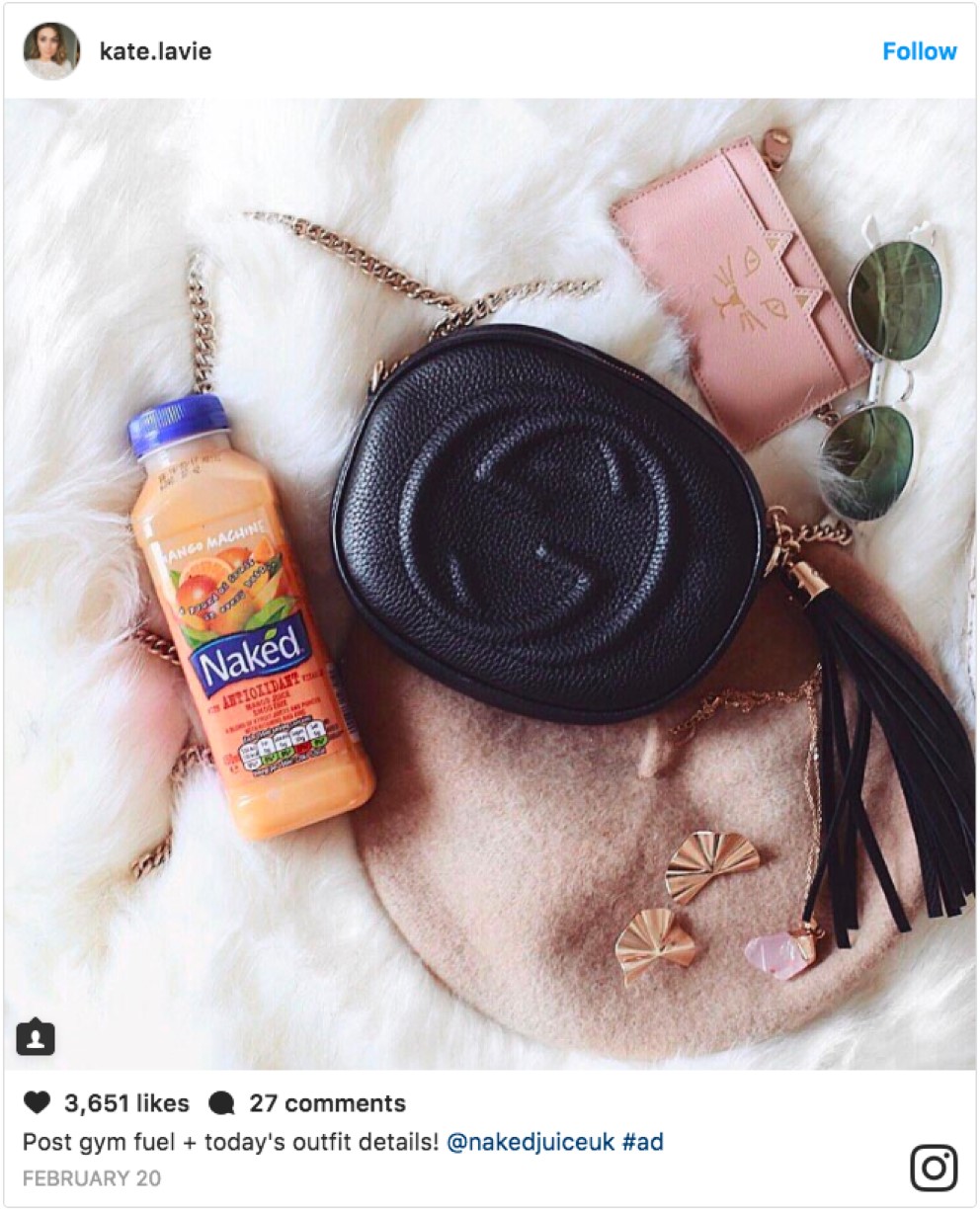
Influencer marketing isn’t just for the big brands. It is quite popular because companies of any size can benefit from it. Naked Juice, a smaller juice and smoothie company that started in the 1980s in Santa Monica, Calif., collaborated with young influencer Beth Norton. They sought her out on Instagram to promote their juices and smoothies to people on the go, whether they are running errands or planning projects. They also entered the beauty, fashion, and health scene on Instagram with help from lifestyle blogger Kate La Vie, who shares sponsored posts featuring images of her daily outfits and beauty essentials — including a strategically placed Naked Juice in the mix.

influencer2

Accompanied by other marketing channel strategies, this influencer campaign allowed Naked Juice to defend its position in the premium juice category by establishing itself in the minds and hearts of their core audience — known as ‘Bare Believers.’ Naked Juice now commands a market share of 58%, far ahead of any competitors, and saw an eight-fold increase in consumer social engagement.

Taking Action

How does one get started in this form of marketing? How do you find influencers and measure the impact of your efforts?

Eighty-four percent of marketers manually search social media platforms to find influencers that may be right for their brand. Many rely on recommendations, social media monitoring tools or attending events and conferences. It is one of the most challenging and time-consuming steps to take as you are getting started with this new medium of advertising, but today there is a plethora of influencer marketplaces that can make this much easier, such as Famebit by YouTube. These online platforms can be used to quickly search for influencers based on specific criteria (follower count, demographics, interests, etc.), to negotiate deals with them as well as give them a clear brief to stay ‘on brand.’ A marketplace makes it easier to not only negotiate a fair price but also find influencers that you may have not heard of before.

First, consider these three criteria when choosing influencers:

  • Context: Who has the largest overlap between their followers and your target audience? Keep in mind this is one of the very few — if not the only — type of advertising that works in an ‘opt-in’ model. Influencers don’t force themselves on their audience. Their audience actively subscribes to them. As a result, the audience is far more engaged than on other channels.
  • Reach: How large is their following? Just like you choose a TV ad spot based on its reach, you can look at how many followers a certain influencer caters to.
  • Actionability: This is the influencer’s ability to cause action and likely the most subtle, yet important, selection criteria to get right. The more skilled an influencer is at convincing their followers to take action related to your product or service the higher your conversion rate will be.

“Influencer marketing delivers an average return of $6.50 (per dollar spent), with the top 13% of marketers making $20 or more.”

Second, decide which pricing model is the best fit for your brand. The four most common pricing models are:

  • Pay-per-post or flat-rate pricing: This is the most common method, with 68% of marketers choosing it. The influencer is paid a flat fee per piece of sponsored content they create, whether it’s a photo, tweet, pin, video or blog post. Depending on who you are working with, prices can range from as little as $50 per piece to as much as $250,000 for top-tier influencers.
  • Product compensation: Some influencers can be wooed with free products or services. This type of compensation is commonly used by travel brands as influencers can creatively endorse their personal travel stories. This model is ideal for smaller campaigns or for brands looking to establish a brand ambassador group.
  • Pay-per-click: In this model, influencers are compensated for how well their content performs. The key metric is number of clicks to a brand’s site. Because influencers rely a lot more on audience interaction in this performance-based model, they are motivated to create larger volumes of content.
  • Pay-per-acquisition: Here, influencers are rewarded for the number of purchases, actions or sign-ups driven by their content. It is the least common payment model because consumers rarely purchase or sign up for something the first time they get introduced to a product or service. Often, repeat exposure is required. The first introduction usually needs to be followed up by discovery, research and validation before resulting in a purchase or conversion.

Lastly, know what success means by defining your measurement criteria. Half of all marketers see sales increases and lead generation as the top goals of influencer marketing. Forty percent look for brand engagement such as clicks and social shares. However, success can also be correlated with spikes in web traffic or higher conversions in concurrent ad campaigns. A little less measurable, yet very effective, is the value of earned media as you saw with Emirates. Also, marketers often forget to take into account less tangible metrics, such as overall brand sentiment. Look at the whole picture and — as with all things in digital marketing — don’t ignore the cross-channel impact of influencer marketing on other channels.

Influencer marketing is clearly here to stay. Its impact is palpable. Brands are using it to establish credibility in the market, create a social conversation around their brand and drive online and in-store sales. The brands that make this part of their always-on strategy are the ones that win the most desired eyeballs.

YouTube Hires Tom Blessington to Lead Brand Strategy and Integrated Marketing

YouTube has hired longtime marketing executive Tom Blessington as Vice President, Brand, Media Experiences, where he will oversee the online video giant’s brand strategy and integrated marketing campaign across all of its business areas.

Blessington will report to YouTube Chief Marketing Officer Danielle Tiedt and will be based at its San Bruno, California headquarters. He will start in the middle of September.

Blessington was previously managing director at Wieden+Kennedy’s Portland, Oregon headquarters, where he spearheaded campaigns for major companies including Levi’s, Chrysler/Dodge, Facebook, Target, Sony, American Express, KFC, Verizon, Samsung. Prior to that, he set up several regional offices at Wieden+Kennedy, including Amsterdam and New York. Before Wieden+Kennedy, he worked at the Los Angeles office of TCD, where he ran the billion-dollar Nissan and Infiniti account.

YouTube is increasingly positioning itself as a competitor to traditional TV networks, already releasing 37 original shows on its YouTube Red subscription service and recently announcing a slate of ad-supported programs viewable for free, featuring some of the platform’s most popular names including Ellen DeGeneres, Kevin Hart and the Slow Mo Guys — and making it a good time to tap a veteran ad executive.

“It’s a great honor to get the chance to help build, from the inside, one of the world’s most important and culturally influential brands,” Blessington said in a statement. “I couldn’t be more excited for what’s to come.”

“Tom is well known for his culture-shaping, innovative marketing campaigns,” Tiedt said in the statement.  “We can’t wait for Tom to bring his breakthrough ideas and rule-breaking spirit to YouTube.”

10 Highest Paid YouTube Stars of 2016 (Photos)


  • Highest Paid YouTube Stars

    Forbes released its list of the highest-paid YouTube stars on Monday, with the top ten earning a total of $70.5 million over 12 months.

    Getty Images


  • Colleen Ballinger

    Colleen Ballinger, $5 million

    Getty Images


  • Rhett and Link

    Rhett and Link, $5 million

    Getty Images


  • German Garmendia

    German Garmendia, $5.5 million

    Getty Images


  • Markiplier

    Markiplier, $5.5 million

    Getty Images


  • Tyler Oakley

    Tyler Oakley, $6 million

    Getty Images


  • Rosanna Pansino

    Rosanna Pansino, $6 million

    Getty Images


  • Smosh

    Smosh, $7 million

    Getty Images


  • Lilly Singh

    Lilly Singh, $7.5 million

    Getty Images


  • Roman Atwood

    Roman Atwood, $8 million

    Getty Images


  • PewDiePie

    PewDiePie, $15 million

    Getty Images


1 of 11

Gamer PewDiePie tops the list with $15 million paycheck

Forbes released its list of the highest-paid YouTube stars on Monday, with the top ten earning a total of $70.5 million over 12 months.

Collaborating for Success in Southern Luxury

Morar_SpearsIn the following interview, Destin, Fla.-based Scenic Sotheby’s International Realty Founder/Co-Owner/Broker Blake Morar and Top 250 Agent for Sotheby’s U.S. Jonathan Spears discuss marketing luxury, including through social media and video, and more.

Number of Offices: 3
Number of Agents: 42
Region Served: Destin, Fla.

How did you first get into real estate, and what led you to Scenic Sotheby’s Intl. Realty?
Blake Morar:
I graduated from college in 1996 and explored various sales positions in pharmaceuticals, but I always loved real estate. My first closing was in 1997. I bought the company in 1999—the owners were looking to get out of the business, but I believed in it and continued to grow the company. Sotheby’s approached us in 2010, and we were curious to learn more. As our market became more sophisticated, and developed, the Sotheby’s brand became relevant. We became part of the Sotheby’s brand in January 2014.

<!–/*
* The backup image section of this tag has been generated for use on a
* non-SSL page. If this tag is to be placed on an SSL page, change the
* 'http://openx.rismedia.com/www/delivery/…'
* to
* 'https://openx.rismedia.com/www/delivery/…'
*
* This noscript section of this tag only shows image banners. There
* is no width or height in these banners, so if you want these tags to
* allocate space for the ad before it shows, you will need to add this
* information to the tag.
*
* If you do not want to deal with the intricities of the noscript
* section, delete the tag (from … to ). On
* average, the noscript tag is called from less than 1% of internet
* users.
*/–>

Jonathan, when did you join the firm?
Jonathan Spears:
I got into real estate right after the BP oil spill, so I was knee-deep in the recession here focusing on the foreclosure side. I wanted to get more focused on luxury real estate and have the opportunity to help customers in a way that I hadn’t seen before. I really wanted to tap into a firm and a market that could help me grow my business and my customer base. I joined the firm in January 2015.

What sets your firm apart in the marketplace?
JS:
One way we set ourselves apart is our investment in videography. We tap into our local producers and parlay it through the brand exposure that Sotheby’s provides. Through our YouTube page alone, we’ve got videos with 200,000 views. Our ability to take a property and tell a story is so important, and having that channel to leverage is everything.
BM: When we met with Sotheby’s, we could tell they had that marathon mindset versus a sprint mindset. The power of their marketing exposure and how that translates to qualified leads and happy sellers exceeded our expectations.
JS: We have a pretty incredible buyer database. I’ll bring a property to a sales meeting pre-market and find a buyer for it.

What’s your unique value proposition for agents?
BM:
We support our agents’ marketing efforts and treat our agents like clients. We’re arming them with the ability to handle their own clients, and part of that involves our collaborative culture. We provide a very engaging, very interactive environment, and our agents and their peers help advance that scenario.

What are the particular needs of your clientele?
JS:
My customers require 24-hour service and constant availability. A lot of them become like family because of the constant communication. Meeting their demands and being available is so important.
BM: When dealing with the upper end of the market, we’re the boots on the ground for them. Ultimately, they’re looking for results, and we need to make sure our marketing machine is in shape, along with our systems and processes.

How do you creatively market the firm and its listings?
BM:
We’re always looking for opportunities to leverage video, as people will give that a lot more attention than something static. We also publish a comprehensive market report in digital format, which we leverage through social media.

What are your plans for growing the firm path forward?
BM:
We’re always looking for seasoned agents who are interested in collaborating with professionals and tapping into the platform we’ve established. For us, growth means bringing on the right people.

Maria Patterson is RISMedia’s executive editor. Email her your real estate news ideas at maria@rismedia.com.

For the latest real estate news and trends, bookmark RISMedia.com.

How Top Gun inspired Wootag founder to put ‘human touch’ into video marketing

An engineer-turned-ad tech developer has spoken of his hope to restore “the power of human touch” in online retail by allowing users to directly interact with – and purchase from – a video they’re watching

Raj Sunder founded the Singaporean-based start-up Wootag two years ago after becoming inspired while watching Tony Scott’s Top Gun and wanting to learn more about the iconic aviator sunglasses worn by lead actors Tom Cruise and Val Kilmer.

After pausing the film to Google the sunglasses, Sunder had a Eureka moment and was inspired to create a tool that would allow users to be able to click on an item without interrupting the video’s play.

The technology works through brands or agencies uploading their videos to a self-serve platform, which allows them to single out specific items in the clip where users can click a call-to-action such as ‘Buy Now’.

The video will continue playing while users can either decide to keep watching or click through to the retailer’s site.

Taking advantage of brands’ increasing demand to see greater return on investment from their online marketing efforts, Sundar persuaded Unilever to test out the tool on toothpaste brand Pepsodent’s Facebook page.

Following the trial, Pepsodent signed up Wootag for a year. Its early success helped draw the attention of marketers from Johnson Johnson, L’Oreal and Zalora and Wootag has since rolled out the business across six markets in Asia-Pacific.

Speaking to Mumbrella Asia, Sundar said: “The first idea is to create a human touch when you watch a video. If you like something in the video, you should be able to ‘grab’ it and maybe buy it. You are driving human touch within a video, finding out who is touching and making it personalised. The touch leading towards a business objective: a retail sale or the drive to an offline store.”

So far the technology is available on Facebook videos, Google Display Network and a number of brands’ own websites. However, YouTube and Instagram currently have their own interactive technology. Sundar said he learned “a lot” from the latter platform.

Concerns related to investing in digital advertising have escalated over recent months after Procter Gamble publicly cut US$140 million from their digital budget due to concerns over ineffective ads and bot fraud. In a recent report published by NewBase, marketers in Asia-Pacific said that ROI and accountability was the second most important priority for 2017. 

Digital video viewership  is also expected to grow by 10.3 per cent and half of the world’s 1.10 billion is expected to come from APAC this year. With that in mind, Sundar said marketers have become more stringent when it comes examining metrics beyond just ad impressions.

“A video may have got thousands of impression, but of those 90 per cent may not have really consumed it. One of the metrics we track is how many watch the full video and when people ‘drop off’ the video. What duration does the product show up in the content? And how many people watched that point? Marketers here are looking beyond just the number of impressions being served. They’re really starting to get this now.”

Meanwhile, Omnicom Media Group chief innovation officer for APAC Guy Hearn argued that it was too early days to say whether clickable videos was the next big marketing step. However, e-commerce players in China have already adopted such approaches and ground currently remains “fertile” for innovation in this region, he said.

“As with all new approaches, the ROI or impact on consumer perception of the brand can’t be known without trial, so a test and learn approach is needed to determine this and also the impact on the consumer experience. But it seems certain that giving the consumer the power to purchase directly from content will become an expectation,” Hearn added.

Wootag itself has seen significant growth since it first launched. Sundar said the company achieved S$50,000 revenue in the first year and S$200,000 in the second. He added: “Right now I would say we are growing 15 per cent in terms of month-on-month revenues.”

However, due to what Sundar described as a “contraction” in the South-East Asian market, the company will now be exploring more opportunities in the United States.

He added: “There is a good enough in-bound traction for now; we just need to start aggressively scaling.”


Holy Cross updates its image with new website and video

While the foundation upon which Holy Cross Catholic School operates remains true to its mission, the parochial school’s brand will soon have a fresh new look.

Karen Johnson, marketing and development team member at the Webster school, explained that over the past several months they’ve been working with a marketing consultant to help them rebrand and update the school’s image. The changes began with the logo. In the spring, the school rolled out the new image containing the Jerusalem cross.

A professional marketing video was also created and contains just over five minutes of testimonials from parents, students and staff about the personalized education and attention to Christian values that are taught at Holy Cross.

The next change they embarked upon was an upgrade to their website. Johnson said the capabilities of the new design are much greater than what they have been using. It’s more user friendly, providing easier access to the calendar and events for parents and prospective families. The website is also mobile responsive, meaning it will appear in an easy-to-read format on cell phones and tablets. It also allows staff to upload videos, the perfect way to display the school’s new promotional film.

“It’s just a better design overall,” Johnson added.

After several months of planning and implementation, Johnson said both the new website and the new video will be online starting Tuesday, Sept. 5.

The website address will remain the same: www.holycrossschool.net.

2018 Marketing Trends to Increase Your VoIP Sales

VoIP Marketing 2018Although the thought is scary, it happens to also be true: 2018 is only months away. Right now is the ideal time to start beginning your 2018 marketing strategy. But what should you focus on? What will be the key marketing trends to focus on in the new year? And are you able to start implementing those practices now? Here are a few different strategies to start taking a look at as we round out Q3 2017.

Digital Advertising Versus Traditional Ads

Digital advertising is not going anywhere. In fact, it has been predicted that it will continue to beat out traditional forms of advertising, such as radio, print, and TV. By the end of 2017, digital advertising will overtake TV as the biggest advertising category. For 2018, your advertising focus should be on digital. Do thorough research of what telecom/VoIP sites would be best for you to advertise on and also identify if you should be paying for PPC ads with Google Adwords. A SEM strategist can assist in your research.

And do not forget about remarketing ads. Just because a potential customer saw your ad once does not mean that they’ll remember you. Those remarketing ads – the ones that keep popping up here and there all the time – are actually quite effective. The Search Engine Journal found that 91% of search experts use remarketing ads and feel they’re highly effective.

Making Sure Your Website is Mobile Optimized

Maybe your focus in 2017 was not your website or SEO. Maybe, instead, it was on rebranding, advertising, or creating promotions. It was found, though, that whenever a customer needs to search for a product, 96% of users will reach for their smartphone to conduct that research. Do you want your customers to search on their smartphone and come across your website that is not mobile optimized? No. It is important to make sure you are anticipating customers’ needs by managing micro-moments and providing them with quick, relevant, and useful information. This means that it is just as important to make sure your website works for them when they are needing this information on their phones.

It is important to make sure you are anticipating customers’ needs by managing micro-moments and providing them with quick, relevant, and useful information. This means that your website needs to work whenever customers are looking to fulfill those needs. With so many users relying on smartphones, your website needs to be optimized for mobile. Also, make sure that mobile site loads quickly. It was reported that the average retail site takes 6.9 seconds to load, but users only want to wait 3.45 seconds.

Use Videos to Engage Your Customers

You post a few photos of phone models on your website and call it a day. But is that really going to grab your customers? Or, would a product video that demonstrates the features in a fresh, informative yet down-to-earth way be a bit better? The Wall Street Journal found that online video consumption increased tenfold between 2011 2016 and this trend does not plan on slowing down. Your customers are more tempted from videos because they attach a deeper attachment to that visual experience. Try promoting your new products – or even your brand in an “About Us” clip – with high-quality video content.

Personalize Your Customers’ Website Experience

It is not “one-size-fits-all” when trying to please your customers. Each customer is going to be looking for a different product to fit their different needs. It may be difficult to know the specific needs of each customer, but you can do this by creating dynamic content on your website. New visitors to your website will receive one message while returning visitors will see another. A returning visitor may see products they recently viewed displayed on the site, while new visitors may receive a pop-up saying “Welcome!” and asking them to subscribe to an e-mail blast. This “smart content,” as defined by HubSpot, will help keep your experiences personalized.

Take Advantage of Email Automation

Email Automation is an effective way to truly engage your email subscribers. This process allows you to send out messages to your customers at designated times or when they perform specific actions. Have a customer that has been keeping items in their online shopping cart for days? Schedule an email to notify them. Have a new subscriber to your email list? Welcome them with a new subscriber email. There are many different email workflows you should become aware of and should be using in your marketing automation in 2018.

Are you a value-added reseller or a service provider that needs a bit more assistance with your marketing in 2018? Contact the marketing team at 888VoIP at marketing@888voip.com to put together your new marketing game plan.

Frosted Flakes Partners With Prank It FWD

In its latest
effort to woo tweens through increased focus on digital marketing, Kellogg’s’ Frosted Flakes has partnered with the popular global platform Prank It FWD.

Prank It FWD, which was launched in 2014 by Defy Media and seeks to harness positive pranks by empowering deserving young people, has amassed
some150 million views to date. Defy creates and distributes original online content for ages 12 to 34 through multiple brands, including Smosh, Smosh Games, Teen.com, and Shut Up!
Cartoons. 

Timed for back-to-school, the new partnership builds on the “Let your gr-r-reat out” campaign launched
last September, from Edelman’s Krispr division and Leo Burnett, which encourages tweens to display their abilities, show who they are and achieve their goals. 

advertisement

advertisement

The
partnership “was a natural fit with Frosted Flakes, as it celebrates deserving tweens who are doing positive things, inspiring others and taking a risk to be true to themselves — putting
themselves out there and proudly sharing with the world what makes them gr-r-reat,” Brad Schwan, senior director of marketing for Kellogg’s U.S. Morning Foods, tells Marketing
Daily

The content created by the media company and cereal brand is “both entertaining and inspiring, and reaches our consumers on the platforms they prefer and through
personalities they most admire and relate to,” he says.

The program launched Aug. 28 with 10 videos featuring Smosh, Smosh Games, AWEme and The Warp Zone, along
with digital talents 11
th Gorgeous, Alex Groot, and musical artist Zach Clayton. 

In one video (below), a young comic book artist sees
his original superhero creation brought to life; in others, an aspiring fashion designer’s dress design is made
real
, and a tween song writer/singer gets to perform with Clayton in front of a live
audience. 

All of the participating Defy brands, talent and partner influencer talent will promote the program across the brand and individual social platforms, including
Facebook, Instagram and/or Twitter.

All videos will be featured on Prank It Forward’s dedicated hub, in addition to individual videos appearing on corresponding brand or
talent YouTube channels and their Facebook pages.

The Frosted Flakes program includes additional media buys and campaigns across Defy’s network, including its YouTube
channels and websites. The advertising includes Frosted Flakes pre-roll video — featuring Tony the Tiger, of course — and Prank It FWD promo videos, which also cross-promote the pranks
platform.

Kellogg’s Frosted Flakes will socially amplify the Prank it FWD content on its owned and operated social/digital platforms throughout the flight.