Archives par mot-clé : video

Report: Trump says firing ‘nut job’ Comey took off pressure

WASHINGTON — President Donald Trump told Russian diplomats last week his firing of “nut job” James Comey had eased the pressure on him, even as the FBI’s Trump-Russia investigation had moved into the White House, according to reports Friday that pursued the president as he began his maiden foreign trip.

White House hopes that Trump could leave scandalous allegations at home were crushed in a one-two punch of revelations that landed shortly after his departure. A Washington Post report, citing anonymous sources familiar with the matter, said a senior Trump adviser is now considered a “person of interest” in the law enforcement investigation into whether Trump’s campaign associates coordinated with Russia in an effort to sway the 2016 election.

And The New York Times reported that the president had told Russian officials he felt the dismissal of his FBI director had relieved “great pressure” on him. The White House has said the firing was unrelated to the FBI’s Russia investigation.

Late Friday, the Senate intelligence committee announced that Comey had agreed to testify at an open hearing at an undetermined date after Memorial Day.

Comey will certainly be asked about encounters that precipitated his firing, including a January dinner in which, Comey has told associates, Trump asked for his loyalty. In the Oval Office weeks later, Comey told associates, the president asked him to shut down an investigation into former national security adviser Michael Flynn.

Comey is known to produce memos documenting especially sensitive or unsettling encounters, such as after the February meeting.

Comey turned down an invitation to testify before the Senate Judiciary Committee.

The new headlines were a fresh indication that Trump would not be able to change the subject from what appears to be an intensifying investigation reaching toward the president and his inner circle.

The White House repeated its assertion that a “thorough investigation will confirm that there was no collusion between the campaign and any foreign entity.”

It did not deny the Times report that Trump was critical of Comey to the Russians the day after he fired him.

The Times reported Trump noted the Russia investigation as he told Russian Foreign Minister Sergey Lavrov and Ambassador to the U.S. Sergey Kislyak of his decision to fire Comey.

“I just fired the head of the FBI. He was crazy, a real nut job,” the Times reported that Trump said during the May 10 meeting. “I faced great pressure because of Russia. That’s taken off.”

White House spokesman Sean Spicer called the president’s rhetoric part of his deal-making.

“By grandstanding and politicizing the investigation into Russia’s actions, James Comey created unnecessary pressure on our ability to engage and negotiate with Russia,” Spicer said. “The investigation would have always continued, and obviously the termination of Comey would not have ended it. Once again, the real story is that our national security has been undermined by the leaking of private and highly classified conversations.”

As for the separate report of a “person of interest” under investigation, the Post said the senior White House adviser “under scrutiny” is someone close to the president but did not name the person.

Among Trump’s senior White House advisers are several former campaign officials, including his son-in-law Jared Kushner, Steve Bannon, Stephen Miller and Kellyanne Conway. In March, Kushner volunteered to answer lawmakers’ questions about meetings he had with Russian officials during the transition.

A spokeswoman for House Speaker Paul Ryan said he would not discuss information provided in classified briefings and said the House Oversight committee had already asked for documents related to Comey’s firing.

Earlier this week, the Justice Department appointed former FBI Director Robert Mueller to take over the federal investigation in an effort to re-establish independence from the White House.

Deputy Attorney General Rod Rosenstein told Congress Friday he stands by a memo he wrote bluntly criticizing Comey. But he made clear it was not his intention for Trump or other White House officials to use the document to justify firing Comey, which is what they have done.

In closed-door meetings with lawmakers on Thursday and Friday, Rosenstein said he wrote the memo after Trump told him one day before the May 9 firing that he wanted to dismiss Comey. Rosenstein said that though he was personally fond of Comey, “I thought it was appropriate to seek a new leader.”

The Justice Department on Friday released the text of Rosenstein’s opening remarks for the briefings on Capitol Hill.

Trump has said he plans to nominate a new FBI director soon, but there was no announcement Friday.

The appointment of Mueller as special counsel has drawn generally favorable comments from Democrats and from some Republicans as well. But lawmakers at both congressional sessions expressed frustration that Rosenstein would say little in answer to their questions about his actions — or others’ — before Comey’s firing.

“There was considerable frustration in the room,” said Rep. Seth Moulton, D-Mass., a member of the Armed Services Committee. “This renewed my confidence that we should not have confidence in this administration. I don’t think (Rosenstein) did a lot to bolster our confidence in him today.”

The White House has struggled since Comey’s firing to explain the chain of events that led to it and the Justice Department’s involvement in that decision. Trump has insisted at times that the decision was his alone, but he also has pointed to the “very strong” recommendation from Rosenstein.

Rosenstein made it clear to the lawmakers that he drafted his memo only after Trump told him of his plans to dismiss the FBI director. “My memorandum is not a statement of reasons to justify a for-cause termination,” he said. But he added, “I wrote it. I believe it. I stand by it.”

The memo focused on Comey’s handling of the Hillary Clinton email investigation, particularly the FBI director’s decision to divulge details to the public at various junctures during her presidential campaign against Trump. Rosenstein denounced that decision as “profoundly wrong and unfair.”

Trump has reacted furiously to the appointment of a special counsel, a prosecutor with wide authority to investigate Russia’s interference and other potential crimes uncovered. However, at a combative news conference Thursday, he fell short in trying to resolve questions about investigations into his campaign and his first four months in office.

Asked point-blank if he’d done anything that might merit prosecution or even impeachment, Trump said no — and then added of the lingering allegations and questions: “I think it’s totally ridiculous. Everybody thinks so.”

___

Associated Press writers Matthew Daly, Richard Lardner, Stephen Ohlemacher, Andrew Taylor, Kevin Freking, Mary Clare Jalonick, Eric Tucker and Deb Riechmann contributed to this report.

Copyright 2017 The Associated Press. All rights reserved. This material may not be published, broadcast, rewritten or redistributed.

Honda Promotes New Activa 4G Through ‘Nayi Generation Hai’ TVC

Once registered, you can:

  • – Read additional free articles each month
  • – Comment on articles and featured creative work
  • – Get our curated newsletters delivered to your inbox

By registering you agree to our privacy policy, terms conditions and to receive occasional emails from Ad Age. You may unsubscribe at any time.

Are you a print subscriber? Activate your account.

The Marketing Heaven Releases Study Showing Significances of Video Marketing

The Market Heaven, an online based marketing company, has released statistics showing a tremendous effect of video marketing on startup and established businesses. The report was released recently to assess the impact of video marketing and social media marketing among businesses.

“Video marketing is powerful. It is so powerful that a recent study we carried out shows that about 61% of businesses that use online marketing have incorporate videos in just the past one year. Similar studies have also shown rising trend in use of online video among statistics. However, it was only till we completed our study that we realized that we need to mobilize as many startups to incorporate video marketing into their business promotion messages,” Johan Gruff, the website founder says.

In a similar study done among established online businesses in the US last year, an overwhelming number of respondents, 74%, reported to have experienced increase in sales and website presence due to their videos. About 80% of the respondents further noted that incorporating social media marketing had boosted their company’s growth rate at tremendous rates.

In addition to releasing info graphics, the Marketing Heaven has also published an article that details the benefits customers who used video and social marketing gained. One of these benefits is that videos boost sales and engagement with customers. According to Johan, the response for people who added video marketing to their strategies in the past one year has been greatly positive. Johan cites a study that compared videos to pictures in terms of success rates-except for the fact that videos had much higher success rates.

“For customers who already found their online marketing methods successful, video marketing had a much bigger impact than social media. But to customers who combined both social media and video marketing among other tactics, online marketing has become their almost most important marketing tool,” Johan from The Marketing Heaven notes.

The study further notes that businesses that incorporated video marketing reported an increase on their return on investment after one year. The report explains that video marketing has become cheaper than most people anticipated. In addition, the fact that it has more impact than most other tactics used in Internet marketing makes contributes tremendously to the overall return on investment at the end of the year. According to Mercy Rose, the company’s spokesperson, video marketing also improved SEO ratings, customer trust and loyalty in measures that text couldn’t.

“We are experiencing a situation where your website gains visibility in double digits thanks to videos alone. This happens because customers stay at your website for longer-in a way showing search engine that you have quality content and therefore deserving better ranking. Our respondents also noticed that they gained loyal customers with increased efforts to add videos to their marketing strategies,” Mercy says.

###

Contact The Marketing Heaven:

Jason Breslin
marketing@themarketingheaven.com

SmartVideo Simon Warner 2017 SmartVideo Personalized Video Marketing Launched

(MENAFN Editorial) SmartVideo by Video Remix, is a cloud-based app that lets users personalize videos in order to use them as a strong marketing tool. Recently launched by Simon Warner, the software provides marketing techniques used by top companies including, Dominoes Pizza, RedBull, Century21, and more.

Wanchai, Hong Kong – May 18, 2017 /PressCable/ —

Simon Warner launched SmartVideo by VideoRemix, a cloud-based app that enables users to personalize videos to look professional and increase their effectiveness as a marketing tool.

For more information on SmartVideo by VideoRemix, visit http://letsgolook.at/SmartVideo.

SmartVideo joined forces with the experienced VideoRemix Team to give customers the opportunity to turn any video into a personalized marketing tool, driving more sales as well as brand awareness.

SmartVideo is an easy-to-use platform that users can execute in three steps. First, they import media–such as YouTube or Vimeo videos–then record audio via Clyp.it, and combine and edit the media. Next, users insert text and personalize their images and popups, which will gives each video a professional edge. Once this is finished, users can leverage autoresponders, landing pages, and Facebook pages. The software lets users distribute their videos to many potential customers and increase their reach and overall traffic.

SmartVideo comes with many features including, video personlization without any rendering required, simple drag and drop features to edit and customize, and the option for unlimited video lengths. The software also integrates with Facebook in order to showcase user’s profile information instantly on any video.

SmartVideo is designed for all skill levels, so that users with little or no graphic design experience can easily customize their videos to their satisfaction. Additionally, the program is easy to navigate and features separate toolbars to categorize projects, templates, analytics, strategies, and training.

The software also provides marketing techniques that are used by top companies and franchises including, Dominoes Pizza, Zumba Fitness, RedBull, Century21, Secret Escapes, and more. With constant software updates, SmartVideo customers will be provided with the latest techniques. The program also includes several different software bonuses that are designed to bring more profits to websites of all niches.

For more information and pricing on Simon Warner’s SmartVideo by Video Remix, visit http://muncheye.com/simon-warner-smartvideo

Contact Info:
Name: Mindquo
Organization: Muncheye
Address: 8 Hennessy Road, Wanchai,, Hong Kong Island 999077

For more information, please visit http://muncheye.com

Source: PressCable

Release ID: 200993

MENAFN1805201700703638ID1095492855

What Trump Needs to Tell the Middle East

Donald Trump’s first priority on his maiden voyage as president must be to restore trust between the United States and its longstanding partners in the Middle East. America’s friends and allies in the region are eager for calm after years of turmoil and mutual suspicions under Presidents Bush and Obama. But it would be a mistake for Trump to ignore the Middle East’s deep dysfunction in his search for a feel-good narrative. Maybe not now—but soon—he will need to deliver some tough messages to regional leaders about the demands of citizens for justice, basic human rights and good governance. Most importantly, he will have to understand that relying on the U.S. military and cutting arms deals are hardly sustainable solutions to the region’s permanent crisis.

The two of us come from different perspectives. Michael is a scholar at the right-leaning American Enterprise Institute, and Brian at the left-leaning Center for American Progress. Last year, our two think tanks came together for a unique project in this age of partisan polarization in Washington—a bipartisan, on-the-ground study of the drivers of instability across the Middle East, based on a series of visits and dialogues in and about the region.

Story Continued Below

What we found is that while we disagree on a lot of issues—like the Iraq war and the Iran nuclear deal—we agree on one central idea: The United States has to stay engaged in the Middle East. Like his predecessor, President Trump has complained vigorously that America has spent trillions on inconclusive wars over the last few decades, and openly fantasized about walking away from the region and its troubles. That, we are convinced, would be a costly mistake.

***

The president’s basic impulse to restore trust with America’s partners in the Middle East is not wrong. The 2003 Iraq war, America’s inconsistent response to the 2011 Arab uprisings, and the 2015 Iran nuclear deal all shook the confidence of America’s historic partners in the region, including the two countries Trump will visit—Saudi Arabia and Israel. Rebuilding those relationships is essential.

To rebuild ties, Trump should keep in mind a key lesson from predecessors’ mistakes: rushing to pursue magic-bullet solutions to the region’s enduring conflicts often causes more harm than good. There is no single cure-all for the Arab-Israeli dispute, Sunni-Shi’ite tensions, or the fight against terrorism.

Neither a grand diplomatic bargain nor a military campaign will resolve the daunting demographic, social, economic and political challenges Middle Eastern countries face. With one wobbly exception—Tunisia—the so-called Arab Spring has left the region no more democratic and no less angry. And when it comes to regional stability and security, the path to peace lies not through Jerusalem or Riyadh alone, but rather through every country’s capital individually.

Intuitively, Trump and his top aides seem to grasp this. In his first four months in office, they have sent messages of support to Middle Eastern leaders. Unlike Bush’s “freedom agenda” and the broad outreach Obama first laid out in a series of speeches, both of which prioritized publics over leaders, Trump has simply sought to steady relations with leaders by shrugging off criticisms of his partners’ human rights records and sending messages of support. Establishing personal rapport and trust with kings, sultans, and presidents may be a necessary first step, but it should not be the end goal – that won’t produce lasting stability.

In the Middle East, optimists are the ones who say things have never been so bad; pessimists recognize they could still get worse. Consider what the United States faces: a fight against the Islamic State not only in Iraq and Syria, but also in Egypt, Libya, and Afghanistan; Iran’s continued regional meddling; aging leaders that portend possible succession struggles in Algeria, Palestine, Oman, and Iran; Turkey and Qatar financing radicalism; Al Qaeda regrouping and waiting in the wings; and an unprecedented refugee crisis that risks a “lost generation” and has upended security in the region and politics in Europe.

As Trump seeks to deal with a region in crisis, he should avoid seeing the U.S. military or the Central Intelligence Agency as the solution to every problem. This was the limitation of Bush’s 2007 surge of U.S. troops in Iraq: It sacrificed long-term stability for short-term quiet. In effect, Bush rented rather than won loyalty from Iraqi Sunni leaders and incentivized further sectarian struggle. Today, as the United States and its partners consider Iraq’s future post-Islamic State, the same pattern could repeat if arms and money for militias substitute for a more holistic, long-term strategy. In Pakistan, the face of U.S. policy for decades has been not the State Department, but rather the Pentagon and CIA—and U.S. engagement there has not uprooted the religious extremism that overshadows Pakistan’s internal politics and regional engagement.

Too much reliance on military and intelligence tools can worsen anti-Americanism, fueling the perception that the United States cares only about its own narrow interests, not the struggles and aspirations of the people affected by its massive global influence. Lucrative military aid packages can also disincentivize countries from solving their own security problems. Why should the Pakistani military defeat the Taliban if that group’s existence brings Islamabad billions of dollars? Or take Yemen, where Saudi Arabia and the United Arab Emirates are fighting a war against an Iran-backed movement called the Houthis: Offering unconditional military partnership without a smart political strategy is only going to make that country’s woes deepen, and fuel more extremism.

Trump is right to be cynical about nation-building. Decades on bureaucratic autopilot have left the State Department and USAID sclerotic. Money should never be a metric of effectiveness. Pouring resources into conflict zones often catalyzes debilitating dependence and corruption, rather than good governance.

But the cure for a broken finger is not amputation of the arm. Massive cuts to the tools of diplomacy, as the Trump administration proposed, are counterproductive. Just as overstaffing is ineffective, so too does understaffing cripple the folks on the ground who are tasked with figuring out how to implement their orders from Washington. If and when the United States and its allies defeat the Islamic State, as Trump has promised, we’ll need diplomats and aid workers to help keep the forces of chaos at bay. And all throughout the region, the painstaking, often frustrating work of civil servants is vital to advancing America’s overall interest in a peaceful, stable and thriving region.

The Trump administration needs to integrate security and military cooperation with credible diplomatic and political efforts to resolve the bloody conflicts in Yemen, Syria, and Libya. Blank checks may please partners, but they do not bring peace. While Trump must, of course, coerce unwilling adversaries, he must also exercise leverage with partners to ensure they undertake the necessary reforms and compromises to translate military victories into sustainable order.

So, yes, as Trump flies to Riyadh, he should be thinking about how to win back America’s wayward friends and allies in the Middle East. But he also must start planning how to tell them some harsh truths.

Michael Rubin is a resident scholar at the American Enterprise Institute.

More from POLITICO Magazine

The Daily 202: Echoes of Watergate as Trump flies to Middle East amid new Comey revelations

With Breanne Deppisch

THE BIG IDEA: Donald Trump goes wheels up at 2:10 p.m. for Riyadh. His nine-day tour will then take him to Jerusalem, the West Bank, Rome, Brussels, and Sicily.

Walter Pincus, who has one of the longest memories in Washington, sees parallels between the president’s first foreign trip and a journey Richard Nixon took to the Middle East as Watergate consumed his presidency in June 1974. It came at the very time the Watergate special prosecutor was in court seeking the actual White House tapes of presidential conversations (do such tapes exist now?) and congressional committees were beginning to look into impeachment. “Back then, ironically, Nixon visited leaders in Egypt, Saudi Arabia, Syria, and Israel in an unsuccessful attempt to strengthen the ceasefire agreement that halted fighting in the Yom Kippur, Arab-Israeli war,” Walter writes for the Cipher Brief.Nixon returned home to challenge and lose his Supreme Court argument over the tapes that set him down the path to resigning the presidency.”

Trying to look at the bright side, David Ignatius notes in his column that “domestic scandals can have the odd effect of encouraging diplomacy abroad”: “Nixon made major peace deals in the Middle East after the Watergate debacle began. But even so, that story didn’t end happily for Nixon or the United States.”

— While many presidents have tried to use statesmanship abroad to distract from their problems at home, the Trump brand of diplomacy has some analysts worried that the tour might only make his troubles worse, Post diplomatic correspondents Anne Gearan and Carol Morello write in a preview of what to expect.

James Carafano, a foreign policy expert at the Heritage Foundation who has close ties to the White House, told them that an overseas trip presents a real opportunity, given all the turmoil in Washington. “Just being out of town for two weeks is probably great,” he said. “The great thing about a trip, they control the environment, you control the interaction, you control the agenda and you control the press access. If you fumble on one of these trips, it’s nobody’s fault but your own.

Trump listens during a news conference yesterday. (Jabin Botsford/The Washington Post)

Despite Trump’s brooding and desperation to turn the page, the truth is that he doesn’t really want to go abroad. “In recent days, Mr. Trump has groused to several friends that he is not looking forward to leaving his new White House cocoon,” Maggie Haberman and Mike Shear report in the New York Times. “At one point, he barked at an aide that he thought his first tour abroad should be only about half as long. He will have to abandon his well-known preference for sleeping in his own bed (or in one at the hotels or golf resorts he owns) as he hops between … places without a Trump-branded property. … In private, Mr. Trump’s advisers acknowledge that they are concerned about his off-script eruptions, his tendency to be swayed by flattery and the possibility that foreign leaders may present him with situations he does not know how to handle. They worry he will accidentally commit the United States to something unexpected, and they have tried to caution him about various scenarios.”

— The cloud hanging over Trump will follow him and his entourage past the water’s edge. Michael Birnbaum reports from Brussels: “Washington’s closest allies in Europe are increasingly worried that rising political chaos in the United States is undermining the strength of the most powerful nation in the world. In conversations with more than two dozen current and former European ministers, lawmakers, diplomats, intelligence officials and military officers in recent days, there was a common theme: …. Many fear that mounting domestic scandals could sap Washington’s ability to respond to challenges ranging from Russia to terrorism to North Korea.” The quotes in the story paint a portrait of a continent on edge:

  • “It’s disturbing,” said Marietje Schaake, a Dutch member of the European Parliament who works on U.S. affairs. “The vacuum may encourage people all over the world to seize the moment of an absent United States.”
  • “One senior European intelligence officer said if his agency ever came into possession of information that was incriminating to Trump or his circle, it would hold back from sharing with the United States for fear the U.S. president would seek revenge.”

— Israel was supposed to be one of the easiest stops on Trump’s tour, but it has become the most awkward for a host of reasons. It offers another case study, if you needed one, of the challenges such an inexperienced president faces as he tries to tackle complex problems.

This is how the visit is playing in today’s Jerusalem Post: “As the [city] is poised to line its streets with festive American flags, a trip that was expected to be one long, smiling photo-op has suddenly gone way off script, as the spring love affair comes closer to hitting the reality of the summer heat in the Middle East.”

The top-secret information Trump slipped to the Russians during their Oval Office meeting last week came from an Israeli source, according to several news reports. Multiple U.S. officials have said that this was the single most valuable source of information on external plotting by the Islamic State. Iran is one of Israel’s biggest enemies and Russia’s closest allies. Trump’s disclosure possibly puts the source and lives at risk, as well as undermines the war effort against ISIS, experts say. This intelligence was so sensitive that the U.S. was not even permitted to share it with our closest allies who we share other super-sensitive information with as part of standard practice.

White House officials then let it be known this week that Trump will not move the U.S. Embassy from Tel Aviv to Jerusalem, at least for now. There had been some internal conversations about using this trip to do so as a way to follow through on one of the president’s signature campaign promises, but he was persuaded by career diplomats and Arab leaders that doing so would complicate efforts to negotiate peace.

Bibi and The Donald participate in a joint news conference in the East Room on Feb. 15. (Pablo Martinez Monsivais/AP)

Adding insult to injury has been a donnybrook over the Western Wall. “Israel’s Channel 2 reported that during a planning meeting between U.S. and Israeli officials, the Israelis were told that Trump’s visit to the Western Wall was private, Israel did not have jurisdiction in the area and that Prime Minister Benjamin Netanyahu was not welcome to accompany Trump there,” according to Reuters. “The statement that the Western Wall is in an area in the West Bank was received with shock, » said an official in Netanyahu’s office.

During a briefing about the trip, national security adviser H.R. McMaster twice refused to answer reporters’ questions about whether Trump believes the Western Wall is part of Israel. Press secretary Sean Spicer also declined to answer, saying only that it is “in Jerusalem.”

Meanwhile, pro-Israel hard-liners inside the Trump administration are sending the opposite messages. “The Western Wall is part of Israel, and I think that is how we have always seen it,” U.N. Ambassador Nikki Haley said on the Christian Broadcasting Network on Tuesday. And the new U.S. ambassador to Israel, former Trump attorney David Friedman, went straight to the wall after landing at the airport.

Another story souring the mood of Israelis is Trump’s cancellation of a planned visit to and speech at Masada. After authorities told him that he could not land his helicopter on top of the ancient mountain fortress (a UNESCO-listed site), he said he’d rather not go at all. Newsweek’s Jack Moore notes that both George W. Bush and Bill Clinton were perfectly happy to take the cable car up. (I hiked to the top when I went in 2013.)

A visit to Jerusalem’s impressive Holocaust museum, Yad Vashem, was also cut short at Trump’s request. Local press reports say he’s scheduled to drop by for just 15 minutes, despite requests that he spend much longer. That is barely enough time to sign a guest book.

Palestinian youth stand next to a poster depicting Abdel Hamid Abu Sorur at the Aida refugee camp in Bethlehem. The 19-year-old died last month after an explosive device blew up on a bus in Jerusalem. (Thomas Coex/AFP/Getty Images)

The cover story in next week’s Economist, aptly enough, is about the legacy of the Six-Day War: “Unexpectedly, there may be a new opportunity to make peace: Trump wants to secure ‘the ultimate deal’.… Netanyahu appears as nervous as the Palestinian president, Mahmoud Abbas, seems upbeat [about Trump]. … The outlines of peace are well known. … The fact that such a deal is familiar does not make it likely. Mr Netanyahu and Mr Abbas will probably string out the process—and try to ensure the other gets blamed for failure. Distracted by scandals, Mr Trump may lose interest; Mr Netanyahu may lose power (he faces several police investigations); and Mr Abbas may die (he is 82 and a smoker). The limbo of semi-war and semi-peace is, sadly, a tolerable option for both.”

The settlements remain a big hurdle. Trump has backed away from the decades-old U.S. commitment to a Palestinian state, though he had a cordial meeting recently at the White House with Abbas. William Booth, in a great story from Bethlehem that just posted, explains how Palestinian payments to prisoners and the families of “martyrs” will be a very big challenge for the two sides in any serious peace talks. (Read it here.)

If you looked at Trump’s itinerary four months ago, all these problems with Israel would have been surprising. Trump exempted the Jewish state from his tough-talking, isolationist rhetoric during the campaign. He repeatedly said no one loves the country more than he does, and Netanyahu said Israel has “no greater friend” than Trump when he took office.

WHILE YOU WERE SLEEPING:

Then-New York mayoral candidate Anthony Weiner and his wife Huma attend a news conference in 2013. (Eric Thayer/Reuters)

— Anthony Weiner plans to plead guilty to “sexting” with a minor in federal court today. The New York Times’ Benjamin Weiser and William K. Rashbaum report: “Mr. Weiner will plead guilty to a single charge of transferring obscene material to a minor, pursuant to a plea agreement with the United States attorney’s office in Manhattan … Mr. Weiner surrendered to the F.B.I. early Friday morning. The federal authorities have been investigating reports that, beginning in January 2016, Mr. Weiner, then 51, exchanged sexually explicit messages with a 15-year-old girl in North Carolina.” The charge carries a potential sentence of between zero and 10 years in prison, meaning that the disgraced congressman and estranged husband of Clinton confidante Huma Abedin could avoid prison. A likely result of the plea is that he will end up as a registered sex offender.

— Swedish prosecutors dropped their investigation into a rape allegation against Julian Assange, closing the seven-year legal saga that led the WikiLeaks founder to seek sanctuary in Ecuador’s embassy in London. “But British police said that Assange still faced arrest on charges of jumping bail if he walked out of diplomatic protection,” Karla Adam reports, “which Assange claims is needed to keep him from being extradited to the United States on charges of disclosing confidential military and diplomatic documents. … He took refuge in Ecuador’s embassy in 2012.”

— The driver who rammed into a Times Square crowd, killing a woman and injuring 22 others, has been charged with 20 counts of attempted murder and five counts of aggravated vehicular homicide. Samantha Schmidt reports: “Richard Rojas, the 26-year-old suspect, was taken into custody after he allegedly mounted the sidewalk on Seventh Avenue in Manhattan, plowing through pedestrians at high speeds, creating a chaotic and terrifying scene amid the afternoon lunch rush at one of the busiest intersections in the world. Preliminary tests show Rojas, a U.S. citizen and resident of the Bronx, was under the influence of the mood-altering drug PCP. He had previously been arrested for drunk driving, and remained in custody Thursday night. … Alyssa Elsman, an 18-year-old tourist from Portage, Mich., was the sole person killed in the crash.”

— Want the smartest and most engaging energy and environment newsletter in Washington? Sign up for Dino Grandoni’s The Energy 202, which will launch next Tuesday.

An Adelie penguin is seen at the New Harbor research station in Antarctica. (Mark Ralston/Getty) 

GET SMART FAST:​​

  1. Researchers in Antarctica say they have discovered rapidly-growing banks of moss popping up around the icy continent, a striking example of how climate change has affected the coldest, most remote area on the planet. (Chris Mooney)
  2. U.S. aircraft struck a convoy of troops aligned with Syrian President Bashar al-Assad, launching a rare and intentional assault on pro-regime forces after they advanced into a de-confliction zone and posed a threat to coalition-backed forces. The Pentagon says that, before the attack, the American aircraft fired warning shots but the Syrian fighters “did not choose to turn away.” (Missy Ryan)
  3. The Treasury Department sanctioned eight judges on Venezuela’s Supreme Court, freezing their assets and prohibiting transactions with U.S. citizens in response to a ruling that stripped power from the country’s opposition-controlled Congress. (Carol Morello)
  4. The Republican-led Federal Communications Commission voted to begin rolling back “net neutrality” rules, drawing fresh battle lines between Democrats and consumer advocates on the future of the Obama-era policy. (Brian Fung)
  5. Planned Parenthood announced it will close four clinics in Iowa, following newly passed state legislation that blocks public family planning funds to abortion providers. The impact will be greatest on women who already face barriers to health care: minorities, the poor and those in rural areas. (Des Moines Register)
  6. John McCain called for the Turkish ambassador to be thrown out of the United States. His remarks come amid growing anger over the violent beating of protesters outside the Turkish embassy in D.C. earlier this week, as President Erdogan watched. (CNN)
  7. Brazilian President Michel Temer defied calls for his resignation overnight, just hours after a bombshell report alleged that he was secretly recorded discussing bribes during in a sprawling corruption investigation. (Marina Lopes and Nick Miroff)
  8. Iranians are voting for a new president today, casting their ballots in an election that could either boost the country’s reform efforts and engagement with the world – or plunge it back into greater isolation. (Erin Cunningham)
  9. The Islamic State’s last stand in Mosul will test the best of Iraqi forces. The Old City, with its labyrinth of streets and alleys, will force Iraqi counter-terror forces to change how they approach the now seven-month-old battle. (Thomas Gibbons-Neff and Mustafa Salim)
  10. Facebook will pay $122 million in fines to the European Union for giving regulators misleading information about its 2014 deal to acquire WhatsApp. It is one of the largest fines the company has paid to a government entity. (Hayley Tsukayama)
  11. The Daily Stormer, a neo-Nazi website that heavily promoted Trump last year, may have helped post fake documents in the 11th hour effort to damage now-French President Emmanuel Macron. The Wall Street Journal reports on digital fingerprints left behind by somebody affiliated with the site. (Craig Timberg and Derek Hawkins)
  12. A Seattle obituary writer is “horrified” after learning one of the subjects she covered was not simply a local woman who lived a “life of devotion to family, » as relatives told her, but she was instead a modern-day slave brought to the U.S. and forced into decades of service. « Lola’s story » is on the cover of The Atlantic this month. (Samantha Schmidt)

IF YOU COME AT THE KING, YOU BEST NOT MISS:

— James Comey prepared extensively for his discussions with Trump because he was so concerned the president was unlikely to respect legal and ethical boundaries between the White House and the FBI. That’s also why Comey took detailed notes of their encounters afterwards. Devlin Barrett, Ellen Nakashima and Adam Entous have another scoop: “[FBI] associates recounted how worried Comey was about meeting with Trump and recalled conversations in which they brainstormed how to handle moments in which the president asked for details of an investigation. One associate referred to Comey’s preparation as a kind of ‘murder board’ — a phrase used to describe a committee of questioners that hurls tough questions at someone as practice for a difficult oral examination. ‘He was pretty insistent that he would have to find a way to politically not answer it,’ one associate recalled. ‘He was confident that he was not going to sacrifice the independence of the investigation, or his own moral compass, but at the same time, he would not try to purposely inflame his commander in chief.’ Before going to the dinner, Comey practiced Trump’s likely questions and his answers … in part to ensure he did not give Trump any ammunition to use against him later.” One associate recalled there were times when, after meeting with Trump, Comey started writing notes as soon as he got into a car, “to make sure he could accurately record what was said.”

— Another significant development: Comey told Trump that, if he wanted to know details about the ongoing FBI investigations, he should not contact him directly but instead follow the proper procedures and have the White House counsel send his inquiries to the Justice Department, the New York Times’ Michael Schmidt reports on this morning’s front page: “After explaining to Mr. Trump how communications with the F.B.I. should work, Mr. Comey believed he had effectively drawn the line after a series of encounters he had with the president and other White House officials that he felt jeopardized the F.B.I.’s independence. The day after the Michael Flynn conversation, [however], Reince Priebus … asked Mr. Comey to help push back on reports in the news media that Mr. Trump’s associates had been in contact with Russian intelligence officials during the campaign.”

— Lawfare editor-in-chief Benjamin Wittes,  a close Comey friend, says that the ousted FBI director was deeply unsettled by what he believed were personal efforts by the president to compromise or implicate him. Ben describes two instances below:

  • Comey was “disgusted” when Trump, two days after his inauguration, tried to hug him. The FBI director told Wittes he “really did not want to attend” and went so far as to try camouflage his dark blue suit with the blue drapes in the back of the room before Trump spotted him. When Trump finally did single him out – “He’s become more famous than me!” – Comey told Wittes that he emphatically did not want any show of warmth. He regarded the episode as a physical attempt to show closeness and warmth in a fashion calculated to compromise him before Democrats who already mistrusted him.
  • “On March 27, he described one incident in particular that had bothered him. Comey was about to get on a helicopter when his phone rang. It was the White House saying that the President wanted to speak with him. Figuring there must be something urgent going on, he delayed his flight to take the call. To his surprise, the President just wanted to chitchat. He was trying to be social, Comey related [and] indeed, he regarded the call as weird for how substanceless it was. What bothered Comey was twofold—the fact that the conversation happened at all (why was Trump calling him to exchange pleasantries?) and the fact that there was an undercurrent of Trump’s trying to get him to kiss the ring.”
  • As a general observation, Wittes notes that Comey was “preoccupied” throughout this period with the need to protect the FBI from inquiries on investigative matters from the White House: “While I do not know how many incidents we’re talking about, how severe they were, or their particular character, I do know this: Comey understood Trump’s people as having neither knowledge of nor respect for the independence of the law enforcement function. And he saw it as an ongoing task on his part to protect the rest of the Bureau from improper contacts and interferences from a group of people he did not regard as honorable. This was a general preoccupation of Comey’s in the months he and Trump overlapped.”

— Don’t forget as these shoes continue to drop: Comey is a Republican.

— Deputy Attorney General Rod Rosenstein indicated to Senate lawmakers during a classified briefing that, contrary to the White House’s version of events, he knew Comey would be fired before he wrote the memo that was used as justification for the dismissal. 

Sen. Lindsey Graham (R-S.C.) said his takeaway from Rosenstein’s briefing is that the focus of the FBI’s investigation has shifted: “It was a counterintelligence investigation until now. It seems to me now to be considered a criminal investigation.”

Sen. Ron Johnson (R-Wis.) said Rosenstein refused to answer « completely appropriate » questions asked by his colleagues, our colleagues report. But several Republicans asked Rosenstein if the Intelligence Committee could continue its work now that Mueller is conducting his investigation, and Rosenstein was “unequivocal” that the panel can and should continue its investigation, according to one attendee.

— During the session, Rosenstein faced especially aggressive questions from two Democrats about the scope of the investigation, why Jeff Sessions was involved in Comey’s firing when he had recused himself and what his role is in selecting a new FBI director. Ed O’Keefe has some buzzy inside details: « Kirsten Gillibrand and Al Franken especially grilled Rosenstein on Sessions’s role and the scope of Mueller’s new investigation … Another aide familiar with the exchange described Franken as ‘heated.’ But one of the senators asked to recount the meeting said that Franken and Gillibrand were ‘passionate’ – not rude. Rosenstein confirmed that Mueller’s investigation will have a broad scope — encouraging news to Democrats especially eager for an investigation to cover all potential angles. Because of the wide berth, Rosenstein referred several of the senators’ questions to Mueller, which caused much of the frustration in the room. »

Comey testifies before the Senate Judiciary Committee earlier this month. (Jim Watson/Getty)

— On Capitol Hill, the race is on to see who can land Comey’s first public appearance. Paul Kane reports: “Leaders of the Senate Intelligence Committee, operating the highest-profile investigation of Russian interference, are trying to reschedule a hearing with Comey after he declined their request to appear in private Tuesday. On Wednesday, the Senate Judiciary Committee sent a formal request for Comey to come before the panel … And not to be outdone, [House Oversight Chairman] Jason Chaffetz … announced on Twitter that he had scheduled a hearing for Comey next week — before he had made contact with the former FBI director. » Every panel believes Comey should still testify even with Muller in place: “Lawmakers can barely hide their ambition at landing what would be a grand media spectacle. It’s a lot like Barbara Walters and other TV personalities fighting over the first interview with a Hollywood starlet beset by scandal.”

Michael Flynn speaks during the daily news briefing at the White House. (AP/Carolyn Kaster)

IS TRUMP TALKING WITH FLYNN?

— Trump has expressed hope that Michael Flynn could rejoin the administration in some capacity after the FBI investigation concludes, The Daily Beast reports: “The president’s continued loyalty to his ousted former aide is so strong, in fact, that the two have remained in touch despite the potential that their communication could be portrayed as White House interference in a federal investigation. ‘He did not want to be national security adviser,’ Michael Ledeen, a friend of the retired Army general. ‘He didn’t want to be in the government. He wanted to go back to private life. But Trump insisted on it.’ Flynn was ‘reluctant but honored’ when offered the post, according to a senior Trump administration official, and only accepted it at the president’s urging. … Several sources [said] Trump has expressed his hopes that a resolution of the FBI’s investigation in Flynn’s favor might allow Flynn to rejoin the White House … a scenario some of Trump’s closest advisers in and outside the West Wing have assured him absolutely should not happen. ‘Trump feels really, really, really bad about firing him, and he genuinely thinks if the investigation is over Flynn can come back,’ said one White House official. One former FBI official and a second government official said Trump thought he owed Flynn for how things ended up and was determined to clear Flynn’s name and bring him back to the White House.”

— « As investigators circled Flynn, he got a message from Trump: ‘STAY STRONG,’” by Yahoo News’ Michael Isikoff: « Saddled with steep legal bills, Flynn wanted to reconnect with old friends and talk about potential future business opportunities. … ‘I just got a message from the president to stay strong,’ Flynn said after the dinner was over, according to two sources who are close to Flynn and are familiar with the conversation, which took place on April 25. »

— Senate Intelligence Chairman Richard Burr said Flynn has not responded to a subpoena from his panel in its ongoing Russia investigation, which was issued last week after he refused to cooperate with an April 28 request for documents. The AP reports: “Legal experts say it’s unlikely Flynn would agree to turn over the personal documents because he would be waiving his constitutional protection against self-incrimination by doing so. Flynn, though his lawyer, had earlier asked for immunity from ‘unfair prosecution’ in exchange for agreeing to cooperate with the committee.”

TRUMP LAWYERING UP FOR WHAT COULD BE A MULTI-YEAR INVESTIGATION:

— Trump convened his legal team yesterday for a strategy session. Politico’s Alex Isenstadt and Josh Dawsey report: « One White House official said the discussion … centered around the nuts and bolts of how the investigation would work – and how the administration will need to handle the inquiry. Among those in attendance was longtime Trump Organization attorney Michael Cohen, who came down from New York to attend. White House Counsel Don McGahn and his team are urging the White House – and Trump – to be cautious in its comments with a special prosecutor involved. McGahn has begun explaining to aides in detail about records retention and potential requests, two people familiar with the conversations say. One objective: to keep Trump from hurting himself any further. Two senior administration officials said they believed Trump’s letter firing Comey was a mistake. Some aides have begun reaching out to lawyers to see if they need (their own) counsel. »

— A longtime private attorney who represented Trump for more than a decade said he has advised the White House that the president really needs to hire a “tough Washington lawyer” to help navigate the special counsel investigation. « He needs a good lawyer, someone who is strong, not that he would go against the lawyer’s advice, but everybody should have a lawyer who sees things through and comes up with good advice, » Jay Goldberg told The Post’s Michael Kranish, who adds: « Trump’s need for a private attorney is viewed as a high priority because he so far has been relying on government lawyers, including his White House counsel, who could eventually be called to testify about their private conversations with him. … Trump’s constant tweeting about subjects under investigation … could undermine efforts to cite executive privilege, analysts said.”

— Trump has signaled that he is likely to hire a new lawyer to join his defense team, but he has not yet made a final decision. From the New York Times’ Maggie Haberman and Glenn Thrush: “The president is said to recognize that he needs help beyond the White House counsel. But he is deeply cautious in selecting people he trusts, and he adds new people to his orbit slowly. … Some of Mr. Trump’s advisers and allies … are pushing him to move at an accelerated pace. »

A DEFIANT PRESIDENT — WHO STILL CAN’T GET HIS STORY STRAIGHT:

— Trump again denied asking Comey to obstruct any FBI investigation. Ashley Parker and David Nakamura report: Asked at a new conference whether he urged Comey to ease up, the president said: « No. No. » Then he ordered the media to move on to the « next question. » Trump also repeated his claim that the decision to appoint a special counsel to look into possible collusion with Russia was “a witch hunt. » “I respect the move, but the entire thing has been a witch hunt, and there is no collusion between — certainly myself and my campaign, but I can only speak for myself and the Russians. Zero,” Trump said. « Believe me, there’s no collusion.”

“In addition to contradicting Comey’s account of their encounter, Trump’s comments also put him into stark opposition with Rosenstein, who appointed the special counsel and whose memo criticizing Comey was initially used as justification by the White House to explain the president’s decision to fire his FBI director. The president himself later said he had long disliked Comey and made up his mind to fire him before Rosenstein presented him with his memo … But during the news conference, Trump contradicted both his own account and that of Rosenstein. » “Director Comey was very unpopular with most people,” Trump said. “I also got a very, very strong recommendation, as you know [from] Rosenstein.”

Even though a Trump appointee decided to name the special counsel, Trump claimed that it was actually “a pure excuse for the Democrats having lost an election » and « hurts our country terribly »: “It shows we’re a divided, mixed-up, not-unified country,” he said during a lunch with television anchors at the White House. “I think it shows division, and it shows that we’re not together as a country. And I think it’s a very, very negative thing.”

Mike Pence prepares to enter the Indian Treaty Room in the Eisenhower Executive Office Building at the White House last week. (Jabin Botsford/The Washington Post)

WHAT DID THE VICE PRESIDENT KNOW AND WHEN DID HE KNOW IT?

— Pence has begun tiptoeing much more gingerly in recent days as scandal has engulfed the White House. From the Associated Press’s Ken Thomas and Catherine Lucey: “It hasn’t been easy, and it’s getting harder by the day. … And there are fresh questions about how much Pence knew as head of Trump’s transition team. The vice president was under new scrutiny Thursday after reports that Flynn in January alerted the transition team about a Justice Department inquiry into whether he was secretly working as a foreign lobbyist for Turkish interests. An administration official said Thursday that Pence knew nothing about Flynn’s activities at the time and referred to the vice president’s comments in a Fox News interview in March in which Pence said, ‘Hearing that story today was the first I heard of it.’”

— Pence’s people inside the White House are apparently beginning to leak in an effort to protect the vice president. This could foreshadow a significant rupture. It appears that the ambitious Pence’s emerging strategy to save his own political future is to insist that he was out of the loop, but this is a risky play because it makes him look less powerful and it will backfire badly if a smoking gun emerges to show that he knew more than he’s let on.

An unnamed source close to Pence told NBC News last night that the Veep was kept totally in the dark about Flynn’s alleged wrongdoings. This person complained that it is part of a « pattern.” « That’s an egregious error — and it has to be intentional,” the source close to Pence told NBC. “It’s either malpractice or intentional, and either are unacceptable.” Vaughn Hillyard, who was NBC’s Pence embed during the fall campaign, reports on the fuller context: “This would be the second time that Pence claims he was kept in the dark about possible Flynn wrongdoings, despite the White House’s alleged knowledge of them. Earlier this year, Pence said he was not made aware of Flynn’s discussions with Russian officials until 15 days after Trump and the White House were notified. The source … is now saying that Pence and his team were not made aware of any investigation relating to Flynn’s work as a foreign agent for Turkey.” This Pence loyalist tried to place the blame on White House counsel McGahn for not alerting the V.P., who was head of the transition.

The last few days have taken a physical toll on Pence and he’s kept a very low public profile, per CNN’s Elizabeth Landers. He even skipped the weekly Senate GOP lunch: “Though Pence will continue to be a ‘loyal soldier’ because he is a ‘relentlessly positive guy,’ he ‘looks tired,’ a senior administration adviser observed … ‘We certainly knew we needed to be prepared for the unconventional,’ but, the source adds, ‘not to this extent.’ »

— Are Pence’s loyalists telling the truth? Or are they just trying to save their boss? “There are two possible defenses for Pence here,” The Post’s Aaron Blake writes: “The first is that maybe McGahn didn’t pass this information along to Pence. This doesn’t make much sense, though, given that Pence was leading the transition effort. That would be gross negligence on McGahn’s behalf. The second is that, even if Pence knew about it, perhaps he was referring strictly to the reports about Flynn having just filed as a foreign agent when he said it was the first he’d heard of it. But that would be highly, highly misleading — at best.”

Dana Rohrabacher, actor Steven Seagal and Rep. Steve King (R-Iowa) speak to the media at the U.S. Embassy in Moscow in 2013. Rohrabacher led a a congressional delegation to Russia. (Alexander Zemlianichenko/AP)

THE FBI WARNED ROHRABACHER:

— F.B.I. agents warned a Republican congressman in 2012 that Russian spies were trying to recruit him, the New York Times’ Matt Apuzzo, Adam Goldman and Mark Mazzetti report: “The congressman, Dana Rohrabacher of California, has been known for years as one of Moscow’s biggest defenders in Washington and as a vocal opponent of American economic sanctions against Russia. He claims to have lost a drunken arm-wrestling match with [Putin] … in the 1990s. … The warning to Mr. Rohrabacher shows that the F.B.I. has for years viewed Russian spies, sometimes posing as diplomats, as having a hand in Washington.” This story comes a day after a story revealed that House Majority Kevin McCarthy said during a private meeting with GOP leaders last summer that Trump and Rohrabacher are being paid by the Russians. (He now claims he was joking.)

THE SPECIAL COUNSEL GETS HIS OWN DUCKS IN A ROW:

— Bob Mueller will undergo a Justice Department ethics review that will examine possible conflicts of interest regarding his former law firm, which represents several figures who could be caught up in his probe. Matea Gold and Rosalind S. Helderman report: « DOJ spokeswoman Sarah Isgur Flores said the agency will conduct a background investigation and detailed review of conflict-of-interest issues, a process outlined in the regulation governing special counsels under which he was appointed. For the past three years, Mueller has been a partner in the Washington office of WilmerHale, whose attorneys represent [Paul Manafort, as well as Ivanka Trump and Jared Kushner]. Federal regulations prohibit officials from participating in matters involving their former employers for two years after joining the government unless they receive a waiver to do so. Ethics experts said they anticipate that the Justice Department will grant a waiver, noting that [Rosenstein] would have taken Mueller’s past employer into consideration when selecting him.” The firm insists there Mueller has no potential conflicts and didn’t work for the others.

Joe Lieberman walks out of the West Wing after a job interview with Trump on Wednesday. (Jabin Botsford/The Washington Post)

LIEBERMAN IS TRUMP’S FAVORITE FOR FBI DIRECTOR, BUT DEMOCRATS BALK:

— Trump said Joe Lieberman is his top choice to replace Comey as FBI director, telling a group of television anchors during a private lunch at the White House that he is nearing a final decision. “We’re very close,” Trump repeated later … Still, some senators on Capitol Hill Thursday continued to express skepticism about choosing a politician to lead the independent investigations bureau. (Ashley Parker)

— The president once again is misreading Democrats. Here are the three most significant problems:

1. There is deep antipathy toward the 2000 vice-presidential nominee, who endorsed John McCain and vouched for Sarah Palin in 2008, inside the Senate Democratic caucus. He was also a huge pain in 2009 and 2010 for Democratic leadership after he became an independent. 

2. Democrats have made very clear that they don’t want a politician running the FBI but someone who has law-enforcement experience.

3. There are additional suspicions about Lieberman because he works for a law firm that represents Trump. “The law firm he has worked for since 2013, Kasowitz, Benson, Torres, has represented Trump since at least Nov. of 2001, often on cases that had to do with his reputation,” Quartz reports. “The firm represented Trump in his lawsuit against journalist Tim O’Brien, for example, who claimed in his book ‘Trump Nation’ that the real estate developer’s net worth was at most $250 million, not the billions he claimed. Trump sued for $5 billion, but lost.”

Chinese jets intercept US aircraft over East China Sea, US says

Sukhoi SU-30 jetImage copyright
AFP

Image caption

File picture of the Sukhoi Su-30 fighter jet

Two Chinese Sukhoi Su-30 jets have conducted an « unprofessional » intercept of a US aircraft, the US military said.

One of the Chinese jets came as close as 150ft (45m) to the US WC-135 plane and flew upside down above it, according to US officials cited by CNN.

The US says the plane was on a mission to detect radiation in international airspace over the East China Sea.

Tensions have repeatedly risen over US activity near the resource-rich international waters off China’s coast.

The intercept, which took place on Wednesday, was deemed unprofessional « due to the manoeuvres by the Chinese pilot, as well as the speeds and proximity of both aircraft, » Air Force spokesman Lt Col Lori Hodge said.

He said the issue was « being addressed with China through appropriate diplomatic and military channels », and a military investigation was under way.

China has not commented on the incident, but it accuses the US of carrying out reconnaissance flights over Chinese coastal waters and regularly calls on the US to reduce patrols in the area.

China claims sovereignty over almost all of the disputed territory in the South and East China seas, though several other countries in the region have competing claims.

China has backed its expansive claims with island-building and naval patrols.

The US sniffer aircraft has previously been used to detect evidence of possible nuclear tests by North Korea.

Why is the South China Sea contentious?

South China Sea- Island, rock or reef?

‘Routine operations’

Separately, China and South East Asian countries have agreed a framework for a long-awaited code of conduct for the disputed South China Sea, China’s foreign ministry said, without giving details on the content.

It will now be submitted to the foreign ministers of the countries in August.

Over the years, the US, China and several of the South East Asian countries have had disputes over rival activity in the South China Sea.

In February, a US aircraft carrier started what Washington described as « routine operations » in the South China Sea, with a fleet of supporting warships.

The deployment came despite Chinese warnings against challenging Beijing’s sovereignty in the region.

In May 2016, two Chinese fighters carried out a similar intercept of a US military aircraft over the South China Sea.

At the time, the US military said its maritime reconnaissance aircraft was carrying out a routine patrol in the area.

In 2001, a Chinese jet and a US Navy surveillance aircraft collided off Hainan Island, killing the Chinese pilot.

The US spy plane was forced to make an emergency landing on the island and China held the crew members for 11 days, sparking a major diplomatic standoff.

Car Rams Into Pedestrians in NYC’s Times Square, Killing at Least 1

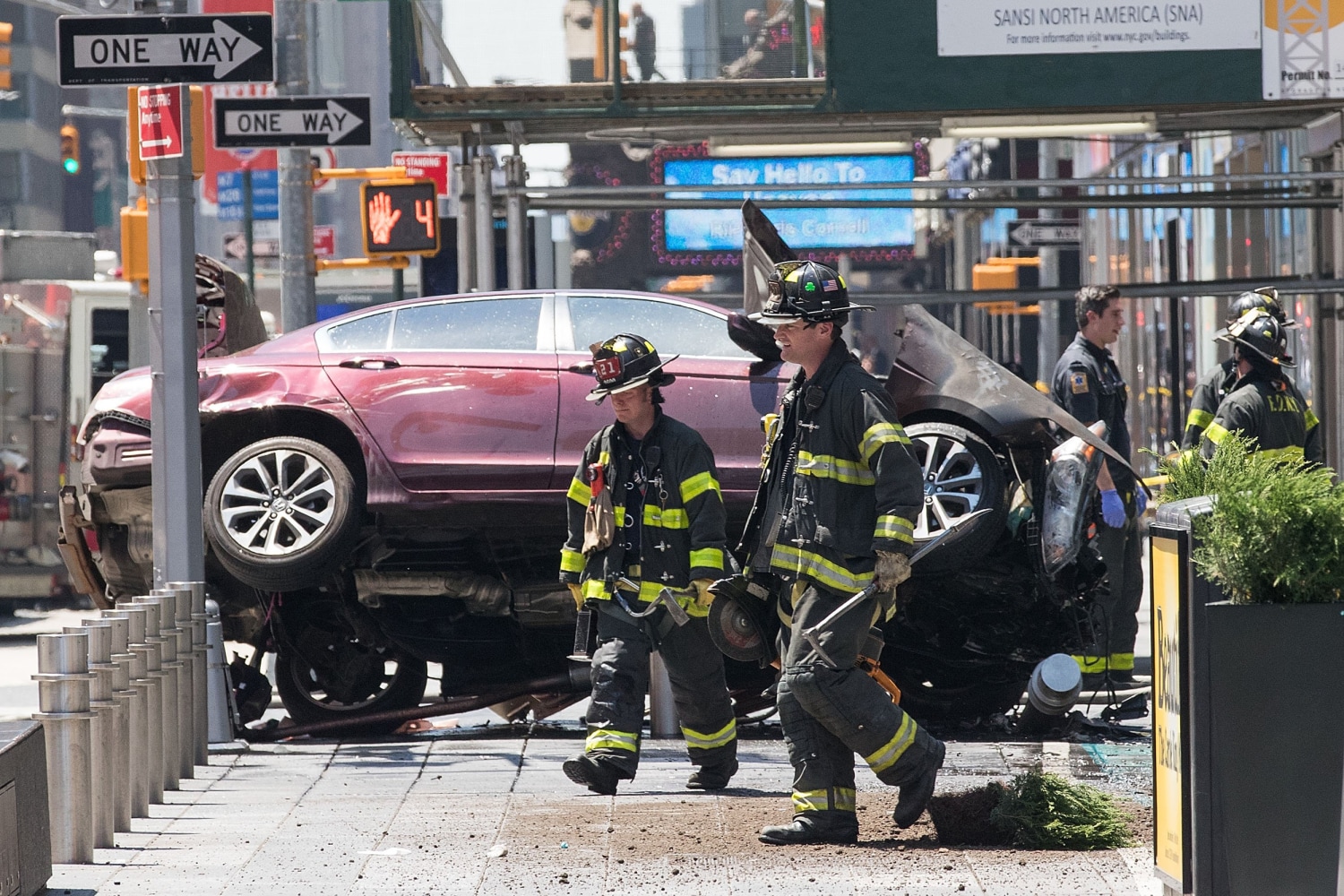
NEW YORK — A wrong-way driver plowed into pedestrians in the heart of Manhattan’s bustling Times Square district minutes before noon Thursday, killing at least one person and injuring nearly two dozen others, city officials said.

The high-speed 11:55 a.m. crash — which authorities initially said appeared accidental, and which is not believed related to international terrorism — left an 18-year-old woman dead at the scene and another 22 injured, New York City Mayor Bill de Blasio told reporters.

The driver of the 2009 Honda Accord, identified as 26-year-old Richard Rojas, was in custody and was charged late Thursday with second degree murder, 20 counts of attempted murder, and five counts of aggravated vehicular homicide, police said.


The Bronx native has a history of arrests for driving while intoxicated, as well as other infractions. Rojas was arrested for DWI in Queens in 2008 and earlier this month for menacing.

Police did not immediately release the cause of the crash. Two law enforcement sources say Rojas claims he heard voices and investigators are looking into the possibility it was a deliberate act.

IMAGE: Richard Rojas


IMAGE: Richard Rojas

« I was in shock, I was screaming, » witness Kristen Boyce told NBC New York. « No one even saw it coming. »

« All of a sudden I heard this boom and a car is barreling down Seventh Avenue hitting people, just, ‘Boom! Boom!’ And everyone just starts running, » she said. « We start running, we don’t know if another one is going to come, we don’t know what’s happening, everyone is panicking. »

Police said an officer tackled Rojas at the scene after he climbed out of the car, which could be seen partially lifted off the ground. The suspect was being tested for possible drug or alcohol intoxication.

Fire and emergency crews surrounded the chaotic crash site at the busy intersection of 42nd Street and 7th Avenue, which is typically swamped by tourists and office workers. The car was traveling in the wrong direction on the sidewalk for about three blocks before the crash occurred, police and witnesses said.

The Honda first mounted the sidewalk at 7th Avenue and West 42nd Street, NYPD Commissioner James O’Neill said. It stopped when it struck a metal stanchion.

IMAGE: Suspect of the Times Square car crash run away


IMAGE: Suspect of the Times Square car crash run away

« The vehicle, occupied by a male driver, proceeded to drive at a high rate of speed along the sidewalk, from 42nd Street to 45th Street, striking a number of pedestrians along the way, » O’Neill said.

The person who was killed was identified by police as 18-year-old Alyssa Elsman of Portage, Michigan. The deceased victim’s 13-year-old sister was among the injured and was taken to the hospital, police said.

The driver « accelerated across at an angle, went up on the curb and hit that whole group of people waiting, » witness Julie Fallo, 47, of New Jersey, told NBC News.


Of the 22 injured, 17 were taken to area hospitals, with four of those suffering what were described as serious injuries, the Fire Department said. Five people who were hurt declined medical attention at the scene.

A Homeland Security official in Washington also told NBC News that based on the preliminary information from authorities in New York this « appears to be an accident. »

« It’s a tough day for New York City, but as usual, the people in New York City will stand firm and be resilient, » de Blasio told reporters.

New York Gov. Andrew Cuomo was briefed at the scene. « Today’s events at Times Square were nothing short of horrific, » he said in a statement.

White House Press Secretary Sean Spicer tweeted that President Donald Trump was « made aware of the situation. »

Image: Alyssa Elsman


Image: Alyssa Elsman

Rojas was in the Navy, the military confirmed. He enlisted in 2011, and was his service ended in 2014. A law enforcement source said he was arrested in Florida on a driving under the influence charges, and was dishonorably discharged from the Navy.

Reports of the confusion and pandemonium initially raised fears of terrorism.

Federal officials have been warning truck owners and truck rental agencies in the U.S. to be « vigilant » about an increasing frequency of terrorist-related « ramming attacks, » NBC News reported earlier this month.

The frequency of such incidents appears to coincide with an ISIS leader telling followers in 2014 to use whatever weapons or tools, including vehicles, they have at their disposal for an attack.

The federal report found that at least 173 people have been killed and more than 700 wounded in 17 ramming attacks around the world. Those include incidents in Nice, France, where dozens were killed last July, and in Berlin, where a dozen people were killed in December.

Image: Car Crashes Into Pedestrians In Times Square


Image: Car Crashes Into Pedestrians In Times Square

The Latest: Trump denies asking Comey to shelve Flynn probe

WASHINGTON — The Latest on President Donald Trump (all times local):

4:40 p.m.

President Donald Trump has responded with a direct “no, no” to a question about whether he asked former FBI Director James Comey to shelve an investigation into his former national security adviser.

Trump also was questioned Thursday over revelations that he had shared secrets with the Russians. He denied this as well.

Comey associates this week revealed the existence of a memo Comey wrote after his Feb. 14 meeting with Trump in which he says the president asked him to shut down the FBI investigation into ousted National Security Adviser Michael Flynn.

Trump sent Comey a letter last week abruptly firing him.

___

4:25 p.m.

President Donald Trump says that the appointment of a special counsel for the ongoing investigation into his campaign’s ties to Russia “divides the country.”

Trump is reacting to the appointment of former FBI Director Robert Mueller to lead the investigation after he fired FBI Director James Comey.

Trump said Thursday that he respects “the entire thing” but said that he personally has no ties to Russia.

He reiterated his earlier comments that the investigation is a “witch hunt.”

Trump says, “we want to bring this country of ours together.”

Trump was speaking in a joint press conference with Colombia’s President Juan Manuel Santos.

___

3:55 p.m.

Deputy Attorney General Rod Rosenstein learned the day before President Donald Trump fired FBI Director James Comey that the law enforcement chief was going to be sacked.

That’s the word from Sen. Dick Durbin, the No. 2 Democrat in the Senate.

Durbin says Rosenstein told senators at a closed briefing Thursday that he “learned of the president’s decision to fire him (Comey) and then he wrote his memo with his rationale.” Durbin said Rosenstein learned on May 8.

He said Rosenstein didn’t tell lawmakers who told him to write the memo with the rationale for ousting Comey.

Durbin said there was frustration among some senators in the briefing because Rosenstein did not want to answer all their questions. He said Rosenstein’s reason was that he didn’t want to infringe on special counsel Robert Mueller.

___

3:40 p.m.

Deputy Attorney General Rod Rosenstein has told senators that he knew FBI Director James Comey was going to be fired even before he wrote a memo that provided a basis for Comey’s dismissal.

That’s according to Missouri Democratic Sen. Claire McCaskill. She addressed reporters after a closed-door meeting where Rosenstein briefed senators.

The White House pointed to Rosenstein’s memo last week as justification for Trump’s abrupt decision to dismiss Comey. In the memo Rosenstein criticized Comey’s handling of the Hillary Clinton email investigation.

But Trump himself has already said that he was going to fire Comey regardless — and the revelation from McCaskill appeared to bolster that version of events.

McCaskill said: “He did acknowledge that he learned Comey would be removed prior to him writing his memo.”

___

3:35 p.m.

President Donald Trump says he’s “very close” to naming a new FBI director.

Asked Thursday how close he is to making an announcement, Trump answered “soon.”

Trump was also asked whether former Connecticut Sen. Joe Lieberman was among the top contenders for the job. Trump’s response was “He is.”

Trump and Lieberman discussed the position at the White House on Wednesday. Three other potential candidates Trump interviewed on Wednesday are former Oklahoma Gov. Frank Keating, former top FBI official Richard McFeely and Andrew McCabe. McCabe became acting director after Trump fired James Comey as director last week.

Trump has said he could name a new director before he leaves Friday on his first overseas trip as president.

___

3:30 p.m.

President Donald Trump says the appointment of a special counsel to oversee the investigation of Russia’s interference in the 2016 election “hurts our country terribly.”

He says the move “shows we’re a divided, mixed-up, not unified country” and is “a very, very negative thing.”

The Justice Department announced Wednesday that former FBI Director Robert Mueller has been given sweeping power to investigate Russian interference in the 2016 presidential campaign, including potential links between Moscow and Trump campaign associates.

The president spoke at a lunch with news anchors at the White House.

Several attendees posted excerpts online.

___

2:35 p.m.

Former CIA Director John Brennan will appear before the House intelligence committee next week to answer questions about allegations of Russia’s meddling in the presidential election.

The committee announced Thursday that Brennan will appear Tuesday at an open session.

The House and Senate intelligence committees are looking into Russian interference in last year’s election as well as any coordination that Trump officials may have had with Russian officials.

___

1:35 p.m.

House Democratic Leader Nancy Pelosi is mocking President Donald Trump’s complaints about unfair treatment by the news media.

Pelosi herself has long been a target of Republican criticism. She scoffed at Trump’s claim that he’s been treated “more unfairly” than any politician in history, saying Thursday, “Get some thick skin, OK?”

Pelosi also ridiculed Trump’s complaint about a “witch hunt” following the naming of a special counsel to investigate possible Trump campaign ties to Russia.

She asked, “How did he spell witch hunt?” a reference to Trump’s frequent misspellings on Twitter. He misspelled the word “counsel” on Thursday.

Pelosi calls the White House unruly and undisciplined and says it “needs adult supervision.”

___

1:10 p.m.

The chairman of the Senate intelligence committee says his panel has not received a response from Michael Flynn’s lawyer — correcting his earlier statement that Flynn would not comply with a subpoena.

Republican Sen. Richard Burr of North Carolina says ousted National Security Adviser Flynn’s attorneys “have not yet indicated their intentions regarding the Senate Intelligence Committee’s subpoena” as part of the panel’s probe into Russia’s meddling in the 2016 presidential election.

Burr says he would welcome Flynn’s willingness to cooperate. Hours earlier, Burr said Flynn’s lawyer said he wouldn’t comply, “and that is not a surprise to the committee. We’ll figure out on General Flynn what the next step, if any, is.”

___

10:31 a.m.

Russian Foreign Minister Sergey Lavrov is mocking U.S. news reports suggesting President Donald Trump shared sensitive intelligence with him about terror threats involving laptops on airplanes.

Lavrov didn’t directly confirm details of their conversation. But he told reporters Thursday in Cyprus that he doesn’t understand what the “secret” was, since the U.S. introduced a ban on laptops on airlines from some Middle Eastern countries two months ago.

He joked that some U.S. media were acting like communist newspapers during the Soviet Union and not offering real news.

Lavrov says media reported that Trump told him “terrorists are capable of stuffing laptops, all kinds of electronic devices, with untraceable explosive materials,” information he says the administration revealed with the laptop ban.

___

11:45 a.m.

The House intelligence committee is asking for more government documents — this time about the ouster of FBI Director Jim Comey and conversations he had with President Donald Trump about investigations into Russian meddling in the election.

The committee said Thursday it sent a letter requesting material from the FBI and Justice Department related to its ongoing counterintelligence investigation.

Texas Republican Mike Conaway and California Democrat Adam Schiff say they will continue to work with the FBI as the investigation moves forward.

___

11:25 a.m.

A lawyer for fired National Security Adviser Michael Flynn has informed the Senate Intelligence Committee he will not honor its subpoena for private documents. That’s according to the panel’s chairman, Republican Sen. Richard Burr of North Carolina.

Burr told reporters Thursday about the response from Flynn’s lawyer. Burr says the panel’s members are not surprised and says, “We’ll figure out on Gen. Flynn what the next step, if any, is.”

The committee is one of several on Capitol Hill investigating possible collusion between Russia and President Donald Trump’s 2016 campaign.

Flynn was ousted earlier this year from his senior administration job.

___

7:55 a.m.

President Donald Trump is assailing the naming of a special counsel as “the single greatest witch hunt of a politician in American history!”

Trump is responding to the appointment of former FBI Director Robert Mueller as special counsel to lead a probe of allegations that Trump’s campaign collaborated with Russia to sway the election.

In another tweet Thursday morning, he claims, “With all of the illegal acts that took place in the Clinton campaign Obama Administration, there was never a special councel (sic) appointed!” Trump later deleted and retweeted that statement to correct the spelling of “counsel.”

He did not provide examples or evidence of any alleged “illegal acts.”

Trump fired FBI Director James Comey last week, prompting some to call for an independent prosecutor to lead the investigation.

The White House says an investigation will prove there was no collusion.

___

3:26 a.m.

The Justice Department has appointed former FBI Director Robert Mueller (MUHL’-ur) as a special counsel to lead a federal investigation into allegations that Donald Trump’s campaign collaborated with Russia to sway the 2016 election that put him in the White House.

Mueller will have sweeping powers and the authority to prosecute any crimes he uncovers.

The surprise announcement to hand the probe over to Mueller, a lawman with deep bipartisan respect, was a striking shift for Trump’s Justice Department, which had resisted increasingly loud calls from Democrats for an outside prosecutor.

It immediately escalated the legal stakes — and the potential political damage — for a president who has tried to dismiss the matter as partisan witch hunt and a “hoax.”

Copyright 2017 The Associated Press. All rights reserved. This material may not be published, broadcast, rewritten or redistributed.

A Guide to Mastering Live-Video Marketing and Livestreaming …

If you’re keeping an eye on digital marketing trends, it’s no secret that video has become a more and more significant piece of the content marketing mix.

By the year 2020 video will account for 82% of all consumer Internet traffic, according to Cisco, so it’s no longer optional for marketers to jump in and make some space for video content in their strategies.

In a digital world overflowing with content, video is one of the most effective ways to engage with audiences, since it can be a more digestible and personal form of interaction than written content. At the same time, there’s a gradual shift away from over-edited glossy videos to unscripted, unedited sharing-the-moment videos that are way more sincere and authentic.

One of the best examples—winning the hearts of audiences everywhere—is live video.

Livestreaming is one of the most rapidly growing trends now, as it provides a way to share the experiences in real-time. Brands are actively incorporating live video it into their marketing strategies, and major social media platforms are aligning themselves with livestreaming.

Snapchat and Twitter-owned Periscope have been there for a while already. Facebook caught up with the trend in 2016 with Facebook Live, and Instagram has also released a livestream broadcasting feature.

A highly valuable characteristic of live video is how versatile it is, allowing you to experiment with diverse types of content at relatively low cost.

So, this article will provide tips and tricks at how you can use video livestreaming—and do it right.

1. Live Interactive Tutorials and QAs

Marketing isn’t solely about selling your products; it’s also about showing your customer how helpful you can be, thus generating loyalty to the brand and provoking interest around the topic you cover.

One of the best ways to use live video for those purposes might be to run a live show that is both entertaining and educational—an interactive lecture or a live how-to demonstration. As an added personal touch, and to entice viewers back, you can suggest viewers brainstorm future topics to cover in the comments section.

A good example is the Office Hours hangouts broadcast by the Google Webmaster team. Once in a while, users are invited to join live to discuss webmaster topics and get questions answered by all kinds of experts joining the hangouts. The sessions are announced and questions collected through social networks in advance; once the hangout starts, the host invites viewers to jump in to make comments and share thoughts, which makes the video experience interactive.

Some tips:

  • Have a plan, but be flexible. Have a specific point to cover, but don’t overthink it ; leave some space for user-contributed suggestions and questions. Be personal and helpful, and do your best finding a balance between delivering and interacting.
  • Practice. Facebook Live, for instance, allows running a private live session, visible to you only. Simply adjust your privacy settings to Only Me before you tap the Go Live button—a great way to get camera-ready before going live in front of viewers.
  • Prepare a schedule. Routine can help grow an audience. People get in the habit of watching the show at a certain date and time, and they’ll know when to come back to hear about the topics they’ve suggested you cover in the future.

2. Live Events

Fully two-thirds of B2B marketers use in-person events as a part of their content marketing strategy, according to research from the Content Marketing Institute and MarketingProfs. Digitell’s experience has been that up to 35% of people who watch a livestream of an event attend that event in person the following year.

Streaming an event (whether a music festival or a conference) can be a fantastic way to attract new audiences despite distance and other obstacles, and build a worldwide online community around the event. It’s also a great opportunity to reach Millennials if you provide the content using new technologies they are so comfortable with.

An inspiring example is Coachella, an annual music and arts festival held in California, livestreamed in 2011 for the first time: The tickets to the event got sold out in three days in 2011 (before it was livestreamed)—and in three hours the year after. In 2016, while daily in-person attendance was close to 100,000 people, it attracted around 9 million live viewers in total.

Live video may be an even better fit for smaller events, which quite often have capacity limits. Live-streaming is a handy way to expand the capacity beyond the venue, while in-person participants still get the intimate experience of attending a closed event.

Some tips:

  • Promote beforehand. Make sure to spread the word about the upcoming event beforehand; promote it across all social networks, and provide the approximate streaming schedule.
  • Count down and mind the buzz. Start a countdown in your social profiles to remind followers of the start date. Come up with a catchy hashtag, use it every time you post anything about the event, and encourage your followers to take it over: Doing this will hugely help you collect feedback later, but it may also allow you to evaluate expectations before the event and clarify whether there’s anything you need to rethink.
  • Make it accessible, by all means. Make sure to find a proper time to livestream. Obviously, not all viewers across the globe will be able to fit your livestream into their schedules, but try detecting the time zone of the major part of your audience, and a convenient timeframe for them to join you live. In the same way, analyze which of the social networks offering live video streaming is the most popular and accessible among your potential viewers, and use it if possible.
  • Let online attendees participate a bit. Allow participation if it fits into the event format. For instance, if you are streaming a conference that has a QA session with speakers after each talk, think of a way to bring up some of the user-contributed questions from the live comments.
  • Do a bit of post-production work. In some networks (Facebook and Periscope), the video you’ve streamed will stick to your profile and may reach even a wider audience afterward, so you may also think of doing a moderate amount of post-production: Add an attractive description, or cut out the dead moments to make the experience as great for the later viewers.

3. Interviews and Discussions

An entertaining and useful way to use livestreaming is to host live interviews and discussions.

Invite an interesting guest or an influencer in your niche (to your studio or remotely) to cover a hot topic, share stories, or discuss current news. Allow users to ask questions along the way and pick up the most interesting ones occasionally during the discussion (or in the end, if it’s an interview your livestreaming). If there’s a danger that the show is becoming too promotional or company-centered, a great way to shift the focus to real people would be to arrange short, candid interview sessions with team members or customers (a brave move!).

A good example is the show streamed live, twice a week, by Live Streaming Pros. Occasionally, the hosts invite a guest to share an experience, a strategy, or proven tips. At the end, user-contributed questions are answered. A nice tip from Luria Petrucci, who hosts the show: Try not to rush while everybody is joining the livestream; begin with a kind of « question of the day » while monitoring the arriving viewers (and first answer it yourself to win some time, as the comments may display with a slight delay).

Some tips:

  • Promote and tease. Share some info about the guest who will be joining you, and drop hints about the important topic you’ll be discussing.
  • Prepare. This is not about producing polished webinars; still, you should have a plan in mind about how to structure the conversation and which questions to ask your guest.
  • Involve the viewers. Again, integrate questions from viewers into the discussion, or address questions at the end of the show (make clear that’s when you’ll get to them). Address viewers by name when referring to their questions.

4. Announcements and Live Launches

If there is exciting company news to share, an announcement to make, or a new product to launch… you can of course share the news with a press-release, on your website, and through social networks. However, if you livestream this kind of content, you will make viewers feel that you care about them enough to announce the news « personally » and therefore build in-the-moment excitement.

When launching a product, for example, you can reveal the details gradually and offer the viewers the intimate experience of seeing it first. If opening a store, you can share with the audience the step-by-step process it took to reach your goal, sharing unhappy and happy moments, and drawing in viewers and building a relationship with them along the way.

You can sum up the livestream with a live QA session to hear immediate feedback and cover the most pressing questions.

Adobe took this approach in 2015 with a 24-hour Periscope session to release its new product, Creative Cloud, and to share the excitement and its « vision for a connected creative process. » Apart from discussing new features, the main idea of the broadcast was to let viewers engage with the teams behind the product and ask any questions in a chat with 24 different team members—a great way to add the personal touch to the presentation!

Some tips:

  • Tease. Reveal details bit by bit, provide a teasing overview, but leave some space for curiosity by not giving away too much info.
  • Offer something special. Use live video to announce a special offer for your consumers; provide an exclusive special for viewers/online community.
  • Involve. Once people know you pay attention to their feedback, and once they feel involved and see the real efforts you’ve made behind the product, it will be of much higher perceived value to them.
  • Embrace the comments. While streaming, keep a balance between delivering the news and reacting to the comments and questions.
  • Show gratitude. Take a moment to thank your audience for coming along with you.

5. A Peek Behind the Scenes or at Company Culture

Nowadays, video is one of the best formats for storytelling, so it can be a great way to humanize the brand and make people feel they can relate to it. It can shed light on big companies that seem to lack transparency, and it can let consumers explore areas often inaccessible to the public.

Sharing company culture is a fantastic opportunity to break down the walls between a company/brand and its customers, helping to establish a more genuine connection.

Live video allows you to invite the audience to be your digital guest, and show viewers around your office; giving a sneak peek into how you get your work done is a proven way to engage.

Perhaps the most well-known example is General Electric, which started using Periscope to boost transparency and provide a behind-the-curtains look at the corporation. During « Drone Week, » the company shared a drone’s-eye view of its manufacturing facilities and machinery at GE sites across five different industries. The questions and comments followed the livestream itself and via the #droneweek hashtag in other social networks. According to Sydney Williams, global digital marketing manager at GE, the program was a huge success, so GE is planning on doing it again in summer 2017.

Some tips:

  • Promote. Yet again. Frame it as a personal invitation to be your guest.
  • Ask for feedback in advance. Collect the feedback before broadcasting; pay attention to what exactly the viewers are willing to see (company’s workspace or tools, the process of baking the cakes you sell, or members of the team). Ask viewers to prepare questions they would like to ask about your company.
  • Be personal. If possible, greet the viewers arriving to your stream by name, and try answering the most interesting questions as honestly as you can.
  • Include a call to action. Unobtrusively remind the viewers of other ways to engage and follow your company through social networks for even more interesting content.

The Outcome

« Afterlive » is as important as your actual in-the-moment, live video, so a common tip for any type of livestreaming would be analyze the results!

It would be a real time-saver to use a social-media listening tool (like Awario) to gather and systematize the feedback. Moreover, to react to the feedback right-away, retweet and repost best user quotes to your company social profiles. And mark the most constructive comments to help you revise and improve your process.

Live video is making its way to people’s screens more and more, so it’s high time to find your own way and make use of the trend—especially if you’re ready to think outside the box and to open the door to live feedback and new, genuine connections!

WANT TO READ MORE?
SIGN UP TODAY …
IT’S FREE!

We will never sell or rent your email address to anyone. We value your
privacy. (We hate spam as much as you do.) See our privacy policy.

Sign in with one of your preferred accounts below: