Archives par mot-clé : video prmotions

Small business to business video marketing can be as straightforward as shooting a melon

Owning and operating a number of medium-small retail websites that sell items that are difficult to ask for in person posed a marketing challenge to its owner Tom Nardone of Troy, Michigan who runs PriveCo. Although he saw the potential of selling an item such as the inexpensive bulletproof vest online according to a recent Associated Press (AP) article, Nardone realized that he needed to reach a wider audience than he was getting at gun shows. He began creating videos where he demonstrates the strength of the vest, shooting everything from watermelons to boxes of candy to illustrate what his bulletproof vest can and will do. The videos can be graphic, with items exploding at slow speed and Nardone sometimes splattered with barbecue sauce or peanut butter.

PriveCo’s videos have collected a following, according to the AP article, with the melon video earning nearly one million views. In the video, Nardone lines up seven melons and shoots them at point blank range. The video illustrates that one would have to carry around four water melons to match the protection Nardone gets from one inexpensive bullet proof vest. Nardone is often recognized at gun shows and has received compliments from people who like to watch him shoot items from gravel to boxed wine, AP notes.

« The vest does its job, but it’s nothing to look at, » Nardone says. « So we said, uh oh, we’ve got to come up with something good. »

It’s natural for some small businesses like real estate brokers to use videos in marketing campaigns for houses and other properties; for others, it can take some brainstorming and perhaps even an offbeat sense of humor to come up with something compelling, the article notes. But more businesses are getting on board — Facebook counted more than 3m small business videos posted in September, up 50% from 2m six months earlier, according to the company’s most recent published figures.

Arlington Machinery, which sells, repairs and appraises used plastic-making machines, began posting videos on YouTube nine years ago with several objectives. One was to raise the company’s rank in internet search results, and another was to display machines for prospective buyers. Or, if equipment was sent to the company for repair, videos could show the owners that the machines were ready to be sent back, the article notes.

But more recently, Arlington realized videos were also a way to market itself to different kinds of customers. The Elk Grove, Illinois-based company decided to have a little fun and commissioned the whimsical animated video that explains the company’s services.

« Used machinery is not all that exciting to most people, » says David Pietig, a general manager at the company. « What we’re trying to do is make people interested in what we do. »

Thinking about what customers want to see is the best way to get inspired, marketing experts say according to the AP article.

« Good ideas can come from everywhere. If there is an old-school mentality at a company, they should get a pool of 21-year-olds that are more digitally and socially media savvy, » suggests Brian Metcalf, CEO of GreenRoom, a digital marketing company based in Miami.

Making videos for these small businesses can cost almost nothing or run into the tens of thousands of dollars. Arlington Machinery says its animation cost only about $100, but Nardone paid more than $15,000 to produce a series of videos last summer. At Mountain View Vineyard, a Pennsylvania winery that began making videos in the past year, a smartphone and a still camera have kept the costs minimal.

When marketing director Laurie Monteforte started working at Mountain View a year ago, she made it a priority to create a campaign that included videos. But the standard way of selling wine — showing smiling people gathered around a food-laden table and lifting their glasses in a toast — won’t work in a video, she says.

« Today’s audience doesn’t want commercials, where we try to sell you something, » Monteforte said in the AP story.

Mountain View’s videos teach viewers how to make something with wine, such as red wine hot chocolate, or show some aspect of the winery’s operations. Last summer, owner Linda Rice demonstrated how she hand-picks Japanese beetles off of plants and drops them into soapy water, killing them without chemical pesticides.

Mountain View says its revenue is up about 30% in the past year, and credits about three-quarters of that gain to video and social media, the AP story notes.

« There are so many options where people can go for wine and spirits, » Rice says. « Video and social media set us apart because people get to know us. »

White House aides struggle to defend Trump wiretap claims

The White House on Monday attempted to defend President Trump’s unfounded claim that former president Barack Obama wiretapped Trump Tower near the end of the presidential campaign, sending out several administration officials — both on and off camera — to reiterate the assertion without providing supporting evidence. 

In tweets over the weekend, Trump claimed he had “just learned” that Obama wiretapped his midtown Manhattan skyscraper, where he lives and which housed his presidential campaign — accusing the former president of a potentially illegal act and writing that Obama was a “bad (or sick) guy.” 

Trump has since provided no proof to back up his assertion, which has been rebuffed by Obama, FBI Director James B. Comey and former director of national intelligence James R. Clapper Jr. On Monday, senior administration officials contorted themselves trying to defend the president’s claims, which seemed to emanate largely in response to a rant on conservative talk radio and in an article on Breitbart News, the conservative website that Stephen K. Bannon, Trump’s chief strategist, formerly led.

Speaking to reporters from the White House briefing room without cameras present, White House press secretary Sean Spicer referred reporters to his weekend statement calling on the House and Senate intelligence committees to investigate the wiretapping charges as part of their broader probe of alleged Russian interference in the 2016 presidential election. He refused to add clarity or context to Trump’s Twitter missives, saying neither the president nor the White House would comment further until the congressional investigations are completed.

“I’m just going to let the tweet speak for itself,” Spicer said. “I think the president speaks very candidly.” 

Spicer, citing news reports, said there was sufficient evidence to warrant further investigation at the congressional level. 

“I think that there’s no question that something happened. The question is, is it surveillance, is it a wiretap or whatever?” Spicer said. “But there’s been enough reporting that strongly suggests that something occurred.”

Asked whether he could unequivocally say that Trump’s tweet was based on more than a talk radio report and the Breitbart article, Spicer declined, again referring to his calls for the intelligence panels to take the lead.

Asked about the specific sourcing behind the president’s tweets, Spicer said there were several options: “It could be FISA, it could be surveillance,” he said, referring to the Foreign Intelligence Surveillance Act, under which a secret court can issue warrants for electronic surveillance on potential spies or terrorists. If there was a FISA wiretap of Trump during the campaign, it would mean that the court had found there was probable cause to believe he was acting as an “agent of a foreign power,” as the law requires.

In perhaps the clearest sign of the uncomfortable situation the president’s tweets created for his aides, the normally media-
hungry White House went largely dark Monday. Although several top officials did defend Trump in TV interviews, Spicer did not allow cameras into the briefing room for his news conference Monday, and Trump signed an executive order for his revamped travel ban in private.

Speaking on NBC’s “Meet the Press” on Sunday, Clapper did provide the White House with a bit of cover, saying there was “no evidence” of collusion between Trump and Russia during the campaign. But he also undercut the president’s assertion that Obama had wiretapped him, saying, “There was no such wiretap activity mounted against the president-elect at the time as a candidate or against his campaign.” 

President Trump and former president Barack Obama at the Capitol on Inauguration Day. On Monday, the White House attempted to defend Trump’s claim that Obama wiretapped Trump Tower. (Pool photo by Jack Gruber/USA TODAY NETWORK)

Spicer urged reporters to note Clapper’s comments about an apparent lack of collusion, but gave less weight to his remarks rebutting Trump’s claims of wiretapping. Asked about the difference, Spicer said, “He said that he wasn’t aware of anything. I take him at his word that he wasn’t aware, but that doesn’t mean that it didn’t exist.”

This reverse-engineering of evidence has happened before, as when the president declared erroneously that his inauguration crowd was the largest in history and when he claimed without evidence that at least 3 million undocumented immigrants illegally voted for Hillary Clinton in the general election.

The public face of this latest effort has mostly been deputy press secretary Sarah Huckabee Sanders, who was dispatched to a Sunday news show — even though Spicer and chief of staff Reince Priebus usually take that task — and to two Monday morning talk shows.

Huckabee Sanders admitted that she had not discussed the matter with the president, and she lacked answers to questions. When asked Monday by ABC News’s George Stephanopoulos whether the president accepted that Comey had refuted his tweets, she responded: “You know, I don’t think he does.”

Like Spicer, Huckabee Sanders claimed Trump’s accusations are supported by news media reports, even though a list of such articles provided by the White House contained no such evidence. She also attempted to recast the president’s words with a softer tone.

“Look, the president firmly believes that the Obama administration may have tapped into the phones at Trump Tower,” Huckabee Sanders said on NBC’s “Today” show on Monday. “This is something that we should look into. We’d like to know for sure.”

Huckabee Sanders repeatedly urged that the news media and others give the president the same benefit of the doubt that they seemed to be giving to those accusing the Trump campaign of coordinating with the Russian government.

“Look,” she said on the “Today” show, “I haven’t had the chance to have the conversation directly with the president, and he’s at a much higher classification than I am, so he may have access to documents that I don’t know about, but I do know that we take this very seriously.”

White House counselor Kellyanne Conway followed a similar script Monday on Fox News’s “Fox Friends,” saying there have been numerous media reports that there was “politically motivated activity all during the campaign and suggesting that there may be more there.”

“He’s the president of the United States,” Conway said. “He has information and intelligence that the rest of us do not. And that’s the way it should be for presidents.”

At times, it seemed that even West Wing officials had not coordinated their responses with one another. Asked about Conway’s comment Monday, Spicer said he hadn’t talked with her about what she meant.

“I can’t specifically respond to you in terms of what she was referring to, whether she was referring to the exact nature of this charge or whether generally speaking he is given information,” Spicer said.

Ultimately, the White House all but stated that the best person to explain or defend the president’s claims was the president himself. Asked by a reporter how it was appropriate for Trump to make an explosive statement and then send out his aides to “clean it up,” Spicer again referred back to Trump’s social media feed.

“The president’s tweets,” he said, “speak for themselves.”

Obamacare Lite? New GOP Health Care Bill Has Host of Critics

A new Republican health care plan keeps much of the basic framework set up by Obamacare, but with a conservative twist, analysts say.

But it’s full of holes, with no detail on how to pay for its provisions and no estimates at all of how much it will cost taxpayers.

While conservatives praised the emphasis on personal responsibility, liberals said it would take newly won health insurance away from millions and cost people protection from some of the worst abuses of the insurance industry.


And it’s not even clear if all Republicans in Congress will vote for it. At best, analysts agreed, it’s a work in progress.

« I think their basic overriding philosophy is to let the states decide a lot of things, which is sensible, » said economist Douglas Holtz-Eakin, president of the American Action Forum and a former director of the Congressional Budget Office.

Related: Entry Ban Could Cause Doctor Droughts in Pro-Trump States

Moments after the House Energy and Commerce and Ways and Means committees unveiled their plans on Monday, Michigan Republican Rep. Justin Amash called it « Obamacare 2.0 » on Twitter.

Kentucky Senator Rand Paul, another Republican, called it « Obamacare Lite. »

« What they kind of have is a repeal plus, » said healthcare expert Joe Antos of the American Enterprise Institute, who’s done stints in the Congressional Budget Office and the Health and Human Services Department.

« This is a kind of a hodge podge and I don’t see it’s much different from what we saw a few weeks ago, » Antos told NBC News.

The plan stops the unpopular mandate that required almost everyone to have some sort of health insurance. It replaces that by allowing health insurance companies to charge 30 percent higher premiums if customers had gone 63 days or more without health insurance.

Both provisions were meant to prevent people from waiting to buy health insurance until they were sick.

« That could encourage some healthy people to sign up initially, » said Larry Levitt, a health policy expert at the nonpartisan Kaiser Family Foundation.

Related: Is Obamacare Collapsing?

The 2010 Affordable Care Act required health insurance companies to cover anyone who wanted to buy insurance, and is laid out a minimum list of conditions that had to be covered or services provided, from pregnancy care to cancer screenings.

It stopped a once-common practice of capping coverage once a customer started costing too much, and aimed to limit bare-bones plans that covered almost nothing.

Many of these appear to be preserved in the new plans, at least for a time, along with another popular provision that allowed young adults to stay on their parents’ plans until they turned 26.

The new American Health Care Act would allow health insurance companies to charge older people five times as much as they charge younger clients — the current limit is three times as much.

Taxes that paid for the old Obamacare subsidies, which helps an estimated 85 percent of people who bought private health insurance on the exchanges, are gone. Instead of subsidies, the plan provides tax credits for people making less than $75,000 a year.

There are few details on how the Republicans plan to pay for the tax credits, however.

« I don’t understand where the money comes from. I understand what they have taken away, said Republican health economist Gail Wilensky, who now is a senior fellow at Project HOPE. « It’s just a mystery. »

Ron Pollack, executive director of Families USA, a strong supporter of Obamacare, said it will return many Americans to pre-Obamacare days.

« This bill would strip coverage from millions of people and drive up consumer costs. It shreds the Medicaid social safety net that serves more than 72 million people, including many children, senior citizens and people with disabilities, » said Pollack. « And it once again leaves millions of people in America with chronic illness and disease at the mercy of insurance companies. »

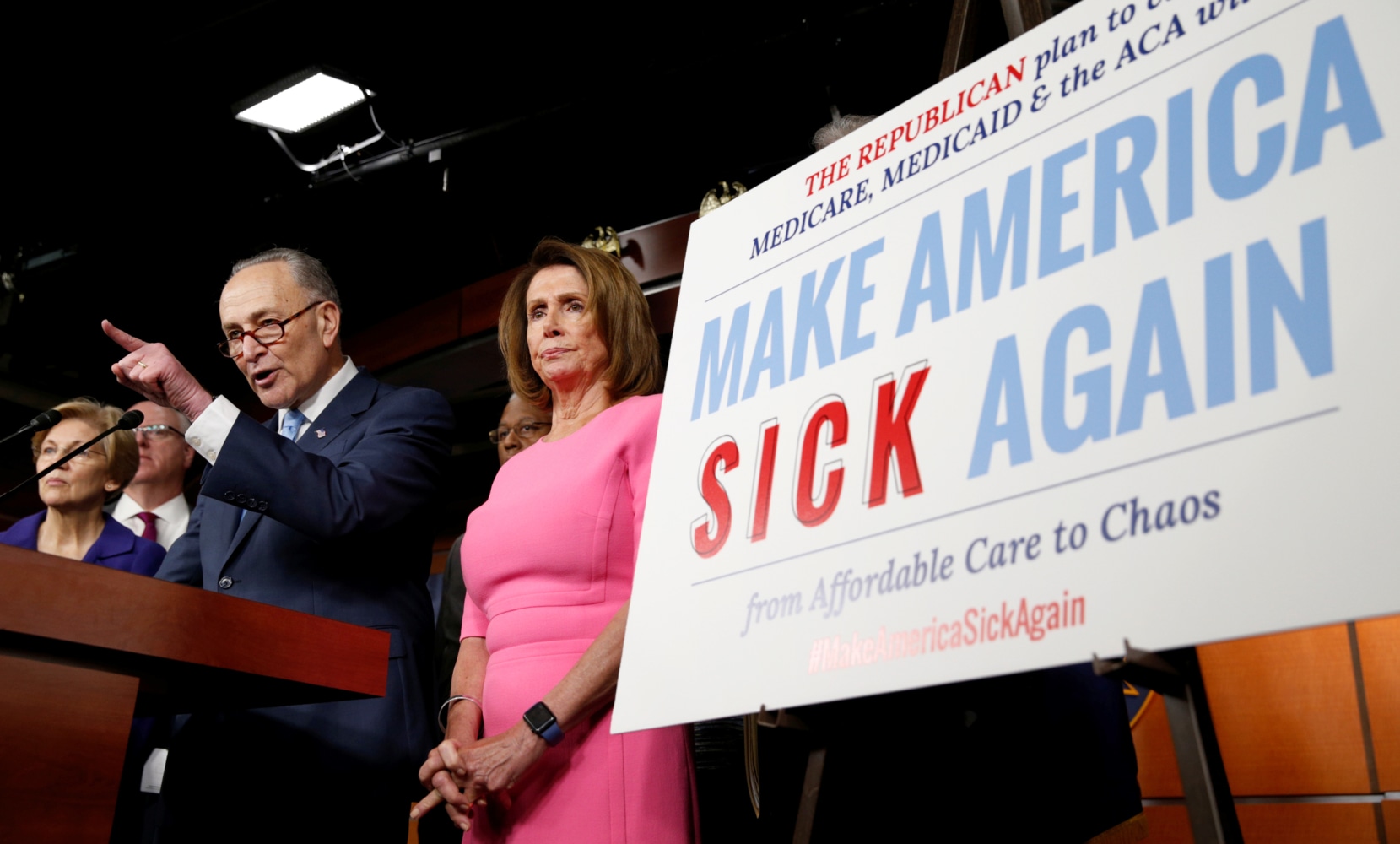
Image: Senate Democratic Leader Chuck Schumer and House Democratic Leader Nancy Pelosi


Image: Senate Democratic Leader Chuck Schumer and House Democratic Leader Nancy Pelosi

House Democratic leader Nancy Pelosi of California called it a « Make America Sick Again » bill.

« Republicans even enable insurers to once again charge more or deny coverage to millions of Americans with pre-existing conditions, abandoning those families who lapse in coverage for any reason at all, » she said

House Energy and Commerce Committee Ranking Member Frank Pallone, Jr., a New Jersey Democrat, and Ways and Means Committee Ranking Member Richard Neal of Massachusetts said they could would not support the plan.

« The Republican repeal bill would rip health care away from millions of Americans, ration care for working families and seniors, and put insurance companies back in charge of health care decisions — contrary to everything President Trump has said he would do with his health care plan, » they said in a joint statement.

The plan sets out a path to revising Medicaid, the joint state-federal health plan for low income people. It allows the 31 states plus Washington D.C. that expanded Medicaid under the Affordable Care Act to keep getting federal funding to do that but inexplicably leaves out the 19 most Republican states that refused to take part.

Instead, those states will get cash. It’s not enough, said Wilensky. « I don’t think $10 billion is enough, » she said.

Baltimore City Health Commissioner Dr. Leana Wen says the changes to Medicaid will eventually leave many people out in the cold. « Medicaid provides the ultimate safety net for individuals who need it the most. I am extremely concerned about that, » she said.

The ACA was designed to get health insurance to more Americans, and it did. At least 20 million more people have health insurance than before the law was enacted, about half of them on new exchanges set up to help people buy private health insurance, often with federal subsidies, and about half through an expansion of Medicaid.

In 2010, the year the law was signed, 48.6 million Americans or 16 percent of the population had no health insurance. The ACA brought that to below 9 percent.

Republicans are wary of making changes that will take health insurance away from millions of Americans, but are under pressure to make the reforms look more like a return to private industry, with less government oversight.

Antos said the plan may compromise too much.

« Some Republicans will say, ‘No, you’ve gone too far (and) give things away’ and other Republicans will say, especially in the Senate, ‘you haven’t gone far enough to say what you are going to replace it with’, » he said.

« So it seems like there’s a sweet spot here, but it’s not a sweet spot that a politician would want to be in. »

Sikhs respond to shooting near Seattle with fear, disbelief

Fear, hurt and disbelief weighed on the minds of those who gathered at a Sikh temple Sunday after the shooting of a Sikh man who said a gunman approached him in his suburban Seattle driveway and told him « go back to your own country. »

« Everybody who is part of this community needs to be vigilant, » Satwinder Kaur, a Sikh community leader, said as several hundred people poured into a temple in Renton for worship services about one mile from Friday night’s shooting.

« It is scary, » she added. « The community has been shaken up. »

Authorities said a gunman approached the 39-year-old Sikh man as he worked on his car in his driveway in the city of Kent, about 20 miles south of Seattle. The FBI will help investigate the shooting, authorities said.

Kent Police Chief Ken Thomas said the department is investigating the shooting as a hate crime. He said no arrests have been made yet after the victim was shot in the arm but that he did not believe anyone was in imminent danger.

« This is a top priority investigation, and we are doing everything possible to identify and arrest the suspect, » Thomas said in an email, adding that residents in the city of about 125,000 should « be vigilant » but also not let the shooting hurt their quality of life.

The FBI’s Seattle office said in a statement Sunday that it is « committed to investigating crimes that are potentially hate-motivated, » the Seattle Times reported.

The shooting comes after an Indian man was killed and another wounded in a recent shooting at a Kansas bar that federal agencies are investigating as a hate crime after witnesses say the suspect yelled « get out of my country. »

Friday night’s shooting was on the minds of many who gathered at a Sikh Temple in nearby Renton Sunday morning for worship. Women in colorful saris and headscarves and men wearing turbans sat on the floor on opposite sides inside the worship space.

As they entered and left the services, many expressed fear that one of their own was targeted and said they’re scared to go to the store or other public places. Some said they have noticed an uptick in name-calling and other racist incidents in recent months. Still others expressed hurt and disbelief at the lack of understanding and ignorance.

« Sikhism teaches about equality and peace, » said Sandeep Singh, 24. « It’s sad to see that’s what it has come to, » he said of the violence. « This is our country. This is everyone’s country. »

Gurjot Singh, 39, who served in the Marine Corps and is an Iraq war veteran, said he was dismayed that people think others who look different aren’t equal or don’t contribute equally to the community.

« This is equally my country as it is your country, » he said. « It doesn’t anger me. It hurts me. »

Hira Singh, a Sikh community leader, said there have been increasing complaints recently from Sikhs near Seattle who say they have been the target of foul language or other comments.

« This kind of incident shakes up the whole community, » he said, adding that about 50,000 members of the faith live in Washington state.

Kent Councilwoman Brenda Fincher went to the temple Sunday to show support for the community. « When a hate crime happens, we have to stand up and make sure everyone knows it’s not acceptable, » she said.

Kent police have not identified the man or released other information. But India’s foreign minister, Sushma Swaraj, identified the victim on Twitter early Sunday, saying, « I am sorry to know about the attack on Deep Rai, a U.S. national of Indian origin. »

She said she had spoken to Rai’s father, who told her Rai is out of danger and recovering in a hospital.

Rai told police a man he didn’t know came up to him Friday night and they got into an argument, with the suspect telling Rai to go back to his homeland. He described the shooter as 6 feet tall and white with a stocky build, police said. He said the man was wearing a mask covering the lower half of his face.

« All of the information that I have available at this time suggests that the information provided by the victim is credible, » Thomas, the police chief, wrote.

Sikhs have previously been the target of assaults in the U.S. After the Sept. 11, 2001, attacks, the backlash that hit Muslims around the country expanded to include those of the Sikh faith. Men often cover their heads with turbans, which are considered sacred, and refrain from shaving their beards.

In 2012, a man shot and killed six Sikh worshippers and wounded four others at a Sikh temple near Milwaukee before killing himself.

The Sikh Coalition, a national civil rights group, on Sunday said everything must be done « to confront this growing epidemic of hate violence. »

« We are all accountable for what happened in Kent, Washington on Friday night, » Jasmit Singh, a Seattle-area community leader, said in a statement.

Raj Singh Ajmani, who lives in Bellevue, said he was shocked by the shooting.

« When it happens in your own community, you realize the danger and the times we’re living in, » he said before heading to service. « Some people worry that more such violence will occur because of President Trump. »

Marines’ Nude Photo-Sharing Scandal Prompts Calls for Justice

In the wake of the revelation that a large group of active-duty Marines is under investigation for sharing nude photos of female troops without their consent, a senior congressman is calling on the Marine Corps to take swift and decisive action.

Rep. Adam Smith, ranking member of the House Armed Services Committee, released a statement Sunday calling the alleged behavior by Marines and Marine Corps veterans « degrading, dangerous, and completely unacceptable. »

« I expect that the Marine Corps Commandant, General Neller, will use his resources to fully investigate these acts and bring to justice any individuals who have broken the law and violated the rights of other servicemembers, » the Washington Democrat said.

« He must also ensure that the victims are taken care of. The military men and women who proudly volunteer to serve their country should not have to deal with this kind of reprehensible conduct, » Smith added.

The investigation was made public Saturday evening by reporter Thomas James Brennan, who reported for Reveal News that members of the private Facebook group Marines United had shared dozens of nude photos of female service members, identifying them by name, rank and duty station. Group members also linked out to a Google Drive folder containing more compromising photos and information, Brennan reported.

A Marine Corps official confirmed an investigation was ongoing, but could not confirm that hundreds of Marines were caught up in it, as Brennan reported. The official referred queries about specifics to Naval Criminal Investigative Service, which did not immediately respond Sunday.

« The Marine Corps is deeply concerned about allegations regarding the derogatory online comments and sharing of salacious photographs in a closed website, » Marine Corps spokeswoman Capt. Ryan Alvis said in a statement provided to Military.com. « This behavior destroys morale, erodes trust, and degrades the individual. »

Of allegations are substantiated, active-duty Marines involved in the photo-sharing ring could be charged with violating UCMJ Article 134, general misconduct, for enlisted troops, and Article 133, conduct unbecoming, for officers, Alvis said. If Marines shared a photo taken without the subject’s consent and under circumstances for which there was a reasonable expectation of privacy, they may be charged with Article 120, broadcasting or distribution of indecent visual recording, she said.

« A Marine who directly participates in, encourages, or condones such actions could also be subjected to criminal proceedings or adverse administrative actions, » Alvis said.

To underscore the significance of the allegations to Marine Corps leadership, both Neller and Sergeant Major of the Marine Corps Ronald Green released statements condemning the alleged behavior.

« I am not going to comment specifically about an ongoing investigation, but I will say this: For anyone to target one of our Marines, online or otherwise, in an inappropriate manner, is distasteful and shows an absence of respect, » Neller said in a statement provided to Military.com. « The success of every Marine, every team, every unit and command throughout our Corps is based on mutual trust and respect. »

Green went further, releasing a 319-word statement in the form of an open letter calling the online photo-sharing « demeaning » and « degrading » and adding there was no place for it in the Corps.

« We need to be brutally honest with ourselves and each other. This behavior hurts fellow Marines, family members, and civilians. It is a direct attack on our ethos and legacy, » he said. « As Marines, as human beings, you should be angry for the actions of a few. These negative behaviors are absolutely contrary to what we represent. It breaks the bond that hold us together; without trust, our family falters. »

Messages Brennan shared with Military.com show that some members of the group responded to his report by threatening him and his family and attempting to publish information about where he lived.

« ‘Amber Alert: Thomas J. Brennan,' » wrote one user, referring to the child abduction emergency system. « 500.00 $ for nudes of this guys girl, » wrote another.

Brennan is a former infantry Marine and combat veteran.

This is not the first time the bad behavior of Marines online has captured the attention of Congress.

In 2013, the harassment of civilian women and female troops on several so-called « humor » Facebook pages with Marine Corps members prompted Rep. Jackie Speier, a Democrat from California, to call on then defense secretary Chuck Hagel and then-commandant Gen. Jim Amos to intervene.

But in that instance, Marine Corps leadership opted to address the behavior privately, and on a case-by-case basis. No criminal prosecutions of Marines connected to the Facebook pages were ever publicized.

A later 2014 report on similar behavior resulted in investigations into 12 Marines, according to internal public affairs guidance published by Marine Corps Times.

As the first female Marines join infantry units in the wake of a 2015 Pentagon mandate opening all ground combat jobs to women, it’s possible service leaders now feel an additional mandate to quell the online exploitation of female service members by their colleagues publicly and decisively.

« Standup, speak out, and be a voice of change for the better. Hold those who misstep accountable, » Green said. « We need to realize that silence is consent–do not be silent. It is your duty to protect one another, not just for the Marine Corps, but for humanity. »

— Hope Hodge Seck can be reached at hope.seck@military.com. Follow her on Twitter at @HopeSeck.

FBI Director Comey asked Justice officials to refute Trump’s unproven wiretapping claim

FBI Director James B. Comey asked the Justice Department this weekend to issue a statement refuting President Trump’s claim that President Barack Obama ordered a wiretap of Trump’s phones before the election, according a U.S. official, but the department has not done so.

Comey made the highly unusual request on Saturday after Trump accused Obama on Twitter of having his “‘wires tapped’ in Trump Tower. »

The revelation, first reported by the New York Times, underscores the fraught nature of the FBI’s high-profile investigation into Russian meddling in the 2016 election. A key question fueling the probe is whether Trump associates colluded with Russian officials to help Trump win.

Justice declined to comment late Sunday afternoon, as did the FBI.

The development came as Trump’s charge against Obama — leveled without any evidence — was being rebuffed both inside and outside of the executive branch. And it drew a blunt, on-the-record denial by a top intelligence official who served in the Obama administration.

Speaking on NBC News on Sunday morning, former director of national intelligence James R. Clapper Jr. denied that a Foreign Intelligence Surveillance Act (FISA) wiretap was authorized against Trump or the campaign during his tenure.

“There was no such wiretap activity mounted against the president-elect at the time as a candidate or against his campaign,” Clapper said on “Meet the Press,” adding that he would “absolutely” have been informed if the FBI had received a FISA warrant against either.

“I can deny it,” Clapper said emphatically.

In his claims early Saturday morning, the president tweeted that he “just found out” that Obama had “my ‘wires tapped’ in Trump Tower » before the election, comparing it to “McCarthyism.”

“Is it legal for a sitting President to be ‘wire tapping’ a race for president prior to an election?” Trump asked in another tweet. “Turned down by court earlier. A NEW LOW!”

By Sunday morning, the White House doubled down on Trump’s explosive tweetstorm and called for a congressional probe into « politically motivated investigations. »

Current and former government officials said such surveillance would not have been approved by any senior Justice official in the Obama administration. Trump’s allegation raised hackles in the FBI leadership, insinuating as it did that the bureau may have acted illegally to wiretap a presidential candidate without probable cause that he was an “agent of a foreign power,” as the foreign intelligence surveillance law requires.

“This is Nixon/Watergate,” Trump tweeted Saturday.

White House press secretary Sean Spicer on Sunday cited “reports” of “potentially politically motivated investigations” during the 2016 campaign, calling them “troubling.” But none of the media reports cited by the White House provides evidence of a politically motivated surveillance effort against Trump.

“President Donald J. Trump is requesting that as part of their investigation into Russian activity, the congressional intelligence committees exercise their oversight authority to determine whether executive branch investigative powers were abused in 2016, » Spicer said. “Neither the White House nor the President will comment further until such oversight is conducted,” the statement added.

Congressional committees in the House and the Senate are probing suspected Russian efforts to undermine the 2016 election as well as any contacts between Russian officials and the Trump campaign.

Trump’s tweets early Saturday may have been prompted by the comments of a conservative radio host, which were summarized in an article on the conservative website Breitbart. The Breitbart story had been circulating among Trump’s senior aides on Friday.

A spokesman for Obama on Saturday said the former president never authorized a wiretap of Trump or any other American citizen.

The White House’s escalation of Trump’s claims were kept at arm’s length by congressional Republicans appearing on Sunday morning news broadcasts.

When asked about Trump’s allegations, Senate Intelligence Committee member Tom Cotton (R-Ark.) declined to comment on the tweets but said he has “seen no evidence of the allegations.”

“Whether that’s a FISA court application or denial of that application or a re-submission of that application, that doesn’t mean that none of these things happened. It just means we haven’t seen that yet,” Cotton added, speaking on Fox News Sunday.

Sen. Marco Rubio (R-Fla.) said he is not aware of evidence to back up the president’s claim. “I have no insight into exactly what he’s referring to,” he said on “Meet the Press.” “The president put that out there, and now the White House will have to answer for exactly what he was referring to.”

Obama’s allies were more blunt, denying flatly that the former president had ordered a wiretap of Trump’s campaign.

“This may come as a surprise to the current occupant of the Oval Office, but the president of the United States does not have the authority to unilaterally order the wiretapping of American citizens,” said former Obama White House press secretary Josh Earnest.

Senate Minority Leader Charles E. Schumer (D-N.Y.) told “Meet the Press” that Trump is “in trouble” and acting “beneath the dignity of the presidency.”

“The president’s in trouble if he falsely spread this kind of information,” Schumer said. “It shows this president doesn’t know how to conduct himself.”

Earnest added that Trump was attempting to distract from the controversy involving contacts between his campaign aides, including now-Attorney General Jeff Sessions, and Russian officials.

“We know exactly why president Trump tweeted what he tweeted,” Earnest added. “Because there is one page in the Trump White House crisis management playbook, and that is simply to tweet or say something outrageous to distract from a scandal. And the bigger the scandal, the more outrageous the tweet.”

Appearing on ABC’s “This Week,” White House deputy press secretary Sarah Huckabee Sanders repeatedly said that the president’s allegation was worth looking into.

“He’s asking that we get down to the bottom of this, let’s get the truth here, let’s find out,” Huckabee Sanders said. “I think the bigger story isn’t who reported it, but is it true. And I think the American people have a right to know if this happened, because if it did, again, this is the largest abuse of power that, I think, we have ever seen.”

Asked whether Trump truly believes Obama wiretapped him, Huckabee Sanders deflected.

“I would say that his tweet speaks for itself there,” she said.

Clapper’s comments referred only to whether Trump campaign officials had been wiretapped. But their conversations could also have been captured by routine surveillance of Russian diplomats or intelligence operatives.

U.S. monitoring of Russian Ambassador Sergey Kislyak, for example, caught his conversations with Trump adviser Michael Flynn during the campaign. Flynn went on to become Trump’s national security adviser, but he was forced to resign last month after admitting that he had misled other senior Trump officials about the nature of those conversations.

The FBI and the National Security Agency also have obtained intercepted communications among Russians officials in which they refer to conversations with members of the Trump team, current and former U.S. officials have said.

On the broader question of apparent Russian interference in the 2016 election, Clapper urged congressional investigators to attempt to settle the issue, which he said has become a “distraction” in the political sphere.

The intelligence community found no evidence of collusion between the Trump campaign and the Russian government — at least until the end of the Obama administration, he said Sunday.

“We had no evidence of such collusion,” he said on “Meet the Press.” But Clapper added a caveat: “This could have unfolded or become available in the time since I left government.”

Whether there was any collusion is a key question fueling a wide-ranging federal probe into Russian interference in the 2016 presidential campaign.

On Jan. 6, the U.S. spy agencies collectively released a report concluding that Russia carried out cyberhacks and other “active measures” with an intent to help Trump and harm the campaign and potential presidency of Hillary Clinton. The report, Clapper pointed out, included “no evidence” of collusion with the Trump campaign.

But the investigation by the FBI, the NSA and the CIA continues. The Senate and House intelligence committees also are conducting investigations.

Ellen Nakashima, Aaron Blake, Greg Jaffe and Robert Costa contributed to this report.

Russia is the slow burn of the Trump administration, and it’s not going away

Russia has become the slow burn of President Trump’s administration. It is the issue that he and his team cannot get beyond. They cannot get beyond it because they are skittish about accepting what is already known. They cannot get beyond it because they have not been as forthcoming as they could be about what they did. They cannot get beyond it because they don’t know what they don’t know.

It’s important to remember that much isn’t yet known about the whole controversy, particularly the contacts between Trump campaign officials or advisers and the Russians. That there were contacts is not in dispute. Some appear routine, but the circumstances and the content of all those contacts is far from fully known. It’s possible they will add up to little or nothing. It’s also possible they will add up to something significant.

The controversy involving Attorney General Jeff Sessions provides the latest example of why the issue won’t go away soon. Sessions failed to tell the truth during his confirmation hearings about meeting with Russian Ambassador Sergey Kislyak, and allegedly no one in the White House knew of those meetings until The Washington Post broke the story last Wednesday.

During his confirmation hearing, Sessions was asked one question but answered another, and in so doing, did not tell the truth. Sen. Al Franken (D-Minn.) asked Sessions, “If there is any evidence that anyone affiliated with the Trump campaign communicated with the Russian government in the course of this campaign, what will you do?”

This was a prospective question, with Franken asking the likely next attorney general how he would handle such allegations if intelligence officials produced such evidence. Sessions chose to answer it this way: “I’m not aware of any of those activities. I have been called a surrogate at a time or two in that campaign, and I did not have communications with the Russians, and I’m unable to comment on it.”

Sessions was neither responsive to Franken’s question nor was he forthcoming about having met with Kislyak, first in passing at the Republican National Convention last July and then for a fuller conversation in September in his Senate office. It was a double error. When the real story came out, he announced that he would recuse himself from any investigation into Russia’s role in the 2016 election.

Something similar happened Thursday night. Sessions was asked by Tucker Carlson of Fox News, “Did the [Trump] campaign believe that the Russian government, the Putin government, favored Trump over [Hillary] Clinton?” Sessions replied, “I have never been told that.” Carlson then asked, “Do you think they did?” Sessions responded: “I don’t have any idea, Tucker. You’d have to ask them.”

A Justice Department spokeswoman said that Sessions was answering to the literal question, by saying that no one in the Trump campaign had ever told him anything like that and that he didn’t know whether anyone in the campaign thought the Russians were favoring Trump over Clinton. But when he said, “You’d have to ask them,” was the “them” in reference to Trump campaign officials, of which he was one, or the Russians?

Whichever, that answer was not adequate, given the supercharged nature of the situation and the controversy he had created by not having volunteered that he had met with Kislyak. Sessions easily could have said that, while no one in the campaign had told him that they thought the Russians were trying to help Trump, the intelligence community in fact had reached that conclusion and that he accepted those findings.

After all, the FBI, which Sessions now oversees, was one of three main signatories, along with the CIA and the National Security Agency, on that January intelligence document. Sessions also could have added that he did not think that Russian interference changed the outcome of the election and that Trump was duly elected president.

This is a pattern that has compounded the administration’s problem. Trump apparently sees the entire issue as an attempt to delegitimize his presidency. The president also has continued to equivocate on the question of whether he truly believes the intelligence community’s findings. As a result, he and others have tried to wish away that something significant happened.

With Sessions under fire and more reports about contacts between Trump officials and Russians, the president on Thursday labeled calls for further investigation of the Russia issue a “witch hunt.” On Saturday, in classic fashion, the president sought to create a new controversy. In a tweet, he accused the Obama administration of a plot to wiretap Trump Tower. He cited no evidence to back up the accusation.

There are several elements to the Russia investigation. The overarching issue is the attempt by a foreign government to disrupt an American election and thereby undermine confidence in the world’s leading democratic government. Just as important is answering the question of whether there was any collusion or cooperation between the Trump campaign and the Russians in attempting to undermine Clinton’s campaign.

Ambassadors routinely meet with elected U.S. officials. They are especially keen to learn as much as they can about someone who could become president and about the people around the candidate. Sessions’s meeting with Kislyak last September easily falls into that category. Similarly, the more recent meetings between Kislyak and retired Lt. Gen. Michael Flynn and White House senior adviser Jared Kushner could be seen in that way as well, or as an effort during the transition to develop necessary contacts.

But Flynn was never forthcoming about his conversations until revelations by The Post, and he was forced to resign after misleading Vice President Pence.

Just as Sessions was unwilling to volunteer his contacts with the Russian ambassador during his confirmation hearings, the administration has rarely volunteered who met with whom and what was discussed. That’s fed suspicions that have intensified calls for more investigation.

The president could begin by ordering an internal investigation, led by someone not now in the administration, of all those contacts. This could force every member of his team to come clean. The administration’s credibility on all this, however, has been weakened because, as one Republican put it, “They keep fanning those flames by denying it so vociferously.” That means any such public report would be viewed with some skepticism, but at a minimum it would provide an inventory that doesn’t exist and the appearance of cooperation.

One vulnerability for the president is his own role in stirring up questions. His posture during the campaign of embracing policies that were in Russia’s interests and his positive comments about Russian President Vladimir Putin put him at odds with Republican orthodoxy and raised questions about his motivations and possible business links with Russia. He has denied having any.

Another vulnerability comes from the nature of the Trump campaign, which for much of the election cycle was loosely structured. A variety of people claimed access or influence. The full extent to which Trump advisers, associates or even campaign hangers-on were in contact with Russians remains a mystery. All are legitimate questions aimed at trying to understand whether there was cooperation or collusion between Russia and the Trump campaign writ large.

As much as Trump would like to wish all this away, he can’t. The reality is that the investigations are at an early stage. Congress hasn’t even begun to call witnesses. The prospect of a special prosecutor looms. This, with health care and tax policy and other initiatives, is now part of Trump’s first-year agenda. The president needs a new strategy, one that treats the Russia issue as the serious problem that it is.

Trump accuses Obama of ‘Nixon/Watergate’ wiretap — but offers no evidence

President Trump on Saturday angrily accused former president Barack Obama of orchestrating a “Nixon/Watergate” plot to tap the phones at his Trump Tower headquarters in the run-up to last fall’s election, providing no evidence to support his explosive claim and drawing a flat denial from Obama’s office.

Leveling the extraordinary allegation about his predecessor in a series of four early morning tweets, Trump said Obama had been “wire tapping” his New York offices and suggested that the former president had meddled with the “very sacred election process.” Obama’s supposed actions, Trump said, amounted to McCarthyism.

“Bad (or sick) guy!” the 45th president tweeted about the 44th, insisting that the surveillance efforts resulted in “nothing found.”

Senior U.S. officials with knowledge of a wide-ranging federal investigation into Russian interference in the election, who spoke on the condition of anonymity to discuss classified information, said Saturday that there had been no wiretap of Trump.

Kevin Lewis, a spokesman for Obama, said in a statement: “A cardinal rule of the Obama Administration was that no White House official ever interfered with any independent investigation led by the Department of Justice. As part of that practice, neither President Obama nor any White House official ever ordered surveillance on any U.S. citizen. Any suggestion otherwise is simply false.”

President Trump speaks to Navy and shipyard personnel aboard nuclear aircraft carrier U.S.S. Gerald R. Ford in Newport News, Va., on Thursday, March 2. (Jabin Botsford/The Washington Post)

Officials at the FBI and the Justice Department declined to comment.

According to senior administration officials, White House Counsel Donald McGahn and his office are inquiring about possible surveillance of then-candidate Trump while being sensitive to legal and national security considerations.

White House press secretary Sean Spicer said McGahn “is reviewing what options, if any, are available to us.”

It could not be immediately determined whether there had been wiretaps of anyone in Trump’s orbit who might be a subject of the Russia probe. Sen. Christopher A. Coons (D-Del.) told MSNBC on Friday that he believes “transcripts” exist that would show whether Russian officials colluded with Trump’s campaign.

Wiretaps in a foreign intelligence probe cannot legally be directed at a U.S. facility without probable cause — reviewed by a federal judge — that the phone lines or Internet addresses at the facility were being used by agents of a foreign power or by someone spying for or acting on behalf of a foreign government.

Ben Rhodes, a longtime national security adviser to Obama, tweeted at Trump: “No President can order a wiretap. Those restrictions were put in place to protect citizens from people like you.”

Neither Trump nor his aides offered any citation to back up Trump’s accusation about Obama. Trump may have been prompted by a report on the conservative website Breitbart and commentary from talk radio host Mark Levin suggesting that the Obama administration used “police state” tactics to monitor the Trump team. The Breitbart report circulated among Trump’s senior aides Friday and early Saturday, and Trump may have simply been reacting to the piece when he took to his preferred megaphone, Twitter, to trumpet his claim.

White House chief strategist Stephen K. Bannon, center, walks offstage with White House Chief of Staff Reince Priebus, right, at the Conservative Political Action Conference on Feb. 23, 2017. (Bill O’Leary/The Washington Post)

Trump’s tweets punctuated a general feeling shared by the president, his advisers and allies that Obama and the “Deep State” of critics within the intelligence community — who they think are fueling stories on Trump and Russia — have been conspiring to derail his presidency. At the heart of each of the president’s tweets is Trump’s apparent belief that Obama himself — as opposed to members of his administration — had been personally overseeing surveillance of Trump Tower.

The conservative media landscape — including Sean Hannity’s show on Fox News and Infowars, the conspiracy website run by Alex Jones, outlets on which Trump has appeared — has in recent days given birth to tales of Obama and his closest confidants trying to spur Trump’s impeachment or force his resignation.

But separately, the president is furious that a slow churn of revelations about communications between Attorney General Jeff Sessions, ousted national security adviser Michael Flynn and other Trump associates and Russian officials has overshadowed the early weeks of his administration. And he has grown fixated on identifying leakers.

“He’s angry, and he thinks that the leaks — even forgetting the rhetoric on politics — are a significant problem that hurts the security of the country,” said Thomas J. Barrack Jr., a close friend who chaired Trump’s inauguration. “He feels if he can’t rely on his team, if he were negotiating with North Korea on something sensitive and death by a thousand leaks continued, he views that as really being disruptive to the security of America.”

Trump has directed his aides to investigate employees across the federal government, with a particular focus on holdovers from the Obama administration and career intelligence officers, who Trump believes are trying to sabotage him.

White House chief strategist Stephen K. Bannon has been in close touch with the president about what he has called the Deep State. Bannon’s remarks in a recent speech about the “deconstruction of the administrative state” were designed in part to raise alarm among activists on the right about entrenched bureaucrats in the intelligence and defense agencies, according to White House officials.

Roger Stone, a longtime political adviser to Trump who does not work in the administration but still talks with the president, said he is urging Trump to fire and prosecute anyone who leaks damaging information.

“What the president doesn’t understand is he has more power than he knows,” Stone said. “He needs to clean house. Just clean house! Hand the pink slips to everybody. . . . Lock them out of their offices and tell the FBI to start going through their emails and phone messages.”

Trump was incensed over Sessions’s decision to recuse himself from the Russia probe after The Washington Post reported that Sessions had met twice with the Russian ambassador but then testified falsely at his Senate confirmation hearing that he “did not have communications with the Russians.”

In the Oval Office on Friday morning, Trump fumed at his senior staff about the Sessions situation and told them that he disagreed with the attorney general’s move, according to senior White House officials who were not authorized to speak publicly.

Trump told aides that he thought the White House and Justice Department should have done more to counter the argument that Sessions needed to step away. Trump said he wanted to see his staff fight back against what he saw as a widespread effort to destabilize his presidency, the officials said.

Trump then departed for Palm Beach, Fla. — in what one associate described as “a [expletive] bad mood” — to spend the weekend at his private Mar-a-Lago Club, where he fired off Saturday morning’s tweets alleging wiretaps.

Trump amended his public schedule Saturday to add an early evening meeting with Sessions and Homeland Security Secretary John F. Kelly, as well as dinner with both men and other advisers, including Bannon.

If the Foreign Intelligence Surveillance Court approved a wiretapping order on one of Trump’s associates, that would mean the federal judge involved had decided there was probable cause that the person was colluding with a foreign government.

Some current and former intelligence officials cast doubt on Trump’s wiretapping assertion.

“It’s extremely unlikely that there would have been any sort of criminal or intelligence surveillance of Trump,” said Jennifer Daskal, a former senior Justice Department national security official. “There’s no credible evidence yet to suggest that that happened. It would be an extraordinary measure for the FBI to ask for and the court to grant a surveillance order on a presidential candidate of the opposing party in an election year.”

Most Republican leaders were quiet on the issue Saturday, but Sen. Lindsey O. Graham (R-S.C.) vowed at a town hall meeting with constituents to “get to the bottom of this.” He said it would be “the biggest scandal since Watergate” if Obama illegally spied on Trump or if a judge approved a warrant to monitor Trump’s campaign for possible communications with Russia.

“I’m very worried that our president is suggesting that the former president has done something illegally,” Graham said. At the same time, because of what it would signal, “I would be very worried if in fact the Obama administration was able to obtain a warrant lawfully about Trump campaign activity with foreign governments.”

Sen. Ben Sasse (R-Neb.) called for Trump to provide the public more information about his charges. “We are in the midst of a civilization-warping crisis of public trust, and the President’s allegations today demand the thorough and dispassionate attention of serious patriots,” Sasse said in a statement.

Democrats, meanwhile, blasted Trump. Rep. Adam B. Schiff (Calif.), the ranking Democrat on the House Permanent Select Committee on Intelligence, said the president leveled a “spectacularly reckless allegation” against Obama without evidence.

Referencing Trump’s description of Obama as a “bad (or sick) guy,” Schiff said in a statement, “If there is something bad or sick going on, it is the willingness of the nation’s chief executive to make the most outlandish and destructive claims without providing a scintilla of evidence to support them.”

Daskal, who now teaches law at American University, agreed. “It is extremely dangerous for the president to be suggesting that he was being surveilled for political purposes, when there is absolutely no evidence of that fact,” she said.

Jenna Portnoy in Palm Beach, Fla., and David Weigel and Matt Zapotosky in Washington contributed to this report.

Trump supporters rally across country; clashes, arrests in some locations

From Colorado’s state Capitol to Trump Tower in New York and the Washington Monument, groups of hundreds of people rallied for President Donald Trump on Saturday, waving « Deplorables for Trump » signs and even carrying a life-size cutout of the president.

Chelsea Thomas, an accountant from Thornton, Colorado, brought her family to the March 4 Trump rally in Denver — and the life-size cardboard cutout of Trump. She said the family has taken it with them on camping trips, boat rides and a country music festival.

« It’s nice to be surrounded by people who share your morals and opinions, » said Thomas, as her son walked back and forth across the grass with a Trump flag.

Many in the crowd held American flags or wore red, white and blue and held signs with messages like « Veterans before Refugees. »